IBM Plunges While ASML Rises: Is Capital Rotating from Software to AI Hardware?





IBM’s sharp decline and ASML’s rise do not mean “software is over and hardware must win.” The more precise conclusion is that enterprise AI budgets are being reordered. When compute, storage, memory, networking, and data-center capacity become bottlenecks, the market is more willing to assign valuation premiums to AI infrastructure companies. IBM’s warning suggests that some software and mainframe-related deals are being affected by budget shifts, while ASML’s raised guidance shows that the advanced chip expansion cycle still has order support. For investors, the key question is whether this is a short-term earnings trade or a more durable rotation from AI application narratives toward hardware monetization.
Key Takeaways
- IBM’s plunge reflects budget migration, but also company-specific execution and deal-timing issues.
- ASML’s rise is supported by order visibility, raised guidance, and AI chip capacity expansion.
- Enterprise AI spending is prioritizing compute, storage, networking, and power bottlenecks.
- Software has not lost value, but the market is scrutinizing monetization speed more strictly.
- To judge capital rotation, investors need breadth, fund flows, and earnings estimate revisions.
- After rapid valuation expansion, AI hardware still faces cyclical and policy risks.
Why Did IBM Fall While ASML Rose?

The opposite moves in IBM and ASML first reflect differences in earnings delivery, and only secondarily reflect the market’s view of AI budget migration. IBM fell because revenue, infrastructure, and software-related deals came in below expectations. ASML rose because AI-related chip demand supported equipment orders and a higher full-year outlook. You should not infer from two stock moves alone that capital is fully rotating from software into hardware, but this pair of moves does suggest that the market is repricing priorities across the AI value chain.
In its preliminary second-quarter data released in July 2026, IBM expected revenue of $17.2 billion, up 1% year over year, but software growth, infrastructure revenue, and the timing of large transactions all raised market concerns. More importantly, IBM’s management noted that in the final weeks of June, customers shifted quarterly capital spending toward servers, storage, and memory to secure infrastructure before supply tightened further and prices potentially rose. That statement quickly led the market to interpret IBM’s shortfall as a sign that enterprise AI budgets were squeezing traditional software and mainframe-related spending.
However, IBM’s plunge was not purely an industry issue. The company also acknowledged that it had not executed quickly enough in response to changing external conditions, and that several large transactions failed to close within the expected time frame. In other words, IBM was hit by three layers of pressure at the same time: customers temporarily redirected budgets, mainframe and transaction-processing-related revenue missed expectations, and internal sales execution did not adjust quickly enough. Market reactions to this type of stock can be amplified because investors had previously been willing to assign stable valuation support to IBM’s hybrid cloud, Red Hat, enterprise AI software, and free cash flow. Once the quality of growth is questioned, valuation can compress quickly.
ASML’s situation was the opposite. In its second-quarter results, ASML reported net sales of €9.3 billion and net income of €2.9 billion, while also raising its 2026 total net sales outlook to €43 billion–€45 billion. ASML’s management said AI-related investment and advances in AI technology were driving demand for advanced logic and memory chips, and that customers were accelerating capacity expansion plans. Because ASML controls a critical part of the advanced-process lithography equipment chain, order improvement is directly read by the market as a beneficiary signal from AI infrastructure expansion.
| Comparison Dimension | IBM | ASML |
|---|---|---|
| Direct catalyst | Preliminary results below market expectations | Q2 results beat expectations and full-year guidance was raised |
| Business profile | Mix of software, consulting, mainframe, and infrastructure | Semiconductor lithography equipment and services |
| AI impact path | Some enterprise budgets shift from software projects to hardware | AI chip capacity expansion drives equipment demand |
| Market focus | Growth quality, delayed deals, execution capability | Order visibility, capacity expansion, gross margin |
| Core risk | Slower software growth and delayed large transactions | Equipment cycles, export restrictions, high valuation |
From the market reaction, IBM’s roughly 25% share-price plunge shows that investors are highly sensitive to the narrative that software budgets are being displaced by AI infrastructure. ASML’s rise, meanwhile, shows that the market is more willing to pay a premium for companies with clear orders, scarce capacity, and visible customer demand. Together, the two moves send an important signal: the AI theme is shifting from “who can tell the best application story” toward “who can turn budgets into orders and revenue first.”
Summary: IBM’s plunge and ASML’s rise are not a simple case of “software loses, hardware wins.” They reflect different positions within the AI budget reshuffling. IBM exposed the vulnerability of software, mainframe, and consulting projects in enterprise budget approvals, while also facing deal-execution issues. ASML demonstrated the scarcity value of advanced chipmaking equipment during the AI capacity expansion cycle. For investors, the real question is not one-day price action, but whether enterprise budgets continue moving toward servers, storage, memory, GPUs, networking, and lithography equipment—and whether software companies can prove their value through AI revenue, renewal rates, and free cash flow.
Why Are Enterprise AI Budgets Moving First Toward Hardware Infrastructure?
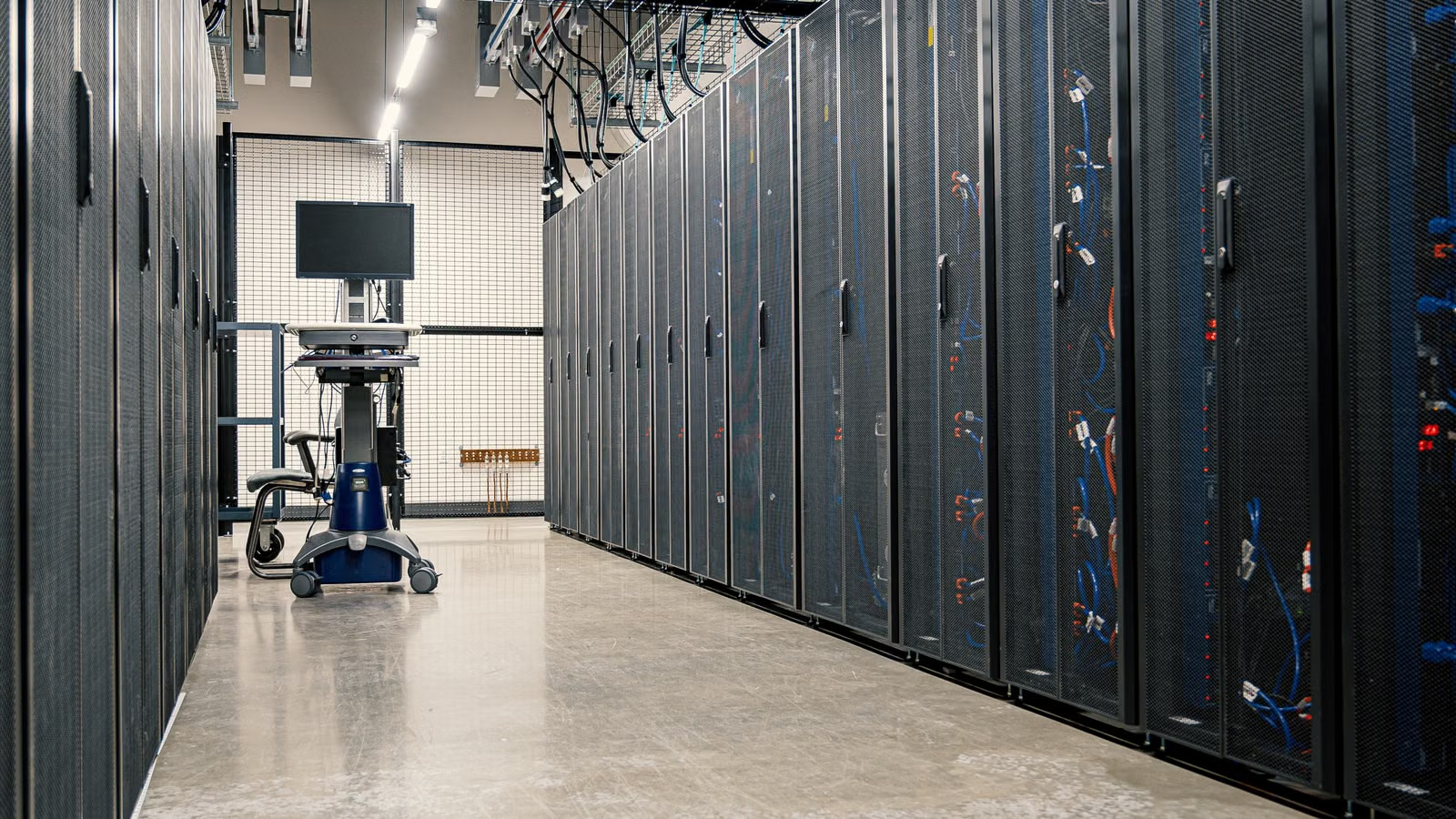
Enterprise AI budgets are moving first toward hardware because compute, storage, memory, networking, and power have become prerequisites for deploying generative AI. Without enough data-center capacity, companies cannot reliably train models, run inference, or support internal AI agents even if they buy application software. Therefore, when budgets are tight or supply is constrained, enterprises often secure hardware and infrastructure first, then gradually increase spending on application-layer, data-layer, and security software.
AI investment does not start with software, nor does it stop at software. A more common path is to first build data-center and power capacity, then purchase GPUs, ASICs, CPUs, HBM, high-speed networking, and enterprise storage, before connecting cloud platforms, model frameworks, databases, security tools, observability systems, and business applications. This sequence explains why hardware companies can see orders earlier in the AI cycle, while enterprise software companies often need to wait until customers finish infrastructure deployment before proving that AI features improve productivity, reduce costs, or generate new revenue.
The key clue in IBM’s warning was that customers shifted capital spending toward servers, storage, and memory at the end of the quarter. Capital expenditure is different from software subscriptions. Servers, chips, and data-center equipment are usually long-term assets, and procurement decisions often involve securing capacity, locking in supply, and deploying ahead of demand. Software subscriptions and consulting projects depend more on operating budgets, seat utilization, renewal rates, and project returns. If management teams believe hardware supply will tighten further, or that memory and storage prices may rise, hardware purchases can temporarily take priority over some software contracts.
| AI Investment Layer | Typical Spending Item | Budget Type | Impact on Stocks |
|---|---|---|---|
| Data center | Land, power, cooling, facilities | Long-term capital expenditure | Supports power equipment and engineering chains |
| Compute chips | GPUs, ASICs, CPUs | High-intensity capital expenditure | Supports chip and server companies |
| Storage and memory | HBM, DRAM, SSDs | Supply-sensitive spending | Supports storage and memory cycles |
| Networking equipment | Switches, optical modules, interconnects | Cluster expansion spending | Supports network infrastructure |
| Software applications | Data, security, automation, agents | Operating expense or subscription | Depends on renewal and ROI proof |
Hardware-first spending does not mean software has lost value. On the contrary, once AI infrastructure is built, enterprises still need databases, data governance, cybersecurity, identity management, model monitoring, workflow automation, and industry applications. The issue is that the market is no longer willing to pay merely for “AI feature launches.” It now expects software companies to disclose clearer AI revenue, customer retention, contract expansion, and productivity gains. In other words, software is moving from “narrative premium” into “execution review.”
You also need to distinguish the speed of order transmission across the value chain. Infrastructure spending usually creates more direct order transmission. When hyperscalers raise capital expenditure, the first beneficiaries are often server, GPU, memory, networking, and equipment suppliers. Software companies tend to benefit later, after customers complete deployment, employees form usage habits, and business workflows are redesigned. That is why the market prefers hardware certainty in the early phase of the AI cycle, and only later re-screens the winners in the application layer.
Enterprise budget priorities can be monitored through the following indicators:
- Whether cloud providers continue raising capital expenditure;
- Whether GPUs, HBM, enterprise SSDs, and networking equipment remain in tight supply;
- Whether semiconductor equipment orders and backlogs continue growing;
- Whether data-center power and cooling projects keep expanding;
- Whether software companies’ remaining performance obligations slow;
- Whether AI applications disclose measurable revenue contribution.
Summary: Enterprise AI spending is tilting toward hardware because deployment sequence and supply constraints demand it. Compute, storage, memory, networking, and power are the foundation for scaling AI projects, so enterprises will prioritize resources that cannot be easily replaced at short notice. Software and consulting projects, by contrast, are easier to renegotiate, delay, or phase in. You should not interpret this shift as the permanent disappearance of software demand. A better interpretation is that the AI investment cycle is first filling the infrastructure layer, then screening application-layer ROI. Only if software renewals still fail to improve after hardware build-out will it suggest deeper pressure on the software sector.
Is Capital Really Rotating from Software to AI Hardware?
There are signs that the market is tilting toward AI hardware and semiconductor equipment, but IBM and ASML alone are not enough to prove a full rotation. A more accurate view is that capital is reassessing which parts of the AI value chain can monetize first. Hardware companies are receiving short-term valuation premiums because their orders, supply tightness, and capital expenditure exposure are easier to identify. Software companies, meanwhile, need to prove that AI features can become real renewals, upsells, and margin improvement.
To judge capital rotation, you cannot look at only two companies. IBM is a major enterprise technology stock, but it is not a pure software company. ASML is the leading semiconductor equipment company, but it cannot represent all hardware companies. A real rotation needs four conditions at the same time: hardware sectors continue outperforming software sectors, semiconductor and AI infrastructure ETFs see sustained inflows, hardware companies receive upward earnings estimate revisions, and software companies see downward earnings estimate or valuation multiple revisions. Only when all four appear together can you say that an asset-allocation-level trend is forming.
Short-term earnings trades can easily create illusions. IBM’s plunge may pressure software stocks because the market worries that enterprise budget cuts will spread to SaaS, IT services, and consulting. ASML’s rise may lift semiconductor equipment stocks, but if other chip, memory, networking, and data-center companies do not improve at the same time, the move may simply be company-specific earnings momentum. You need to assess whether the rally has industry breadth, not just whether one or two news events look powerful.
| Evidence Layer | Indicator to Watch | What It Means |
|---|---|---|
| Stock performance | Semiconductor indices keep outperforming software indices | Tests whether relative strength continues |
| Fund flows | AI hardware and semiconductor ETFs see sustained net inflows | Tests whether institutional allocation is changing |
| Earnings estimates | EPS estimates for chip, equipment, and storage companies are revised higher | Tests whether fundamentals support price action |
| Enterprise budgets | Cloud and enterprise capital expenditure continues rising | Tests whether hardware demand is sustainable |
| Software quality | Software renewal rates, RPO, and AI revenue disclosures | Tests whether software is only under short-term pressure |
From a broader capital-allocation perspective, AI capital expenditure is indeed changing how the market values technology stocks. Reuters analysis noted that capital expenditure expectations for hyperscalers including Microsoft, Alphabet, Amazon, Meta, and Oracle have risen sharply. That means companies once viewed as asset-light platforms increasingly resemble a hybrid model of “software revenue plus heavy infrastructure assets.” This change will reshape valuation allocation: the companies that control bottleneck resources are more likely to receive short-term market preference.
However, software itself will also diverge internally. Security, databases, cloud management, data governance, and workflow automation may still benefit from AI deployment. Software companies with weak differentiation, difficult seat expansion, or little pricing power for AI features are more vulnerable to budget cuts. In other words, capital is not simply moving from “software” to “hardware”; it is moving away from uncertain AI narratives and toward segments that can turn demand into orders, cash flow, and supply-demand tension faster.
You can use the following checklist to judge whether the rotation is real:
- Are semiconductor equipment companies broadly raising orders or guidance?
- Are storage, memory, and networking companies seeing demand and pricing improvement?
- Are cloud providers raising capital expenditure for at least two consecutive quarters?
- Are software companies broadly lowering revenue or RPO expectations?
- Are sector ETFs seeing sustained inflows or outflows?
- Are analysts raising hardware earnings estimates and cutting software estimates?
Summary: The current market looks more like a repricing within the AI value chain than a complete abandonment of software. IBM’s plunge and ASML’s rise provide powerful observation points: enterprise budgets are indeed prioritizing compute, memory, storage, and data centers, but a real rotation requires confirmation from industry breadth, fund flows, earnings estimates, and corporate capital expenditure. You should avoid misreading a short-term earnings shock as a long-term trend, while also not ignoring the real valuation support created by AI infrastructure orders. A more balanced conclusion is that hardware has stronger short-term visibility, while software has entered a stricter execution-filtering phase.
What Do IBM and ASML’s Valuation Differences Reveal About Market Expectations?
The valuation gap between IBM and ASML reflects how the market prices revenue certainty and technological scarcity. ASML sits in a critical equipment layer for advanced-process capacity expansion, so AI chip demand can translate more directly into orders. IBM has hybrid cloud, Red Hat, and enterprise AI software exposure, but its business mix is more complex, while consulting and mainframe-related revenue are more sensitive to customer budget timing. Therefore, the two companies should not be compared only by price-to-earnings ratios. They should be evaluated through orders, cash flow, gross margin, and customer bargaining power.
ASML’s scarcity comes from lithography equipment, especially EUV. In its product materials, ASML describes EUV lithography systems as enabling the highest-resolution patterning in high-volume manufacturing, helping chipmakers place more transistors on a single chip. For AI chips, the more important advanced processes become, the more strategic lithography equipment becomes within the supply chain. High equipment prices, long delivery cycles, and complex supply chains also give ASML’s orders and capacity stronger scarcity value.
ASML also said in Q2 that customers were accelerating capacity expansion, and that the company plans to increase low-NA EUV capacity in 2027 by 30% from the 2026 level of about 65 systems, while studying another 30% increase in 2028. The market reads this kind of capacity plan as stronger long-term demand visibility. Meanwhile, Reuters Breakingviews noted that ASML’s shares rose by roughly 4% after the results, suggesting investors had gained more confidence that the AI capital-expenditure snowball could keep rolling.
IBM’s valuation logic is different. IBM is not a pure SaaS company, nor a pure consulting company. It is a mix of software, consulting, infrastructure, financing, Red Hat, mainframe ecosystems, and emerging AI projects. That structure provides stable cash flow, but also creates valuation discounts. The market has difficulty applying a single high-growth software multiple to the entire company. IBM disclosed continued Red Hat revenue growth, but declining infrastructure revenue, shortages in transaction-processing-related software, and delayed large transactions still made investors question the quality of growth.
| Valuation Item | IBM Focus | ASML Focus |
|---|---|---|
| Revenue quality | Recurring software revenue, consulting signings, Red Hat growth | System sales, service revenue, order backlog |
| Growth driver | Hybrid cloud, automation, AI software, large enterprise contracts | EUV, DUV, memory and advanced logic expansion |
| Cash flow | Free cash flow, acquisition integration, margins | Gross margin, prepayments, capacity utilization |
| Moat | Customer relationships, enterprise software ecosystem, mainframe installed base | Lithography technology, supply chain, customer qualification cycles |
| Main risk | Budget delays, deal deferrals, slower-than-expected transformation | Equipment cycle, export restrictions, valuation already priced for growth |
This also explains why the market reacted more directly to ASML’s positive news. The link between ASML’s order improvement and AI chip expansion is relatively short. IBM’s AI software story has to pass through sales, deployment, customer usage, renewal, and profit realization. That chain is longer and more exposed to budget approvals. In an uncertain environment, investors prefer companies with “orders already in hand” rather than companies whose “software value may materialize later.”
However, ASML’s valuation premium is not risk-free. The semiconductor equipment industry is cyclical. Foundry customers may place orders early, but they may also delay delivery if inventory, end demand, or policy conditions change. ASML’s risk disclosures mention that order volatility, export controls, supply-chain capacity, and the pace of customer capacity expansion can all affect actual performance. That means hardware leaders may be scarce, but they are not low-risk assets.
Summary: The valuation gap between IBM and ASML is not a simple victory of traditional software over AI hardware, or vice versa. It reflects different market pricing of visible revenue, technological barriers, and order certainty. ASML is closer to the bottleneck layer of AI chip expansion, so its orders and capacity plans are easier for the market to capitalize. IBM needs to prove that software, consulting, mainframes, and AI can combine into a stable growth engine. When comparing the two types of companies, you should not rely only on price-to-earnings ratios. Order visibility, free cash flow, customer budget cycles, gross margin, and policy risk all need to be evaluated within the same framework.
How Can Investors Judge How Long the AI Hardware Rotation May Last?
Whether the AI hardware rotation can continue depends on three factors: whether cloud providers keep raising capital expenditure, whether hardware orders turn into revenue and profit, and whether the software layer starts showing clear returns on AI investment. If capital expenditure keeps expanding, equipment orders remain strong, and storage and networking demand improve together, hardware may continue to outperform. If hardware valuations already price in years of growth, or cloud providers begin cutting budgets, capital may rotate back toward software and platform companies with stable cash flow.
To judge the hardware trade, you should not look only at price strength. You need to see whether profit estimates are keeping up. The most dangerous phase for hardware stocks is often not when orders are still growing, but when stock prices already reflect years of expansion while customers begin slowing incremental capital spending. Semiconductor equipment, memory, storage, and servers are all cyclical. Supply tightness amplifies the upside, while inventory buildup and order delays can also amplify the downside.
Signals supporting continued AI hardware outperformance include:
- Cloud providers continue increasing data-center capital expenditure;
- Equipment companies such as ASML, Applied Materials, and Lam Research maintain strong orders;
- Earnings estimates rise for compute-chip companies such as Nvidia, AMD, and Broadcom;
- HBM, DRAM, enterprise SSDs, and high-speed networking equipment demand improves together;
- Power, cooling, and data-center engineering companies continue reporting order growth;
- AI model training and inference demand keeps raising hardware utilization.
Signals that could send capital back toward software are also clear. First, compute supply improves, hardware delivery cycles shorten, and customers no longer need to rush purchases of servers, memory, and storage. Second, enterprises shift from “building infrastructure” to “using AI to redesign workflows,” which supports renewed contract growth in data governance, security, automation, and industry software. Third, software companies begin reporting clear AI revenue contribution rather than merely announcing new features. Fourth, software valuations fall to levels that attract long-term capital.
You also need to include trading costs in your analysis. Popular AI hardware stocks, semiconductor ADRs, technology ETFs, and enterprise software stocks can be volatile, and bid-ask spreads, platform fees, external agency fees, exchange rates, and order types can all affect actual returns. If you use Biya to monitor US and Hong Kong stock opportunities, you can use US stock search to compare IBM, ASML ADRs, chip, storage, and software company information. Biya charges $0 commission for US stock trading, while platform fees, external agency fees, and other charges are subject to the US stock trading fees and the order display. Before trading, you should still confirm service availability based on your location, identity verification result, platform rules, and applicable laws and regulations.
| Tracking Dimension | Signal That Hardware May Keep Outperforming | Signal That the Rotation Is Cooling |
|---|---|---|
| Cloud capital expenditure | Data-center budgets continue rising | Guidance stabilizes or declines |
| Equipment orders | Net orders and backlogs increase | Orders are delayed or canceled |
| Storage and memory | Prices rise and deliveries stay tight | Inventories rise and prices loosen |
| Software demand | AI software revenue has not yet been released | Software renewals and upsells recover |
| Valuation | Earnings estimates catch up with stock prices | Multiples expand faster than earnings |
| Risk appetite | Market is willing to buy high growth | Capital shifts toward stable cash-flow assets |
From an investment-decision perspective, the AI hardware rotation does not become safer simply because prices keep rising. Hardware upside comes from order certainty, supply tightness, and expanding capital expenditure, but downside can come from the same chain: if customers pause expansion, inventories build, or policy restrictions intensify, valuations can contract quickly. Software companies may be under pressure in the short term, but if enterprises begin buying data, security, automation, and agent tools at scale after infrastructure is built, software could regain investor attention.
Summary: Whether the AI hardware rotation can continue depends not on one-day price action, but on whether capital expenditure, orders, earnings estimates, and valuation remain aligned. As long as cloud providers continue expanding data centers, semiconductor equipment, chips, storage, networking, and power infrastructure may retain strong revenue visibility. But when valuations price in too much growth, customers slow expansion, or orders begin to slip, hardware-stock volatility can rise sharply. A better approach is to track quarterly data instead of making conclusions from IBM’s plunge or ASML’s rise alone.
How Should You Build a Framework for Watching Software and AI Hardware?
You should place IBM and ASML within the same AI budget chain rather than treating them as isolated stocks. Upstream are data centers, power, chips, lithography equipment, storage, and networking. In the middle are cloud platforms, models, databases, and security. Downstream are enterprise applications, AI agents, and consulting services. Capital’s short-term preference for hardware does not mean software is structurally impaired. It means AI investment is moving from proof-of-concept narratives into infrastructure construction.
A practical framework is to look first at budgets, then orders, and finally returns. Budgets show whether enterprises and cloud providers are willing to keep spending. Orders show whether hardware companies can convert demand into revenue. Returns show whether software and applications can regain valuation support. IBM’s risk is that software and consulting projects depend more on customer ROI assessment. ASML’s opportunity is that customer capacity expansion plans are more directly reflected in equipment demand.
You can build your watchlist in the following order:
- Start with cloud-provider capital expenditure: are Microsoft, Alphabet, Amazon, Meta, and Oracle still increasing data-center budgets?
- Then track semiconductor equipment orders: are ASML, Applied Materials, Lam Research, and KLA raising orders or backlog?
- Then track storage and networking: are Micron, SK Hynix, Arista, and Broadcom seeing both pricing and demand improvement?
- Then track software monetization: are Microsoft, Oracle, ServiceNow, Salesforce, and Adobe disclosing clear AI revenue or renewal improvement?
- Finally, track valuation risk: are hardware earnings estimates catching up with valuation, and is software free cash flow enough to support buybacks and dividends?
| Observation Target | Representative Question | Why It Matters |
|---|---|---|
| IBM | Is software and consulting demand being delayed? | Helps assess enterprise IT budget pressure |
| ASML | Are equipment orders and capacity still expanding? | Helps assess AI chip capacity expansion intensity |
| Cloud providers | Is capital expenditure growing faster than cash flow? | Helps assess AI infrastructure spending pressure |
| Storage and memory | Are HBM, DRAM, and SSDs still tight? | Helps assess the hardware supply-demand cycle |
| Software companies | Are AI features generating paid usage and renewals? | Helps assess whether the application layer is recovering |
| Portfolio | Are sector concentration and valuation too high? | Helps assess whether risk exposure is controlled |
For ordinary investors, it is also important not to confuse “the industry trend is right” with “any purchase is reasonable.” The AI hardware chain is long, and different links have very different cycles and profit distribution. Semiconductor equipment depends on foundry expansion. GPUs depend on model training and inference demand. Storage depends on price cycles. Power equipment depends on data-center construction timelines. Software depends on customer renewals and implementation speed. Even if the broad direction is the same, stock performance can diverge significantly.
If you are tracking rotation among IBM, ASML ADRs, semiconductor equipment, AI chips, storage, networking, and enterprise software, you can use Biya to view market information across different asset classes, while confirming fees, order types, liquidity, and risk tolerance before trading. For cross-market assets, you should also consider trading hours, quote currency, ADR structure, exchange rates, and local regulatory requirements. Sector rotation can be an observation signal, but it should not replace fundamental analysis and risk control.
Summary: To build a framework for watching software and AI hardware, the key is to place capital flows back into the enterprise budget chain: first cloud-provider capital expenditure, then equipment and hardware orders, then software revenue monetization. IBM’s plunge shows that enterprise IT budgets can be reordered in the short term. ASML’s rise shows that bottleneck equipment can receive a more direct order premium. But long-term value will not be determined by the labels “software” or “hardware.” It will depend on whether a company can turn AI spending into revenue, profit, cash flow, and sustainable competitive advantage.
If you want to turn this type of market action into an actionable watchlist, you can build a two-column stock pool: on the left, track hardware and data-center names such as ASML, Nvidia, AMD, Broadcom, Micron, Arista, and Vertiv; on the right, track software and platform names such as IBM, Microsoft, Oracle, ServiceNow, Salesforce, and Adobe. After you register an account, you can compare trading costs alongside market information, fee structures, and order displays. Biya is a global multi-asset trading wallet that supports US stocks, Hong Kong stocks, and cryptocurrency trading. Service availability depends on your location, identity verification result, platform rules, and applicable laws and regulations. Public market information and fee structures can improve decision quality, but they do not constitute investment advice.
FAQ
Does IBM’s Plunge Mean Enterprise Software Stocks Are Broadly Weakening?
Not necessarily. IBM includes software, consulting, mainframe, and infrastructure businesses, so its plunge reflects not only enterprise budget shifts toward AI hardware, but also company-specific execution and delayed large transactions. To judge whether software stocks are broadly weakening, you still need to monitor renewal rates, RPO, AI revenue, and earnings estimate revisions across SaaS, database, security, and cloud-platform companies.
Does ASML’s Rise Mean All AI Hardware Stocks Are Worth Buying?
No. ASML’s rise is supported by advanced lithography scarcity, raised guidance, and customer capacity expansion plans, but other AI hardware companies still need to be evaluated separately based on valuation, orders, gross margin, inventory, customer concentration, and policy risk. AI hardware may benefit from capital expenditure growth, but risk-return profiles differ significantly across individual stocks.
Will Enterprise AI Capital Expenditure Keep Squeezing Software Budgets?
Not necessarily. In the early build-out phase, AI capital expenditure tends to prioritize servers, chips, storage, networking, and data centers. But once infrastructure is in place, enterprises still need data, security, automation, and industry software. The key question is whether software companies can turn AI features into renewals, upsells, and measurable returns on investment.
What Is the Difference Between ASML ADRs and ASML Shares in Europe?
ASML ADRs and European ASML shares mainly differ in trading market, trading hours, quote currency, liquidity, ADR structure, and exchange-rate exposure. Before investing, you should review your broker’s specific rules, fees, tax treatment, and local regulatory requirements. You should not assume trading costs and risks are identical simply because the underlying company is the same.
Which Indicators Should Beginners Track for the AI Hardware Rotation?
Beginners can start with cloud-provider capital expenditure, semiconductor equipment orders, GPU and HBM supply-demand conditions, storage pricing, data-center construction progress, and earnings estimate revisions for both hardware and software companies. Do not rely only on stock-price moves. Sector rotation needs confirmation from fund flows, orders, and earnings expectations.
What Costs Should Investors Watch Before Trading IBM, ASML, and Other US Stocks?
Investors should watch commissions, platform fees, external agency fees, transaction activity fees, exchange rates, bid-ask spreads, and order types. Fee structures differ by platform, and the final cost should be based on platform rules, account statements, and order displays. Popular technology stocks can be volatile, so fees are only one part of the decision; valuation, liquidity, and risk tolerance also matter.
*本文仅供参考,不构成 BiyaPay 或其子公司及其关联公司的法律,税务或其他专业建议,也不能替代财务顾问或任何其他专业人士的建议。
我们不以任何明示或暗示的形式陈述,保证或担保该出版物中内容的准确性,完整性或时效性。
其他BiyaPay博客内容

Are SMH, SOXX, and Hardware Leaders Absorbing Outflows from Software Stocks?


What Is Kevin Warsh’s Policy Framework? How It Affects the U.S. Dollar, Treasuries, and Tech Stocks


How Much Is Venmo Worth in the PayPal Acquisition Case? User Scale, Revenue, and Strategic Value


Understanding Net Interest Margin and Provision Changes Through JPM, BAC, and Citi

选择国家或地区,阅读当地博客
 澳大利亚
澳大利亚 奥地利
奥地利 比利时
比利时 加拿大
加拿大 塞浦路斯
塞浦路斯 捷克
捷克 丹麦
丹麦 爱沙尼亚
爱沙尼亚 芬兰
芬兰 法国
法国 德国
德国 希腊
希腊 香港
香港 印度
印度 印度尼西亚
印度尼西亚 爱尔兰
爱尔兰 意大利
意大利 日本
日本 拉脱维亚
拉脱维亚 立陶宛
立陶宛 卢森堡
卢森堡 马来西亚
马来西亚 马耳他
马耳他 摩洛哥
摩洛哥 尼泊尔
尼泊尔 荷兰
荷兰 新西兰
新西兰 挪威
挪威 巴基斯坦
巴基斯坦 菲律宾
菲律宾 波兰
波兰 葡萄牙
葡萄牙 罗马尼亚
罗马尼亚 新加坡
新加坡 斯洛伐克
斯洛伐克 斯洛文尼亚
斯洛文尼亚 南非
南非 韩国
韩国 西班牙
西班牙 瑞典
瑞典 泰国
泰国 美国
美国 土耳其
土耳其 阿联酋
阿联酋 英国
英国 越南
越南
联系我们



