Offshore RMB (CNH) vs Onshore RMB (CNY): Which Exchange Rate Is More Favorable for You



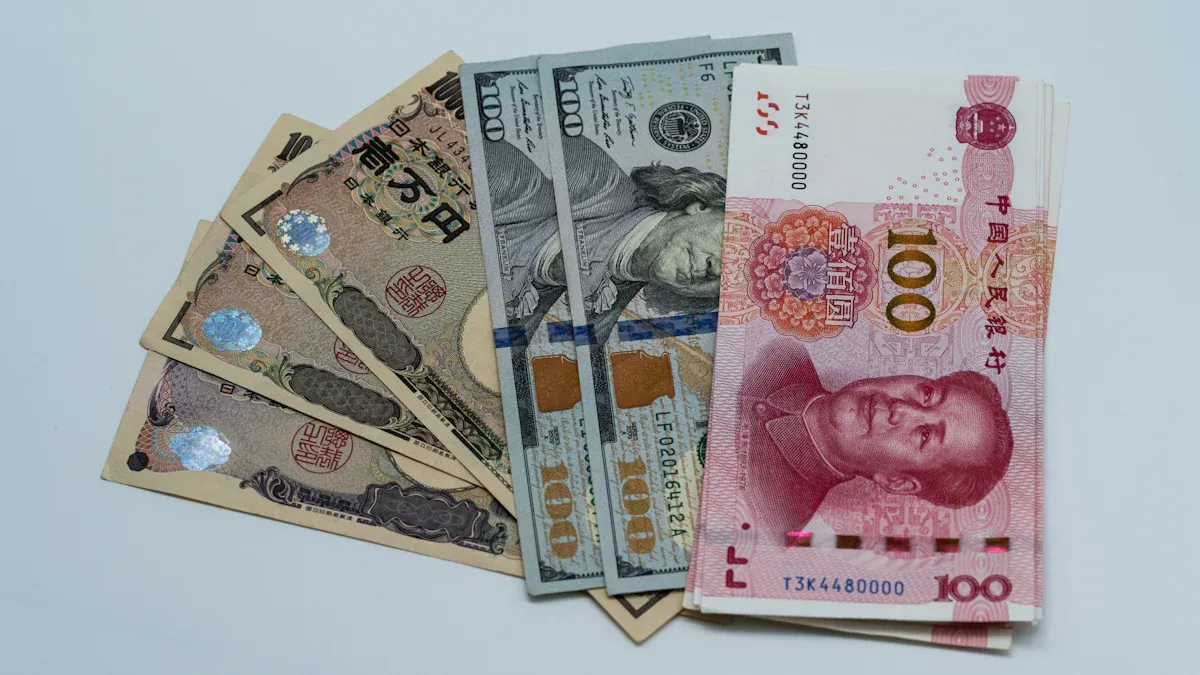
Image Source: pexels
For most individuals and businesses outside mainland China, the freely tradable currency is usually offshore RMB (CNH). Although the RMB currently accounts for about 2% of global cross-border transactions, its importance is growing. Which exchange rate is more favorable depends on the transaction direction and market spread.
Buying currency is like shopping — look for the rate that gets you the most RMB with the least foreign currency. Selling currency is like selling goods — aim for the rate that gets you the most foreign currency from your RMB.
Key Takeaways
- CNY and CNH are the same currency but traded in different markets.
- CNY rates are managed by the Chinese government, while CNH rates are market-determined.
- Importers should choose the higher rate number to pay with less foreign currency.
- Exporters should choose the lower rate number to convert RMB into more foreign currency.
- Individuals exchanging currency should compare total costs and choose the most cost-effective channel.
CNY vs CNH: Core Differences Explained
Image Source: unsplash
To understand which rate is more favorable for you, you must first clarify the essential differences between CNY and CNH. Simply put, they are the same currency but traded in two separate markets under different rules.
Origins and Naming of the Two Types of RMB
The official code for the Renminbi is CNY (Chinese Yuan), in circulation in mainland China since 1948. It operates under a strictly controlled capital system.
To promote RMB internationalization, facilitate trade and investment, and reduce reliance on the US dollar, China established an offshore RMB market. This process accelerated after the 2008 financial crisis and officially gave birth to offshore RMB in 2010, coded as CNH. The “H” originally pointed to Hong Kong, marking its status as the first and most important offshore center.
Regulation and Rate Determination Mechanisms
The core difference lies in how the exchange rates are formed.
CNY (Onshore RMB): Its rate is strictly managed by the People’s Bank of China (PBoC). The PBoC announces a daily “midpoint rate” against the USD and sets a narrow trading band (usually ±2%). This aims to maintain stability and reflect policy orientation.
CNH (Offshore RMB): Its rate is primarily determined by free market supply and demand, more directly reflecting international confidence and expectations for the RMB. Therefore, CNH typically has greater volatility than CNY.
This “one currency, two systems” design makes the CNH-CNY spread a barometer for market sentiment and sometimes serves as a policy “pressure release valve”.
Main Trading Markets and Users
Hong Kong is the world’s largest and most active offshore RMB trading center. Since 2010, Hong Kong’s RMB business has seen rapid development, with deposits, trade settlement, and financial products growing multiple or even dozens of times.
The main users of the CNH market are financial institutions and enterprises outside mainland China. They use CNH for cross-border trade settlement, bond issuance (known as dim sum bonds), and various financial derivatives. For international investors and multinational companies, CNH is the RMB they can freely exchange and use.
For a clearer comparison of the differences, refer to the table below:
| Feature | CNY (Onshore RMB) | CNH (Offshore RMB) |
|---|---|---|
| Trading Location | Mainland China | Outside mainland China (e.g., Hong Kong, Singapore, London) |
| Regulatory Authority | People’s Bank of China (PBoC) | Primarily local financial regulators |
| Rate Determination | Daily midpoint + strict trading band | Market supply and demand, free floating |
| Main Users | Mainland China residents and enterprises | International investors, multinational enterprises, financial institutions |
| Launch Year | 1948 | 2010 |
Different Identities: How to Choose the Favorable Rate?
Image Source: pexels
After understanding the differences between CNY and CNH, the next step is to apply this knowledge to real scenarios. Different identities and transaction purposes determine which rate is more favorable. The core principle is simple: payers seek to use the least foreign currency to obtain RMB, while receivers hope to convert RMB into the most foreign currency.
Importers: How to Pay RMB More Cost-Effectively
For importers needing to pay mainland China suppliers, the goal is to use the least USD (or other foreign currency) to pay a fixed amount of RMB. This means they should choose the higher rate number (e.g., 6.9 is better than 6.8).
Traditionally, many importers convert USD to offshore RMB (CNH) through their local bank and then remit via the Society for Worldwide Interbank Financial Telecommunication network to China. However, this process can present challenges:
- Slow processing: CNH payments rely on the Society for Worldwide Interbank Financial Telecommunication network, usually taking 2-3 business days to arrive, risking delayed payment issues.
- Higher costs: Some payment providers or banks charge extra fees for CNH transactions, and rates may include wider spreads. For example, banks may charge up to 2% spread on mainland China transactions.
- Rate volatility risk: CNH rates are freely market-determined with higher volatility, potentially negatively impacting business profits.
In contrast, if conditions allow, directly using onshore RMB (CNY) for payment is usually more cost-effective. By using China’s local banking clearing system, you can “cut out the middleman,” shortening wait times and reducing costs. CNY rates are strictly managed with lower volatility, making it easier for importers to estimate final costs and profits.
Decision Key: When paying, importers should compare the current USD/CNH and USD/CNY rates. Choosing the higher number means each USD gets more RMB, reducing procurement costs. Also factor in transaction speed and fees.
Exporters: How to Receive RMB More Profitably
For exporters selling to China and receiving RMB, the goal is the opposite of importers. They hope to convert received RMB payments into the maximum USD (or home currency). This means they prefer the lower rate number (e.g., 6.8 is better than 6.9).
As of the first quarter this year, RMB-settled trade accounted for about 23% of China’s total goods trade. Although not at historical highs, it shows more international trade adopting RMB settlement. This gives exporters opportunities to leverage rate differences.
When CNH is stronger than CNY (i.e., USD/CNH lower than USD/CNY), exporters benefit more by receiving offshore RMB (CNH). For example, receiving 1 million CNH and converting in the offshore market yields more USD than converting onshore with CNY.
Investors: How to Profit from Offshore RMB Spreads
For international investors, the spread between CNH and CNY itself is a trading opportunity. They can profit in various ways, mainly direct investment and speculation.
1. Investing in CNH-Denominated Financial Products International investors can buy CNH-denominated products issued in offshore markets. These allow holding RMB assets without directly entering the mainland China market. Common products include:
- Dim Sum Bonds: RMB bonds issued in offshore markets like Hong Kong.
- FX-Linked Products: Structured products linked to USD/CNH performance.
- Offshore RMB Funds and ETFs: Funds tracking offshore RMB asset performance.
2. Spread Speculation and Arbitrage More professional investors use financial derivatives to speculate on CNH-CNY spreads.
- Options Strategies: For example, building “USD/CNH put spreads” betting on CNH appreciation.
- Non-Deliverable Forwards (NDF): Though commonly for non-convertible currencies, also used to hedge or speculate CNY-related risks.
- Cross-Border Arbitrage: In theory, when spreads are large enough, traders may use complex trade operations for arbitrage. For example, buying USD onshore at lower CNY rates, transferring via over-invoicing imports offshore, then selling USD at higher CNH rates. Such operations usually involve multiple companies and mix with real trade to evade regulation.
Individual Users: Currency Exchange and Cross-Border Remittance Strategies
For individual users, CNH vs CNY choices mainly appear in exchange and cross-border remittances.
First, understand mainland China’s individual forex regulations with strict limits.
| Item | Limit (Per Person) |
|---|---|
| Annual FX Purchase/Settlement | Equivalent to $50,000 USD |
| Overseas Cash Withdrawal | Daily equivalent to 10,000 RMB, annual 100,000 RMB |
| Carrying RMB Cash Outbound | 20,000 RMB per trip |
| Carrying Foreign Cash Outbound | Equivalent to $5,000 USD (excess requires declaration or approval) |
These limits mean onshore CNY exchange mainly serves regulated personal needs like study abroad or travel.
For individuals overseas needing to remit to mainland China or holding RMB assets overseas, offshore RMB (CNH) offers greater flexibility. Many international banks (e.g., East West Bank) and fintech companies provide CNH receipt and payment services.
Personal Strategy Tip: When remitting or exchanging, compare not just CNH and CNY rates but total costs. Some providers offer seemingly favorable rates but add high fees. Others claim zero FX fees but hide costs in spreads. The wise approach is to calculate the “final amount received” and choose the most cost-effective channel.
Practical Operations: Querying Spreads and Real Applications
Theoretical knowledge creates value through practice. Mastering how to query real-time spreads and choose suitable channels is key to turning rate differences into actual benefits.
Real-Time Rate Spread Query Tools
To seize favorable exchange opportunities, reliable tools for monitoring real-time rates are essential. Professional financial data platforms are best for businesses and individuals.
- TradingView: Provides detailed USD/offshore RMB (USD/CNH) charts and market data. Users can use technical analysis tools, news, and economic calendars to judge rate trends.
- IG: Also offers real-time USD/CNH charts and trading signals, emphasizing fast and reliable data updates with analysis tools and educational resources.
Pro Tip: Many trading platforms and bank apps (e.g., online banking or FX apps) offer clients “price alerts”. Set a target rate or spread level, and the system notifies you automatically when reached, ensuring no missed opportunities.
How to Open a CNH-Tradable Account
To trade offshore RMB, you need an account handling CNH receipts and payments. Mainly two options:
- Traditional International Banks: For large multinationals, many Hong Kong-licensed or international banks (e.g., Bank of China, Standard Chartered) offer comprehensive cross-border RMB services including clearing, trade finance, global markets trading, and risk management — suitable for complex financial needs.
- Fintech Platforms: For SMEs and individuals, fintech platforms offer more flexible and lower-cost options. Platforms like Biyapay focus on simplifying cross-border payments with advantages:
- Lower costs: Usually more competitive rates and fees than traditional banks.
- Higher efficiency: Fast processing, some transactions complete in hours.
- User-friendly: Intuitive interfaces make managing multiple transactions simple.
Cost-Saving Exchange Case Study
Let’s look at a specific case to see the cost difference from choosing different rates.
Assume a US importer needs to pay a mainland China supplier 1,000,000 RMB. Current market rates:
| Rate Type | Rate (USD/RMB) |
|---|---|
| Onshore Rate (USD/CNY) | 7.25 |
| Offshore Rate (USD/CNH) | 7.30 |
The importer’s goal is to pay with the least USD.
- Option A: Traditional channel with CNY payment
- Required USD cost: 1,000,000 / 7.25 = $137,931.03 USD
- Option B: Platform supporting CNH payment
- Required USD cost: 1,000,000 / 7.30 = $136,986.30 USD
In this case, choosing the offshore market CNH rate saves the importer $944.73 USD. Through platforms like Biyapay, businesses can easily capture more favorable offshore rates, directly reducing costs and turning rate advantages into real profits.
There is no absolute better or worse between CNH and CNY — the key is suitability for specific transaction needs. Users should choose the most favorable rate based on transaction direction.
Decision Mnemonic:
- Payers seek rates using the least foreign currency for RMB.
- Receivers seek rates converting RMB to the most foreign currency.
Developing the habit of monitoring the two rate spreads can turn it into a practical wealth management tool, flexibly applied to create business value.
FAQ
Where does the CNH vs CNY spread come from?
The spread mainly arises from different regulatory mechanisms. CNY rates are strictly managed by the PBoC with limited volatility. CNH rates are freely determined by offshore market supply and demand, better reflecting international sentiment, thus creating spreads with CNY.
Can individuals hold both CNY and CNH accounts?
It depends on location.
- Mainland China residents: Mainly use CNY accounts, subject to FX limits.
- Overseas residents: Can easily open CNH accounts at international banks or fintech platforms for free trading and remittances.
CNH has higher volatility — how do businesses manage risk?
Businesses can use financial tools to manage CNH rate risk.
Common strategies include forward FX contracts or currency options. These tools help lock in future exchange costs, avoiding losses from unfavorable rate moves.
Why is CNH sometimes “more expensive” than CNY and sometimes “cheaper”?
This reflects international expectations for the RMB.
When international investors are bullish on China’s economy, CNH demand rises, potentially making it stronger than CNY (lower rate number). Conversely, during risk aversion, CNH may weaken, becoming “cheaper” than CNY (higher rate number).
*This article is provided for general information purposes and does not constitute legal, tax or other professional advice from BiyaPay or its subsidiaries and its affiliates, and it is not intended as a substitute for obtaining advice from a financial advisor or any other professional.
We make no representations, warranties or warranties, express or implied, as to the accuracy, completeness or timeliness of the contents of this publication.
Related Blogs of

Beginner's Guide to US Individual Income Tax Rates: Understanding Minimum Filing Income Requirements

Exclusive for Chinese Users: Longbridge Securities Account Opening Process and Permanent Commission-Free Strategy


It's Finally Here: Mainland China Users Can Now Register Wise with ID Card Only


2025 U.S. Job Search Websites Comparison: In-Depth Analysis of 20 Platforms' Pros and Cons
Choose Country or Region to Read Local Blog
 Australia
 Austria
 Belgium
 Canada
 Cyprus
 Czech Republic
 Denmark
 Estonia
 Finland
 France
 Germany
 Greece
 Hong Kong
 India
India Indonesia
 Ireland
 Italy
Italy Japan
Japan Latvia
 Lithuania
 Luxembourg
 Malaysia
 Malta
Malta Morocco
 Nepal
Nepal Netherlands
 New Zealand
 Norway
 Pakistan
 Philippines
 Poland
 Portugal
 Romania
 Singapore
 Slovakia
 Slovenia
 South Africa
 South Korea
 Spain
Spain Sweden
 Thailand
 The United States
 Turkey
 United Arab Emirates
 United Kingdom
 Vietnam
Contact Us




BIYA GLOBAL LLC is a licensed entity registered with the U.S. Securities and Exchange Commission (SEC No.: 802-127417); a certified member of the Financial Industry Regulatory Authority (FINRA) (Central Registration Depository CRD No.: 325027); regulated by the Financial Industry Regulatory Authority (FINRA) and the U.S. Securities and Exchange Commission (SEC).
BIYA GLOBAL LLC is registered with the Financial Crimes Enforcement Network (FinCEN), an agency under the U.S. Department of the Treasury, as a Money Services Business (MSB), with registration number 31000218637349, and regulated by the Financial Crimes Enforcement Network (FinCEN).
BIYA GLOBAL LIMITED is a registered Financial Service Provider (FSP) in New Zealand, with registration number FSP1007221, and is also a registered member of the Financial Services Complaints Limited (FSCL), an independent dispute resolution scheme in New Zealand.