Tesla's Do-or-Die Turnaround? The Hidden Risks in Its $30 Billion Rally



Tesla’s stock price staged an unexpected “April Fool’s Day miracle” on April 1, 2025 - a single-day surge of 3.59%, and its market value surged by $29.90 billion overnight, reaching $863.50 billion. This strong rebound seems to have given Tesla, which is deeply mired in the quagmire, a glimmer of hope. However, behind this sudden rise, Tesla still faces severe challenges such as plummeting sales, brand trust crisis, and intensified market competition. Is this a brief rebound in market sentiment or a signal of Tesla’s true bottoming out?
Tesla’s Struggles: Plummeting Sales, Halved Market Cap, and a Crisis of Trust
The past year has been tough for Tesla. Sales have collapsed in multiple global markets. In the U.S., deliveries fell 11% year-over-year, while in Germany, sales plunged 76% between February 2024 and February 2025. Meanwhile, Tesla’s market cap has shrunk by nearly 700billionfromitsDecember2024peakof700billionfromitsDecemb**er2024peakof1.54 trillion, with its stock price dropping 36% in Q1 2025 alone—almost halving in value.
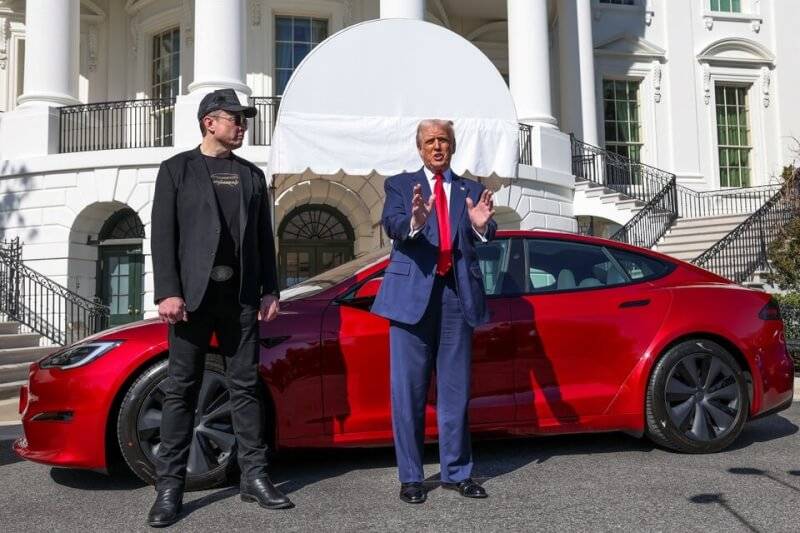
Worse still, Tesla’s brand image has suffered unprecedented damage. Vandalism targeting Tesla stores has erupted in multiple countries, and some consumers have voiced strong opposition to Elon Musk’s political stances, even calling for boycotts. Musk himself is mired in political controversy, having previously expressed a desire to step down from his role as a government special employee, while Donald Trump hinted that the “Department of Government Efficiency” (DOGE) might soon be dissolved. These factors have cast a shadow over Tesla’s long-term prospects.
Why Did Tesla’s Stock Suddenly Soar? What Is the Market Betting On?
Given such dire circumstances, why did Tesla’s stock surge on April 1? Market analysts attribute the rebound to several key factors:
Pessimistic Expectations Already Priced In
Tesla’s stock had already fallen nearly 50% over the past few months, with the market bracing for dismal Q1 delivery numbers. Analysts widely predicted deliveries of around 373,000 vehicles, down 3.6% year-over-year, possibly even as low as 340,000. Since the stock had already priced in this bad news, some investors began betting that “the worst was over.”
Positive Market Developments
Despite global sales declines, Tesla appears to have found a breakthrough in one key market. The upgraded Model Y sold over 43,000 units in March, potentially making it the best-selling EV in that region. This data gave investors hope that Tesla still has rebound potential in critical markets.
Short-Term Boost from U.S. Tariff Policies
The U.S. government is set to impose a 25% tariff on imported passenger vehicles, prompting a wave of preemptive buying. As a company with high local production, Tesla stands to benefit more than brands like BMW and Mercedes-Benz, which rely heavily on imports.
Technical Rebound and Short Squeeze
Given Tesla’s oversold position, some short sellers took profits, while technical buying further fueled the rally. However, whether this uptrend can sustain depends on whether fundamentals actually improve.
Tesla’s Future: How Can It Overcome the Crisis?
While the stock has rebounded in the short term, Tesla’s core problems remain unresolved. If it fails to reverse declining sales and eroding brand trust, this rally could be short-lived. So, how can Tesla turn things around?
Accelerate Product Updates to Stimulate Demand
Tesla’s current flagship models, the Model 3 and Model Y, are nearing the end of their lifecycle, and consumers are growing tired of the “old designs.” Tesla urgently needs more competitive offerings, such as the rumored $25,000 entry-level EV and faster Cybertruck production, to reignite market excitement.
Emphasize Safety and Tech Leadership to Rebuild Brand Trust
Tesla’s global VP, Tao Lin, has recently emphasized the company’s investments in safety technology, attempting to counter the perception that Tesla prioritizes sales over safety. Tesla must further highlight its leadership in Full Self-Driving (FSD) and battery tech to convince markets of its long-term value.
Adjust Market Strategy to Mitigate Geopolitical Risks
In Europe, Tesla faces fierce competition, while in the U.S., political factors may sway consumer choices. Tesla needs more flexible regional strategies, such as expanding in emerging markets like Southeast Asia and Mexico, to reduce reliance on any single market.
Managing Musk’s Double-Edged Influence
Musk has been Tesla’s “soul,” but his political statements and controversies have hurt the brand. Tesla may need to “de-Musk” somewhat, shifting focus to its products rather than its founder’s personal views.
How Should Investors Navigate Tesla’s Volatility?
Given Tesla’s wild price swings, investors must stay calm and analyze rationally. Tesla is at a critical inflection point—high risk but potentially high reward. Investors should tailor strategies to their risk tolerance and goals.
For those investing in U.S. stocks, choosing a reliable broker is crucial. Globally recognized platforms like Charles Schwab offer integrated banking and brokerage accounts. Investors can fund their accounts via digital assets (e.g., USDT) through multi-asset wallets like BiyaPay, convert to fiat, and trade Tesla (or other stocks) seamlessly. BiyaPay also allows direct stock searches and purchases.

Regardless of strategy, diversification is key. While Tesla has high-growth potential, its risks are substantial. Investors should avoid overconcentration and maintain balanced portfolios. Additionally, Tesla’s valuation remains high compared to traditional automakers, and geopolitical risks (e.g., Musk’s political stance, regional market performance) could further impact the stock.
Conclusion: Tesla’s “Make-or-Break” Moment Isn’t Over
Tesla’s recent rebound seems more like a brief respite from extreme pessimism than a true trend reversal. While certain markets show promise and U.S. tariffs provide a short-term boost, Tesla must address its fundamental challenges.
2025 will be Tesla’s “defining year”—it must either reignite growth through innovation and strategic adjustments or continue losing market share. For investors, Tesla presents both risk and opportunity. In these uncertain times, leveraging platforms like BiyaPay for global asset allocation and smart risk management could be crucial.
As for whether April 1’s surge was an “April Fools’ joke” or the start of a real comeback—the answer may soon be clear.
*This article is provided for general information purposes and does not constitute legal, tax or other professional advice from BiyaPay or its subsidiaries and its affiliates, and it is not intended as a substitute for obtaining advice from a financial advisor or any other professional.
We make no representations, warranties or warranties, express or implied, as to the accuracy, completeness or timeliness of the contents of this publication.
Related Blogs of

The A-Share Index Apps Professional Investors Are Using — Have You Downloaded Them?


Is NVDA Stock Worth Buying Now? A Comprehensive Analysis of Its Pros and Cons

Nasdaq 100 vs S&P 500: From Components to Future Outlook in One Article


Beginner’s Must-Read: Complete Breakdown of VOO, IVV, and SPY—the Three Major S&P 500 ETFs

Choose Country or Region to Read Local Blog
 Australia
 Austria
 Belgium
 Canada
 Cyprus
 Czech Republic
 Denmark
 Estonia
 Finland
 France
 Germany
 Greece
 Hong Kong
 India
India Indonesia
 Ireland
 Italy
Italy Japan
Japan Latvia
 Lithuania
 Luxembourg
 Malaysia
 Malta
Malta Morocco
 Nepal
Nepal Netherlands
 New Zealand
 Norway
 Pakistan
 Philippines
 Poland
 Portugal
 Romania
 Singapore
 Slovakia
 Slovenia
 South Africa
 South Korea
 Spain
Spain Sweden
 Thailand
 The United States
 Turkey
 United Arab Emirates
 United Kingdom
 Vietnam
Contact Us
Company and Team
BiyaPay Products
Customer Services




BIYA GLOBAL LLC is a licensed entity registered with the U.S. Securities and Exchange Commission (SEC No.: 802-127417); a certified member of the Financial Industry Regulatory Authority (FINRA) (Central Registration Depository CRD No.: 325027); regulated by the Financial Industry Regulatory Authority (FINRA) and the U.S. Securities and Exchange Commission (SEC).
BIYA GLOBAL LLC is registered with the Financial Crimes Enforcement Network (FinCEN), an agency under the U.S. Department of the Treasury, as a Money Services Business (MSB), with registration number 31000218637349, and regulated by the Financial Crimes Enforcement Network (FinCEN).
BIYA GLOBAL LIMITED is a registered Financial Service Provider (FSP) in New Zealand, with registration number FSP1007221, and is also a registered member of the Financial Services Complaints Limited (FSCL), an independent dispute resolution scheme in New Zealand.