
What Does Quadruple Witching Day Mean? Analyzing the Critical Moments of Market Turbulence




One-Sentence Definition
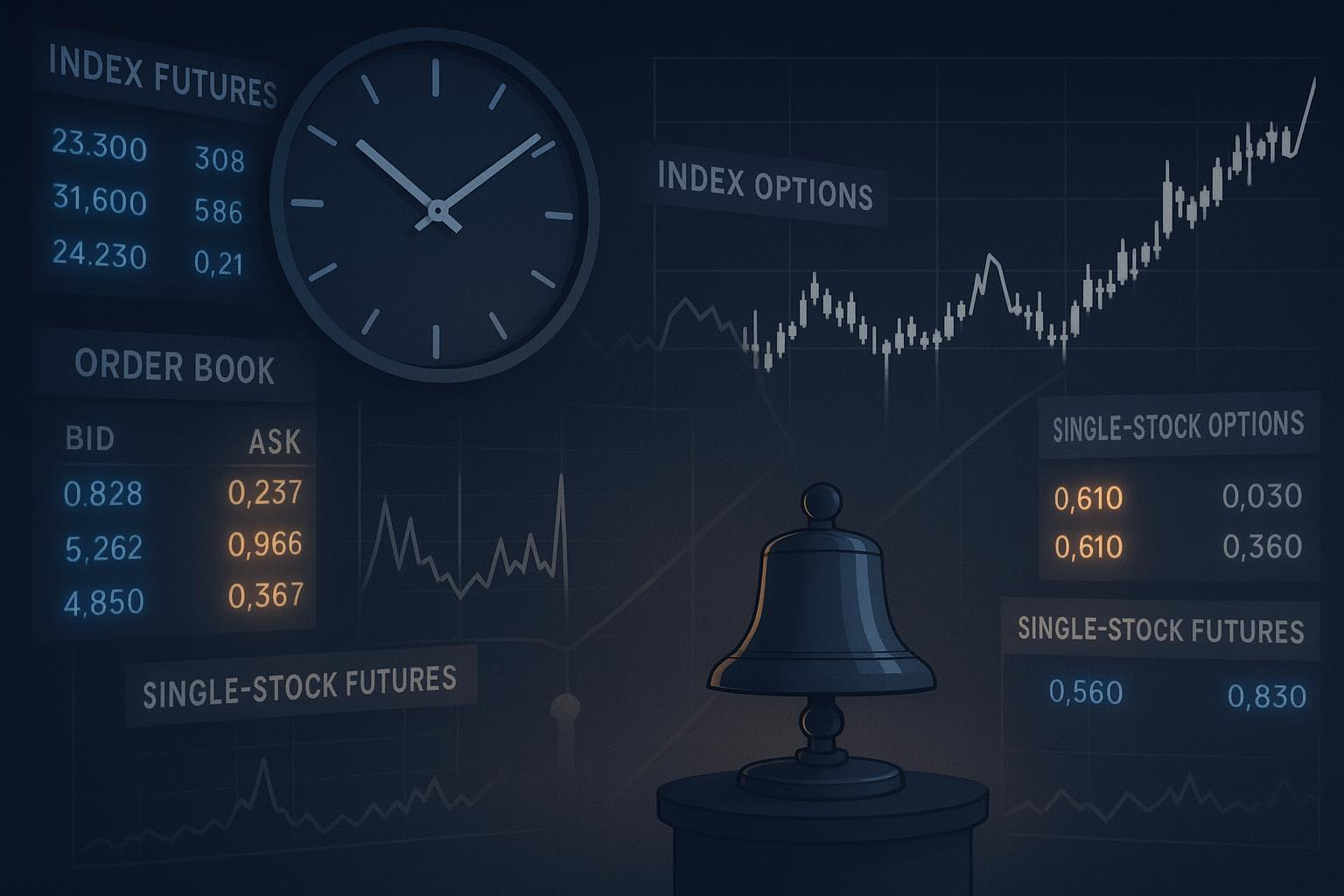
“Quadruple Witching” is a term used in the stock and derivatives markets, referring to the four times a year (the third Friday of March, June, September, and December) when multiple stock/index-related derivatives expire simultaneously. Think of it as “multiple highways merging at a toll booth,” where vehicles (trading orders) pile up, causing congestion (surging trading volume) and braking/acceleration (price volatility) to become more pronounced.
When Does It Happen? Which Contracts Are Involved?
- Fixed Timing: The third Friday of March, June, September, and December each year. For 2025, these are March 21, June 20, September 19, and December 19 (all in Eastern Time).
- Traditional “Four Types” of Contracts:
- Stock index futures;
- Stock index options;
- Individual stock options;
- Individual stock futures (historically present in the U.S. market but largely dormant since 2020).
- “Witching Hour”: The final hour of the trading day (typically the last hour before the U.S. stock market closes) is more likely to see concentrated changes in liquidity and price.
It’s worth emphasizing: “Surging volume” on these days is nearly a consensus, but the direction is not predetermined—it doesn’t necessarily mean a sharp rise or fall. This is clearly explained in Nasdaq’s educational article, which notes that “Triple/Quadruple Witching” is more notably characterized by rising trading volume and activity, not directional conclusions, see Nasdaq’s 2021 Analysis of Triple Witching Impact.
Why Does Volume Surge and Volatility Spike at the Close? Three Key Mechanisms
1) Closing Auction Pushes Liquidity to a Single Moment
The closing price of U.S. stocks is determined by the exchange’s closing auction (Closing Auction/Closing Cross). For example, at the NYSE, MOC/LOC (Market-on-Close/Limit-on-Close) orders face strict cancellation or modification restrictions after 15:50 (ET), and imbalance information is disclosed to the market, guiding counterparty orders to converge in the unified auction near 16:00. This compresses a large volume of hedging, closing, and rebalancing demands into the same time window at the close, amplifying trading volume and volatility. For the mechanism and time window, see NYSE Closing Auction Process Fact Sheet (2023).
2) Index and ETF Quarterly Rebalancing Often Coincides with Quadruple Witching
Index methodologies, such as those of S&P Dow Jones, typically adopt quarterly rebalancing, with adjustments effective after the close on the third Friday of the quarter-end. Passive index funds need to buy or sell near the closing auction to track new weights. When rebalancing coincides with Quadruple Witching, the hedging/rollover of expiring derivatives and passive index trading overlap in the same period, further amplifying closing volume and price impact. See S&P U.S. Indices Methodology (S&P DJI).
3) Concentrated Expirations Trigger Closing, Exercise, and Re-hedging
Options and futures expiring that week or month, when prices are near key strike/settlement prices, prompt hedging adjustments by market makers and institutions. Additionally, position holders decide whether to exercise or abandon options based on in-the-money/out-of-the-money status, with these trading actions converging temporally, leading to higher “stampede-like” liquidity demand, especially at the close. Nasdaq’s 2021 educational material highlights “rising trading volume” as a key feature (see link above).
Triple Witching vs. Quadruple Witching: A Historical Evolution
Historically, “Quadruple Witching” included individual stock futures. However, with the closure of the U.S. single-stock futures exchange OneChicago in 2020, the phenomenon is now closer to “Triple Witching” (stock index futures, stock index options, individual stock options). The term “Quadruple Witching” persists in markets, largely due to historical habit or as a general reference to “quarterly expiration day phenomena,” as explained in Nasdaq’s terminology discussion (2021 article, see link above).
What Does It Mean for Different Investors?
- Short-Term/Active Traders
- Pay attention to exchange closing auction rules and time windows. The NYSE imposes strict cancellation/modification limits after 15:50 (ET), and imbalances near 16:00 may lead to slippage and rapid volatility, see NYSE Closing Auction Process Fact Sheet (2023).
- Assess potential hedging demand using options open interest (OI) and expiration distribution to avoid blindly chasing orders at the close.
- Medium-to-Long-Term/ETF Holders
- Quarter-end (March, June, September, December) price and volume anomalies during Quadruple Witching, combined with index rebalancing, are often “technical” in nature, so avoid overreacting with trades. Index methodologies confirm rebalancing takes effect at this point, see S&P U.S. Indices Methodology.
- Options Holders
- Final instructions for exercising or abandoning options typically must be submitted to brokers by 17:30 (ET) on expiration day; some brokers may have earlier cutoffs. Regulatory reminders are available at FINRA 2021 Information Notice (Exercise Deadlines).
- Note the automatic exercise (Exercise by Exception, Ex-by-Ex) threshold. The Options Clearing Corporation (OCC) explains in multiple memos that in-the-money options by $0.01 trigger automatic exercise, see OCC Info Memo Example: Info Memo 55843, 2025-01-02. To abandon automatic exercise, follow your broker’s instructions promptly.
Common Misconceptions and Clarifications
- Misconception 1: “Quadruple Witching always leads to big gains or losses”
- Clarification: The consensus is “surging volume and increased activity,” but there’s no consistent directional pattern. News narratives may create “selection bias,” so don’t treat isolated cases as a rule.
- Misconception 2: “Only U.S. markets have Quadruple Witching”
- Clarification: Quadruple Witching is a U.S. market term, but the combined effect of “quarter-end multi-instrument expirations + passive rebalancing + closing auctions” may occur in other markets (e.g., some Asia-Pacific markets’ quarterly expiration or index futures settlement days), though terminology and rule details differ.
- Misconception 3: “Individual stock futures are still a standard part of Quadruple Witching”
- Clarification: U.S. single-stock futures have been dormant since 2020, making it more of a “Triple Witching” phenomenon; “Quadruple Witching” is often a retained term.
Summary
Think of “Quadruple Witching” as a “mechanistic congestion moment”: derivatives expirations, unified closing auctions, and index/ETF quarterly rebalancing converge temporally, leading to amplified trading volume and increased volatility at the close. For investors, the key is to distinguish technical from fundamental drivers and act per your strategy: short-term traders should manage slippage and position exposure, medium-to-long-term holders should avoid emotional trading, and options holders should clarify exercise and assignment rules before expiration. The above points and rules are based on publicly available information as of 2025.
Quadruple Witching is a moment of "liquidity congestion" driven by market mechanics. The concentrated surge in volume and price offers short-term opportunities for active traders to capture stocks spreads. However, this high volatility is accompanied by high slippage risk. If your trading costs (commissions, fees) are excessive, the profits you capture can be instantly eroded by friction. During critical market shakes, you need a global trading platform that ensures maximum cost efficiency.
BiyaPay provides robust support for navigating events like the Quadruple Witching. You can trade US and Hong Kong equities on one platform without a foreign account, benefiting from zero commission on contract order placement. This significantly reduces the transaction friction when capturing opportunities in highly volatile markets. Furthermore, BiyaPay offers real-time exchange rate checks and conversion services, supporting seamless exchange between 30+ fiat currencies and 200+ cryptocurrencies, with remittance fees as low as 0.5%, ensuring same-day transfer and arrival of funds. Register quickly with BiyaPay today to convert market volatility into your allocation advantage with zero-cost trading and efficient global capital management.
*이 문서는 일반 정보 제공 목적으로만 제공되며, BiyaPay 또는 그 자회사 및 계열사의 법률, 세무 또는 기타 전문적 조언을 구성하지 않으며, 재무 자문가나 기타 전문가의 조언을 받는 것을 대체할 의도도 없습니다.
당사는 본 간행물의 내용의 정확성, 완전성 또는 적시성에 관하여 명시적이든 묵시적이든 어떠한 진술이나 보증도 하지 않습니다.
의 관련 블로그

International Money Transfer Limits: Per-Transfer, Daily, and Monthly Caps Explained


Buying US Stocks from Overseas: Broker Options, Funding, and Costs





 호주
 오스트리아
 벨기에
 캐나다
 키프로스
 체코 공화국
 덴마크
 에스토니아
 핀란드
 프랑스
 독일
 그리스
 홍콩
 인도
 인도네시아
 아일랜드
 이탈리아
 일본
 라트비아
 리투아니아
 룩셈부르크
 말레이시아
 몰타
 모로코
 네팔
 네덜란드
 뉴질랜드
 노르웨이
 파키스탄
 필리핀
 폴란드
 포르투갈
 루마니아
 싱가포르
 슬로바키아
 슬로베니아
 남아프리카
 한국
 스페인
 스웨덴
 태국
 미국
 터키
 아랍에미리트
 영국
 베트남