What Are the Major US Stock Market Indexes? An Article to Understand the Three Major US Stock Indexes





Image Source: unsplash
You may often hear news saying “US stocks surge” or “plunge,” but are unclear what this specifically refers to. This usually refers to changes in the major US stock market indexes. This index is like a large scoreboard, tracking the performance of a group of representative companies’ stocks to tell us whether the overall performance of the entire stock market is good or bad.
Did you know? As of October 1, 2025, the total market capitalization of the US stock market has reached an astonishing $67.8 trillion. Such a massive market requires clear indicators to measure it.
People usually observe the market through three major “scoreboards”: the Dow Jones Industrial Average, the Standard & Poor’s 500 Index, and the Nasdaq Composite Index.
Key Takeaways
- Major US stock market indexes are tools to measure the overall performance of the stock market.
- The Dow Jones Index focuses on 30 large traditional companies.
- The S&P 500 Index represents the 500 largest US companies and is the best indicator for measuring the overall market.
- The Nasdaq Index mainly reflects the performance of tech and growth companies.
- Understanding these indexes can help us better comprehend the US stock market and economic conditions.
A common mistake when you see headlines like “US stocks surged/plunged” is to treat one index as “the whole market.” In practice, the three major indexes are like three different thermometers: the Dow often reflects sentiment around legacy blue chips, the S&P 500 is closest to broad-market “feel,” and the Nasdaq is typically more sensitive to tech/growth risk appetite. If you quickly check all three before reading news, it becomes much easier to tell what actually moved—tech, traditional sectors, or the broader market.
If you want to turn this article into a daily tracking template, here’s a simple 3-minute routine: start from a single hub like the US stock market page to see the day’s direction, then open a representative heavyweight (for example, NVDA) to confirm whether leadership is still tech-driven, and finally compare whether the Nasdaq and S&P 500 are moving in the same direction (alignment often signals a cleaner trend; divergence can hint at a more “sector-rotation” market). This helps you connect “index → sector → stock” instead of memorizing definitions.
If you later want to explore “how people invest around indexes” (without buying an index directly), it also helps to keep research and action in one place—using a platform like BiyaPay to centralize tickers and price checks can reduce context switching and make your routine more consistent.
What Are Major US Stock Market Indexes?
A major US stock market index is a statistical tool. It tracks the performance of a specific “basket” of stocks that represent particular markets or economic sectors. This tool helps investors and analysts quickly understand the overall market direction without analyzing thousands of individual companies.
Definition: Statistical Indicators Tracking Overall Market Trends
Fundamentally, an index is a number. Changes in this number reflect the rise or fall in the overall value of its component stocks. If the index rises, it means the stock values of most companies it tracks are increasing; vice versa.
According to the official Investor.gov website of the US Securities and Exchange Commission (SEC), market indexes are defined as tools tracking the performance of a specific “basket” of stocks. For example, the Dow Jones Industrial Average tracks 30 US “blue-chip” companies, while the Standard & Poor’s 500 Index covers most publicly traded US stocks.
Role: Reflecting US Stock Market and Economic Conditions
The primary role of indexes is to reflect the overall health of the US stock market and often serve as a barometer for economic activity. By observing the long-term trends of indexes, people can gain insights into market cycles, including bull markets (rising) and bear markets (falling). Historical data shows how indexes record major market corrections:
| Market Trend | Start Date | End Date | Cumulative Return |
|---|---|---|---|
| Secular Bear Market | January 11, 1973 | October 3, 1974 | -48.2% |
| Secular Bear Market | March 23, 2000 | October 9, 2002 | -49.1% |
| Secular Bear Market | October 9, 2007 | March 9, 2009 | -56.8% |
From a broader perspective, the performance of major US stock market indexes is highly correlated with overall economic growth (measured by GDP) in the long term. Although short-term decoupling may occur, such as during the 2020 pandemic, in the long run, a country’s economic strength ultimately supports its stock market performance. Famous investor Warren Buffett even proposed a theory, suggesting that long-term stock market returns approximately equal the sum of the following three items:
- 3% real GDP growth
- 2.0% inflation
- 2.0% dividend yield
This theory illustrates that the long-term growth of the stock market is rooted in the expansion of the real economy. Therefore, indexes are not only the market’s scoreboard but also an important window for observing major economic trends.
Dow Jones Index: Focusing on US Blue-Chip Stocks
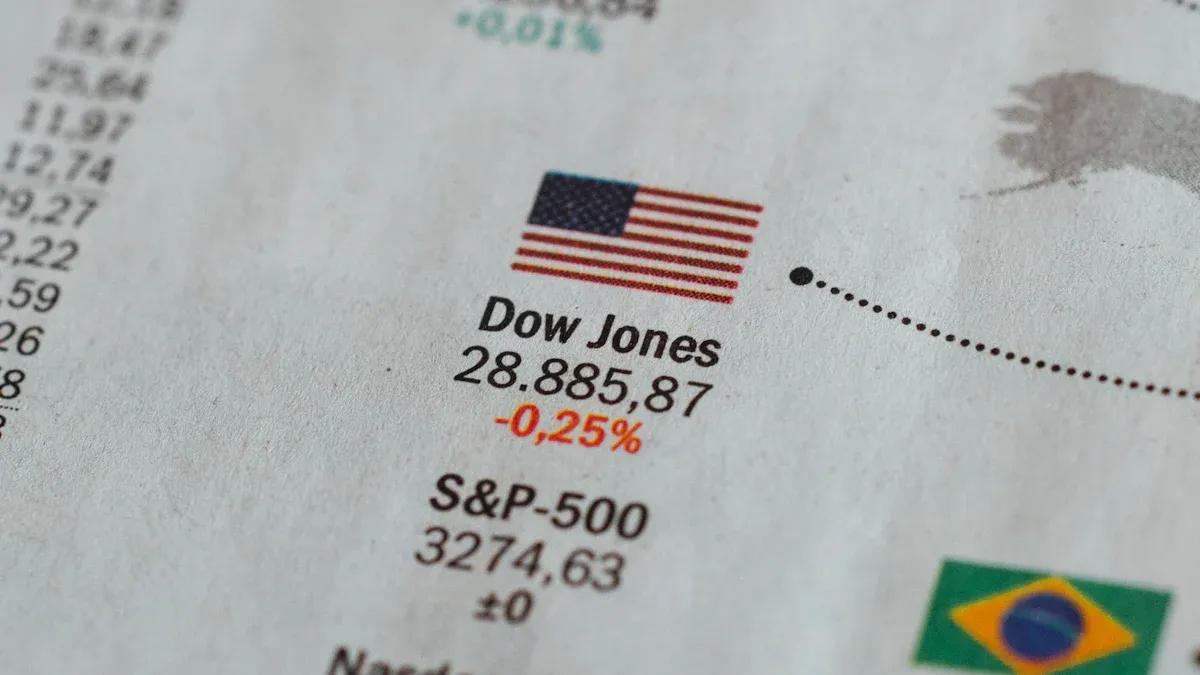
Image Source: unsplash
The Dow Jones Industrial Average (DJIA), commonly referred to as the “Dow,” is one of the oldest and most well-known stock indexes in the world. It is often seen as a symbol of the US stock market, but its composition and calculation method are unique.
Component Stocks: 30 Large Mature Companies
The Dow’s component stocks are very streamlined, including only 30 large listed companies considered pillars of the US economy. These companies are typically leaders in their industries, with stable earnings records and good reputations, known as “blue-chip stocks” (Blue-chip Stocks).
However, the list of these 30 companies is not fixed. To reflect changes in the US economy, the index’s components are periodically evaluated and adjusted. In fact, since its establishment in 1896, the Dow’s components have been replaced more than 50 times.
Historical Changes: From Industrial to Diverse
- Initial Composition (1896): The index initially consisted of 12 companies, mostly from industrial sectors such as railroads, cotton, natural gas, and tobacco.
- Current Composition: Today’s 30 companies cover multiple industries including technology, healthcare, finance, and consumer goods, better reflecting the structure of the modern US economy.
Market Representativeness: Traditional Power of Industrial Economy
Historically, the Dow is an important indicator for measuring the health of the US industrial economy. Its original purpose was to track core enterprises driving national industrialization. Although its components have become more diversified today, due to its long history and the feature of only 30 companies, many still view it as a window to observe the performance of large traditional US enterprises.
However, precisely because of its small number of components, critics argue that the Dow cannot represent the entire US stock market as comprehensively as the S&P 500 Index.
Calculation Method: Price-Weighted
The most unique feature of the Dow is its “price-weighted” calculation method. Under this approach, stocks with higher share prices have greater weight in the index, and their price fluctuations have a larger impact on the index. Simply put, a $1 price change in a stock priced at $200 has 10 times the impact on the index as a $1 change in a stock priced at $20.
To handle stock splits, company replacements, and other events, the Dow uses a special “Dow Divisor” to adjust calculations, ensuring index continuity. For example, when Apple conducted a stock split, its share price decreased, but the divisor was adjusted accordingly to ensure the index did not experience sharp fluctuations due to such technical operations. The existence of this divisor allows today’s Dow to be meaningfully compared with the past.
S&P 500 Index: The Best Measure of the US Market
If the Dow is a window to observe traditional US blue-chips, then the Standard & Poor’s 500 Index (S&P 500), abbreviated as S&P 500, is widely considered the best single indicator for measuring the US large-cap market. It provides a broader and more comprehensive market view than the Dow.
Component Stocks: 500 Top Listed Companies
The S&P 500 Index tracks 500 largest and most influential US listed companies. Unlike the Dow’s subjective selection by a committee, the S&P 500’s components have a strict set of objective standards. Companies must meet specific requirements to be included.
Inclusion Criteria A committee uses clear rules to decide which companies can join. Main criteria include:
- Market capitalization must be at least $8.2 billion.
- Stocks must have high liquidity, ensuring active trading.
- Companies must achieve sustained profitability, with positive total earnings in the most recent four quarters.
- At least 50% of shares must be available for public trading.
These strict conditions ensure that index components are financially healthy, market-recognized premium enterprises.
Market Representativeness: Comprehensive Barometer of the US Economy
The importance of the S&P 500 lies in its broad coverage. These 500 companies together cover about 80% of the total US stock market capitalization. Therefore, its rises and falls can very accurately reflect the overall condition of the entire US stock market, making it a true comprehensive economic barometer. Observing the highest-weighted companies in the S&P 500 can reveal current market dominant forces.
Current top-weighted companies are mainly concentrated in technology and consumer sectors:
Calculation Method: Market Cap Weighted
Unlike the Dow’s price-weighted method, the S&P 500 Index uses “market cap weighted” approach. A company’s market cap equals its share price times the number of outstanding shares. In a market cap weighted system, the larger the company’s market cap, the higher its weight in the index, and the greater its share price fluctuations impact the entire index.
For example, if the total market cap of all S&P 500 companies is 40 trillion dollars, and one company’s market cap is 1 trillion dollars, then that company has a 2.5% weight in the index. This calculation method allows the major US stock market index to more truly reflect changes in market structure.
Nasdaq Index: Barometer for Tech and Growth Stocks

Image Source: unsplash
When people talk about tech stocks, they usually mention the Nasdaq Composite Index. This index is a key window for observing the performance of US innovative enterprises and high-growth companies, especially known for its large number of tech companies.
Component Stocks: Innovation Enterprises Dominated by Tech Stocks
The Nasdaq Composite Index has very broad coverage, including almost all companies listed on the Nasdaq stock exchange, with over 3,000 companies. This makes it the index with the most components among the three. Its components are mainly concentrated in cutting-edge fields such as technology, biotechnology, and the internet.
To list on Nasdaq, companies must meet a series of strict conditions. These standards ensure the quality of index components.
- Securities must be exclusively listed on the Nasdaq exchange.
- Security types must be common stocks, real estate investment trusts (REITs), or other specific types.
- Companies must meet strict financial requirements, such as reaching specific standards in earnings, cash flow, or market cap.
- Companies also need to comply with corporate governance rules, such as having a majority of independent directors on the board.
Market Representativeness: Insights into High-Tech Industry Trends
The Nasdaq Index is an excellent barometer for insights into high-tech industry trends. Due to the significant position of tech companies in the index, its trends profoundly reflect the rise and fall of the entire tech industry. The most famous historical example is the internet bubble around 2000.
Driven by the internet boom, the Nasdaq Index surged nearly 6 times from 1995 to March 2000. However, the bubble burst after peaking on March 10, 2000, with the index plummeting about 75% in the following two years. The market took about fifteen years to recover to previous highs.
This dramatic process clearly shows how the Nasdaq Index records the irrational prosperity and subsequent adjustments in the tech industry. Therefore, analysts and investors closely monitor it to capture changes in emerging technologies and market sentiment.
Calculation Method: Market Cap Weighted
Like the S&P 500 Index, the Nasdaq Composite Index also uses market cap weighted calculation method. This means the larger the company’s market cap, the higher its weight in the index. Tech giants like Apple, Microsoft, and Nvidia have pivotal influence on the overall index trend through their share price performance. This calculation method ensures the index accurately reflects changes in dominant forces in the market structure.
Core Differences Comparison of the Three Major Indexes
After understanding the basic situation of each index, investors can more clearly see their core differences. These differences determine that each index provides a unique perspective on the market.
Difference One: Number of Components and Coverage
The most intuitive difference among the three indexes is the number of companies they include, which directly affects the breadth of their market coverage.
| Index Name | Number of Stocks |
|---|---|
| Dow Jones Industrial Average | 30 |
| S&P 500 Index | About 500 |
| Nasdaq Composite Index | 3,000+ |
The Dow only tracks 30 companies, like an elite club with very concentrated focus. In contrast, the Nasdaq Composite Index covers thousands of companies, providing the broadest view. The S&P 500 is in the middle, becoming the gold standard for measuring overall major US stock market index performance by tracking 500 leading enterprises.
Difference Two: Differences in Weighting Methods
Weighting method is a deeper difference among the three indexes, determining which types of companies have greater impact on index rises and falls.
- Dow Jones Index (Price-Weighted): Under this method, stocks with higher share prices have greater weight. For example, a price change in a $500 stock has far greater impact on the index than in a giant company priced at $50. Therefore, index changes sometimes more reflect fluctuations in high-priced stocks, rather than the companies’ own economic size.
- S&P 500 and Nasdaq Indexes (Market Cap Weighted): These two indexes both use market cap weighting. The larger the company market cap (share price × outstanding shares), the higher its weight in the index. This approach makes a few giant companies’ share price performance decisive for the overall index trend. Currently, the top 10 companies by market cap occupy a considerable proportion of the S&P 500 Index.
Difference Three: Different Industry Representativeness
Each index’s industry focus is also vastly different, depicting different sides of the US economy.
- Dow Jones Index: Traditionally represents blue-chips in industrial and financial sectors, a window to observe mature US industries.
- S&P 500 Index: Covers all major industries, with composition closest to the overall US economic structure, a comprehensive market barometer.
- Nasdaq Index: Clearly biased toward the tech industry. Over 50% of weight concentrated in tech companies, making it a key indicator for insights into technological innovation and growth enterprise trends.
The three major indexes each have their uses. The Dow is a window to observe large blue-chips, the S&P 500 is the benchmark for measuring overall market conditions, and the Nasdaq is the key to insights into tech and growth trends.
No single index is perfect. Investors should combine the three, like using different maps, to more comprehensively understand the full market picture.
For example, the Nasdaq Composite Index’s past twenty years 10.9% annualized return embodies the growth potential of tech stocks. Using this knowledge as reference and taking action through tools like Biyapay is the first step to making informed investment decisions.
FAQ
Which index is the best?
There is no “best” index. Each index provides a unique perspective. The Dow focuses on large traditional companies, the S&P 500 measures the overall market, while the Nasdaq Index focuses on tech and growth enterprises. Investors should combine the three for a comprehensive market understanding.
Can individuals directly invest in indexes?
Individuals cannot directly buy the index itself, as it is just a statistical number. But investors can invest in a basket of stocks represented by the index through financial products that track specific indexes, such as index funds or exchange-traded funds (ETFs).
Why does news always report the Dow Jones Index first?
The Dow Jones Index is the oldest and most famous stock index in the US. Due to its long history and widespread recognition, media habitually use it to quickly summarize the day’s market performance, even though its representativeness is not as good as the S&P 500 Index.
What are “blue-chip stocks”?
“Blue-chip stocks” usually refer to stocks of large-scale, reputable, financially stable listed companies. These companies are typically leaders in their industries, with long-term stable earnings records, considered relatively safe investment choices.
*This article is provided for general information purposes and does not constitute legal, tax or other professional advice from BiyaPay or its subsidiaries and its affiliates, and it is not intended as a substitute for obtaining advice from a financial advisor or any other professional.
We make no representations, warranties or warranties, express or implied, as to the accuracy, completeness or timeliness of the contents of this publication.
Related Blogs of

Investing in Japanese Real Estate for Rental Yield: How to Convert JPY Rent to USD and Trade US Stocks Using the Same App?


Digital Currency Credit Card Comparison: Which Card Offers the Best POS Exchange Rate in China and Lowest Risk of Suspension?


International Students Returning Home After Graduation: How to Most Conveniently and Cost-Effectively Bring Back the Few Thousand USD Left in Your US Bank Card?

Cross-Border Merchants' Dilemma: Received Crypto Payments Containing Gray Assets — How to Clean and Comply Through a Compliant Platform?

Choose Country or Region to Read Local Blog
 Australia
 Austria
 Belgium
 Canada
 Cyprus
 Czech Republic
 Denmark
 Estonia
 Finland
 France
 Germany
 Greece
 Hong Kong
 India
India Indonesia
 Ireland
 Italy
Italy Japan
Japan Latvia
 Lithuania
 Luxembourg
 Malaysia
 Malta
Malta Morocco
 Nepal
Nepal Netherlands
 New Zealand
 Norway
 Pakistan
 Philippines
 Poland
 Portugal
 Romania
 Singapore
 Slovakia
 Slovenia
 South Africa
 South Korea
 Spain
Spain Sweden
 Thailand
 The United States
 Turkey
 United Arab Emirates
 United Kingdom
 Vietnam
Contact Us




BIYA GLOBAL LLC is registered with the Financial Crimes Enforcement Network (FinCEN), an agency under the U.S. Department of the Treasury, as a Money Services Business (MSB), with registration number 31000218637349, and regulated by the Financial Crimes Enforcement Network (FinCEN).
BIYA GLOBAL LIMITED is a registered Financial Service Provider (FSP) in New Zealand, with registration number FSP1007221, and is also a registered member of the Financial Services Complaints Limited (FSCL), an independent dispute resolution scheme in New Zealand.