Must-Watch US Stock Market Signals: Don't Miss These Important Indicators



Image Source: pexels
Entering 2025, investors face a market full of opportunities and challenges. Corporate earnings growth and strong rate cut expectations bring momentum to the US stock market. Market prices have reflected high expectations for future rate cuts.
| Source | Date | Event | Probability | Implied Rate Cuts |
|---|---|---|---|---|
| CME FedWatch Tool | December 3, 2025 | Federal Funds Rate at 3.50 - 3.75% in December 2025 | 84.3% | 3 times |
However, policy uncertainty from the U.S. election, combined with inflation risks that have not fully dissipated, also pose potential resistance. History shows that market volatility often increases before elections. This article provides an analysis framework to help investors interpret daily close signals, thereby making wiser decisions amid turbulence.
Key Takeaways
- Investors should focus on macroeconomic data, such as inflation and employment reports, as they influence the Federal Reserve’s rate cut decisions.
- Technical analysis, such as candlestick charts and moving averages, can help investors understand market trends and buy/sell signals.
- Market sentiment indicators, such as the Fear & Greed Index, can help investors judge whether the market is overly optimistic or pessimistic.
- The U.S. election brings policy uncertainty, and investors need to monitor its impact on the market and different sectors.
- Investors should combine macroeconomic, technical, and market sentiment signals to make more comprehensive investment decisions and manage risks well.
Macro Signals: Key Data Influencing the US Stock Market

Image Source: pexels
Macroeconomic data is the foundation for the Federal Reserve’s monetary policy formulation, directly determining market fund flows. Investors must closely monitor these key data to judge the future direction of the US stock market.
Inflation Data (CPI, PPI) and Rate Cut Trades
In 2025, inflation data is the core driver of the market’s “rate cut trade.” When inflation data is below expectations, the market predicts the Federal Reserve has more room for rate cuts, thereby pushing stocks higher. For example, September’s CPI report slightly below expectations directly prompted the S&P 500 and Nasdaq 100 to hit new highs.
Entering the second half of 2025, the market holds expectations for continued cooling inflation. Here are predictions from some institutions for key inflation indicators:
| Indicator | Predicted Value (%) | Reference Date |
|---|---|---|
| PPI Ex Food, Energy and Trade YoY | 2.90 | September 2025 |
| One-Year Inflation Expectations (New York Fed) | 3.2 | November 2025 |
| Core CPI (YoY %) | 2.99 | December 2025 |
After daily closes, investors should analyze whether inflation data meets or falls below these expectations to judge if the “rate cut trade” can continue providing momentum to the US stock market.
Employment Reports and Economic Resilience
Employment reports are an important window for measuring U.S. economic resilience. In September 2025, non-farm payrolls increased by 119,000, with the unemployment rate holding at 4.4%, showing the labor market remains stable. However, market interpretation of employment data is very complex.
On one hand, strong employment data means a healthy economy, positive for corporate earnings. On the other hand, it may trigger inflation concerns, delaying rate cuts. Sage Advisory points out that a stagnant labor market complicates the Federal Reserve’s rate cut path. Conversely, U.S. Bank strategists believe softening labor markets increase the possibility of multiple future rate cuts.
Therefore, investors need to combine other data to judge how the market will interpret the impact of employment reports on the economy and interest rates.
Federal Reserve (FOMC) and Policy Expectations
The Federal Reserve (FOMC) meeting statements and chair speeches are the market’s ultimate “referee.” Investors carefully dissect every word for clues on future interest rate paths. Key information from recent meetings includes:
- Cutting the federal funds rate by 25 basis points.
- Planning to end balance sheet reduction on December 1, 2025.
- Future decisions will fully depend on economic data and risk assessments.
When combined with new information like declining Atlanta Fed GDP forecasts, any subtle statements from the Federal Reserve about “increased labor market risks” or “controlled inflation” may be interpreted by the market as more dovish signals, potentially triggering significant stock volatility at the close.
Technical Patterns: Buy/Sell Signals from Candlestick Charts
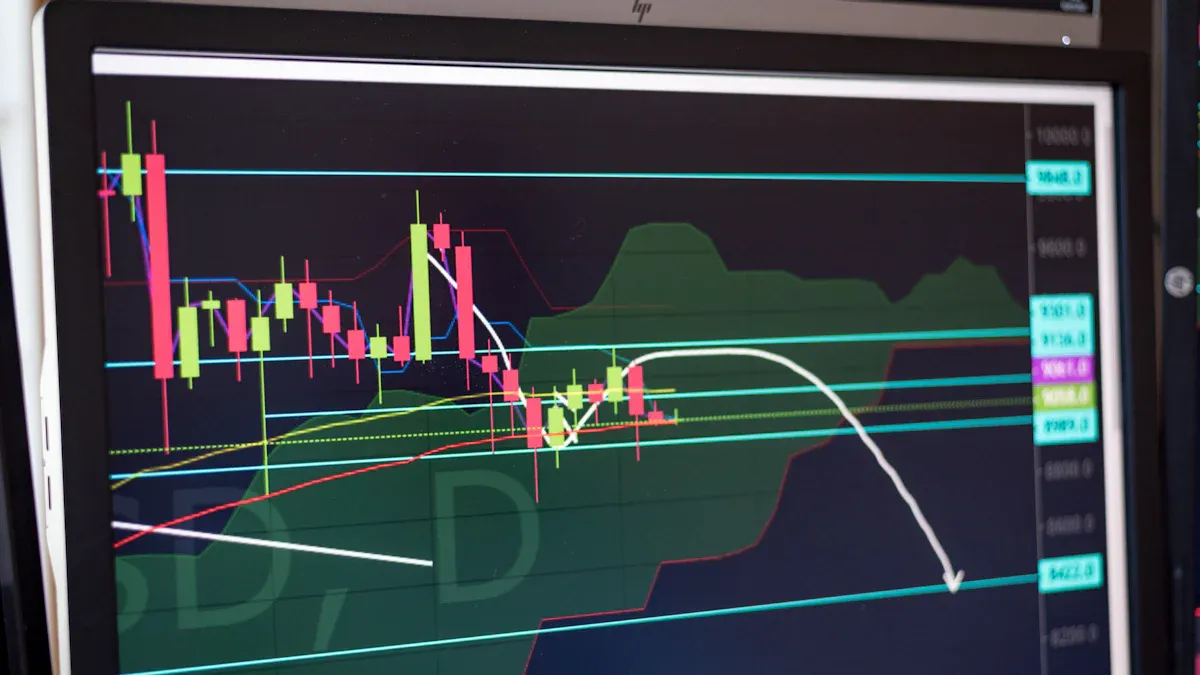
Image Source: pexels
In addition to macroeconomic data, technical patterns provide an intuitive window for investors to observe market psychology and fund flows. Daily candlestick charts contain a wealth of information; learning to interpret them allows better grasping of the short-term pulse of the US stock market.
Key Support and Resistance Level Analysis
When an index hits a historical high, old resistance levels become new support levels. Taking the S&P 500 as an example, after breaking the 6000-point mark in 2025, this integer level itself becomes an important psychological support.
Daily closing prices’ performance at these key levels is crucial. If the closing price steadily holds above 6000 points, it indicates strong buying, with the uptrend likely to continue. Conversely, if the closing price breaks this level, it may signal the start of a short-term pullback.
Investors should closely monitor these key areas formed by previous highs, integer levels, or Fibonacci retracements.
Moving Average (MA) Crossover Signals
Moving averages are classic tools for judging long-term market trends. Among them, the 50-day MA crossing above the 200-day MA forming a “golden cross” is usually seen as a bullish signal, while the 50-day MA crossing below the 200-day MA forming a “death cross” is viewed as a bearish signal. Historical data shows:
- In the past five years, the S&P 500’s 50-day and 200-day MAs have crossed four times.
- The “death cross” during the 2020 COVID pandemic was followed by a rapid rebound.
- The most recent significant “death cross” occurred in March 2022, foreshadowing the subsequent downturn.
Although these signals are powerful, they are lagging. Investors need to verify with closing prices to confirm if the trend is truly forming, avoiding being misled by brief market fluctuations.
Volume and Fund Flows
Volume is a key indicator for measuring market participation, verifying the reliability of price movements. Rising prices with increasing volume indicate healthy uptrends, while rising prices with shrinking volume may suggest weakening momentum. For example, SPY ETF’s current daily trading volume is about 55.23 million shares, below its 80.55 million share 30-day average, which may indicate recent upward momentum is weakening.
Deeper analysis requires tracking fund flows. By observing whether funds are flowing into or out of different asset classes, one can judge the true intentions of “smart money.” For example, some investors use platforms like Biyapay to monitor market data in real time.
| Fund Type/Category | Fund Flows (July 2025) |
|---|---|
| S&P 500 Mutual Funds | Outflow $212 billion |
| Equity Strategies (ETFs and Mutual Funds) | Outflow $270 billion |
| Fixed Income and Money Market Strategies | Inflow nearly $100 billion |
The table above shows that despite stock market rises, large amounts of funds are flowing from equity funds to safer fixed income and money markets, revealing potential risk-aversion among institutional investors.
Market Sentiment: Tracking Smart Money and Sector Rotation
In addition to macroeconomic data and technical charts, market sentiment is the third dimension for capturing market psychology. It reflects collective investor feelings, often providing valuable clues leading price changes.
Contrarian Application of Fear & Greed Index
CNN’s Fear & Greed Index is a classic tool for measuring market sentiment. It integrates seven different indicators to judge whether investors are mainly driven by fear or greed.
Contrarian investors follow a simple principle: Be fearful when others are greedy, and greedy when others are fearful. When the index enters the “extreme fear” zone, it usually means the market is oversold, potentially signaling a buying opportunity. Conversely, when the index shows “extreme greed,” it warns of market overheating and increased pullback risk.
Investors should use this index as a reference after daily closes to assess if market sentiment has reached extremes that could trigger reversals.
Magnificent Seven and Market Divergence
The 2025 market shows clear polarization, with the Magnificent Seven as absolute leaders. Their daily close performance has decisive influence on the US stock market direction. Data shows that as of now, the Magnificent Seven stocks have a year-to-date return of 22.7%, significantly higher than the S&P 500’s 15.8% over the same period.
This divergence indicates that most profit growth and upward momentum are concentrated in these few companies. Therefore, after daily closes, investors need to analyze: Is the Magnificent Seven independently pulling the index, or is the uptrend spreading to broader sectors? This helps judge the health of market rises.
Sector Rotation and Trump 2.0 Concepts
Market styles are not static; funds rotate between different sectors. Political expectations are an important driver of sector rotation, such as market discussions on the “Trump 2.0 era.” If related policy expectations heat up, some traditional industries may benefit. Analysts believe the following areas are worth attention:
- Industrial Sector: Factory automation companies Regal Rexnord and building materials supplier Vulcan Materials are expected to benefit from U.S. manufacturing reshoring and infrastructure investment.
- Energy Sector: Builders of nuclear and gas power plants may receive policy support, while LNG export terminal approvals could accelerate.
Investors can judge if market style is shifting from tech stocks to these traditional sectors by observing leading and lagging sectors after daily closes, thereby positioning in advance.
In the complex 2025 market, investors combining macroeconomic, technical, and market sentiment signals can gain deeper insights. To make more comprehensive daily decisions, it is recommended that investors upgrade their review checklist:
Daily Review Checklist 2.0
- Monitor Earnings Expectations: Analysts predict S&P 500 earnings growth of 11.6% in 2025.
- Track Election Policies: Focus on potential changes like tariff policies impacting specific industries.
Ultimately, effective risk management is crucial. Investors should cope with uncertainty through diversified investing and maintaining a long-term perspective, making cautious decisions.
FAQ
Which Signal is the Most Important?
No single signal is absolutely the most important. Investors should combine macroeconomic, technical, and market sentiment signals to form a complete analysis framework. They verify each other, helping investors make more comprehensive judgments and avoid being misled by a single indicator.
How Often Should I Check These Signals?
Check frequency depends on the investor’s strategy. Short-term traders may need daily reviews, while long-term investors can focus more on weekly or monthly trends.
Tip: Regardless of strategy, immediate analysis should be conducted after key data releases (such as CPI) or Federal Reserve meetings.
What If Technical Signals Conflict with Macro Data?
This situation indicates market divergence and uncertainty. At this time, cautious investors usually choose to wait and see or reduce positions, waiting for the market direction to become clearer. In the long term, macroeconomic fundamentals are often the key determining the market’s ultimate direction.
How Does the U.S. Election Affect Interpretation of These Signals?
Elections significantly amplify market sentiment fluctuations and influence sector rotation. For example, expectations for specific candidate policies may cause funds to flow from tech sectors to energy or industrial sectors. Investors need to closely monitor changes in election situations and their impact on market expectations.
*This article is provided for general information purposes and does not constitute legal, tax or other professional advice from BiyaPay or its subsidiaries and its affiliates, and it is not intended as a substitute for obtaining advice from a financial advisor or any other professional.
We make no representations, warranties or warranties, express or implied, as to the accuracy, completeness or timeliness of the contents of this publication.
Related Blogs of

2025 Latest US Stock Account Opening Tutorial: Complete Online Application in 5 Steps


2025 US Stock Market Opening Hours Guide: What Time in Beijing Time? Daylight Saving and Standard Time Notes

In-Depth Analysis of US Stock Pre-Market Trading: Unveiling the Secrets of the Market Before Opening


Profit Expansion is the Core Driver: Analyzing the Growth Engines of the US Stock Market in 2026

Choose Country or Region to Read Local Blog
 Australia
 Austria
 Belgium
 Canada
 Cyprus
 Czech Republic
 Denmark
 Estonia
 Finland
 France
 Germany
 Greece
 Hong Kong
 India
India Indonesia
 Ireland
 Italy
Italy Japan
Japan Latvia
 Lithuania
 Luxembourg
 Malaysia
 Malta
Malta Morocco
 Nepal
Nepal Netherlands
 New Zealand
 Norway
 Pakistan
 Philippines
 Poland
 Portugal
 Romania
 Singapore
 Slovakia
 Slovenia
 South Africa
 South Korea
 Spain
Spain Sweden
 Thailand
 The United States
 Turkey
 United Arab Emirates
 United Kingdom
 Vietnam
Contact Us




BIYA GLOBAL LLC is a licensed entity registered with the U.S. Securities and Exchange Commission (SEC No.: 802-127417); a certified member of the Financial Industry Regulatory Authority (FINRA) (Central Registration Depository CRD No.: 325027); regulated by the Financial Industry Regulatory Authority (FINRA) and the U.S. Securities and Exchange Commission (SEC).
BIYA GLOBAL LLC is registered with the Financial Crimes Enforcement Network (FinCEN), an agency under the U.S. Department of the Treasury, as a Money Services Business (MSB), with registration number 31000218637349, and regulated by the Financial Crimes Enforcement Network (FinCEN).
BIYA GLOBAL LIMITED is a registered Financial Service Provider (FSP) in New Zealand, with registration number FSP1007221, and is also a registered member of the Financial Services Complaints Limited (FSCL), an independent dispute resolution scheme in New Zealand.