When the Golden Cross Appears, Can the Trend Be Immediately Judged? Moving Averages Help You Catch the Starting Point of a Bull Market!




Image Source: pexels
Have you ever seen a golden cross and assumed a market reversal was imminent? In the U.S. stock market, when the 50-day moving average crosses above the 200-day moving average, many investors believe a bull market is starting. However, historical data shows that after a golden cross in 2015, the S&P 500 fell over 5% in the short term. Approach golden cross signals rationally, avoiding blind reliance.
Key Highlights
- A golden cross occurs when a short-term moving average crosses above a long-term one, often seen as a bull market signal, but requires careful analysis.
- Golden crosses aren’t always reliable; historical data shows false signals, necessitating confirmation with other indicators.
- Proper position sizing and risk management protect capital from losses due to premature entries.
- Volume spikes enhance golden cross reliability, with high volume signaling stronger buy opportunities.
- Continuous learning and strategy adjustments, paired with multiple tools, improve market opportunity capture.
Golden Cross and Trend Analysis

Image Source: pexels
Golden Cross Defined
In technical analysis, you’ll often hear about the “golden cross.” It occurs when a short-term moving average (e.g., 50-day) crosses above a long-term moving average (e.g., 200-day). Traders view it as a signal of strengthening market trends. The table below summarizes definitions from authoritative sources:
| Source | Definition |
|---|---|
| Corporate Finance Institute | A golden cross is a technical indicator when an asset’s short-term (50-day) moving average rises above its long-term (200-day) moving average, signaling a strong bull market. |
| SoFi | A golden cross is a technical pattern when a security’s short-term moving average surpasses its long-term moving average, indicating a potential market rally. |
| Britannica | A golden cross is a bullish pattern when a short-term moving average (typically 50-day) crosses above a long-term moving average (typically 200-day), signaling rising momentum and a potential long-term uptrend. |
In U.S. markets, the 50-day and 200-day moving averages are standard for spotting golden crosses, helping you gauge potential trend shifts.
Trend Confirmation
A golden cross often signals a potential bull market. In technical analysis, the 50-day and 200-day moving average crossover is a key trend indicator. Consider these points:
- A 50-day moving average crossing above the 200-day is typically a buy signal.
- Traders often enter long positions post-golden cross, anticipating sustained rallies.
- Golden crosses correlate with bull market trends, especially in U.S. markets where major uptrends often align with this signal.
Tip: View the golden cross as a pivot in market sentiment and capital flow, but don’t assume it guarantees a bull market.
Signal Limitations
While a golden cross signals a bull market, its limitations require caution. Research and historical data highlight issues:
- False signals or whipsaws occur when a golden cross precedes a pullback rather than a sustained rally.
- As a lagging indicator, it may miss rapid market shifts, causing delayed entries.
- In choppy or range-bound markets, golden crosses often fail, misleading short-term gains as long-term trends.
- Relying solely on a golden cross without other indicators risks poor decisions.
Common misconceptions include:
- Assuming every golden cross triggers significant rallies.
- Ignoring broader market conditions and fundamentals.
Use the golden cross as a reference, not a sole decision driver, and combine it with other methods to reduce risks and seize opportunities.
Moving Average Basics
Types of Moving Averages
You’ll encounter various moving averages in trend analysis, each with unique calculations and sensitivities. The table below outlines common types and their methods:
| Moving Average Type | Calculation Description |
|---|---|
| Simple Moving Average (SMA) | Equal weighting for all data points. |
| Exponential Moving Average (EMA) | Higher weighting for recent data. |
| Weighted Moving Average | Weights assigned based on predefined criteria. |
| Triangular Moving Average | Higher weighting for mid-period data. |
| Variable Moving Average | Weights adjusted based on price volatility. |
SMAs suit long-term trends, while EMAs, being more responsive, are ideal for short-term trading in U.S. markets.
Parameter Selection
Choosing moving average periods impacts signal sensitivity and reliability. Short-term averages (e.g., 5-day, 10-day) react quickly but risk false signals. Mid-term averages (e.g., 20-day, 50-day) balance sensitivity and stability, ideal for mid-term trends. Long-term averages (e.g., 100-day, 200-day) confirm long-term trends but lag. In U.S. markets, traders often pair 20-day and 50-day EMAs with volume and price action to validate golden crosses. Adjust parameters based on your trading horizon and risk tolerance.
Trend Identification
Moving averages help identify market trends by smoothing price data to filter noise:
- Prices above the moving average indicate an uptrend.
- Prices below suggest a downtrend.
- The moving average’s slope signals bullish (upward) or bearish (downward) momentum.
- Crossovers like the golden cross pinpoint trend shifts.
Though lagging, moving averages are vital for trend confirmation and decision-making when paired with other tools.
Practical Golden Cross Analysis
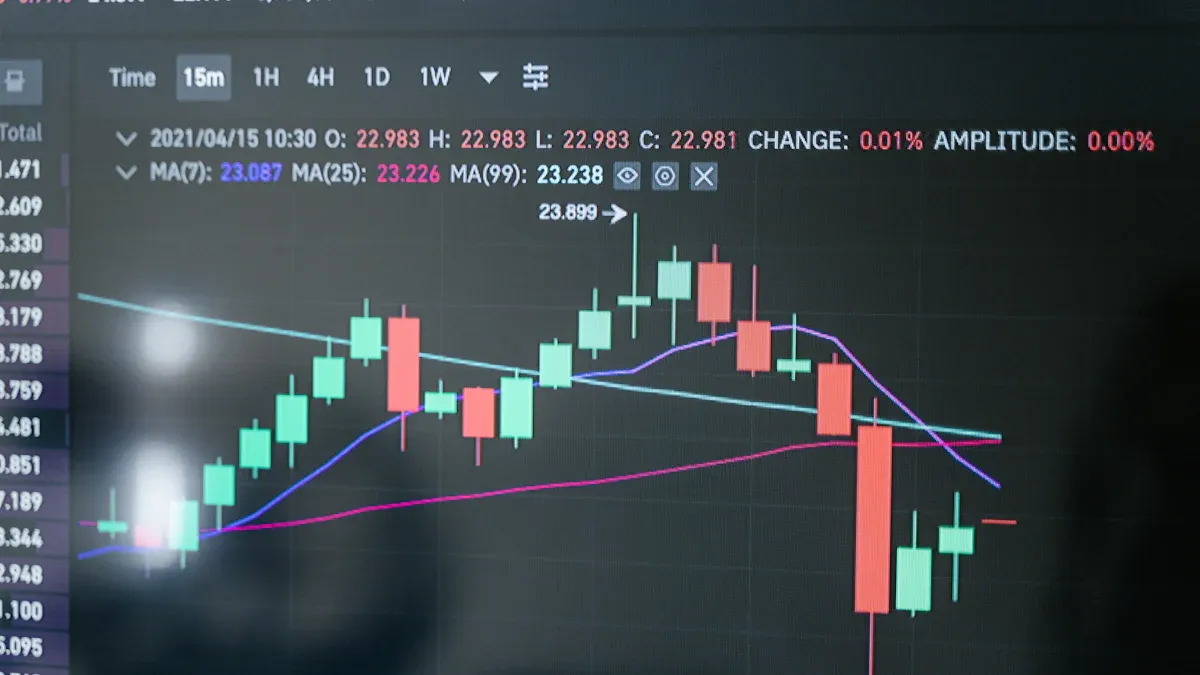
Image Source: pexels
Golden Cross Formation
A golden cross typically emerges in specific market conditions. After a downtrend, the short-term moving average lies below the long-term one, forming a death cross, signaling bearishness. As the market recovers, the short-term average rises and crosses above the long-term, creating a golden cross, suggesting a potential long-term uptrend. Volume often spikes during formation, reflecting strong buying conviction and capital inflows.
- Downtrend: Short-term average below long-term.
- Recovery: Short-term average crosses above, forming a golden cross.
- Volume surge: Confirms bullish momentum.
Bull Market Trigger
Can a golden cross pinpoint a bull market’s start? Historical data shows a three-month average return of 4.07% post-golden cross, with a 75% chance of above-average returns:
| Indicator | 3-Month Average Return | Probability of Above-Average Return |
|---|---|---|
| Golden Cross | 4.07% | 75% |
| Average 3-Month Return | 2.12% | 65.9% |
In U.S. markets, golden crosses carry weight but don’t guarantee sustained rallies. False signals occur, so confirm with technical and fundamental indicators to avoid chasing false trends.
Bullish Alignment
To validate a golden cross, look for a bullish alignment where multiple moving averages (short- to long-term) stack upward, with the shortest on top. This signals strong bullish momentum. Combine with volume and price action for accuracy. A golden cross is one signal, not a standalone buy trigger.
Tip: Use bullish alignment and complementary indicators to confirm bull market opportunities.
Trading Strategies and Risk Management
Indicator Synergy
Enhance golden cross reliability with complementary indicators to filter false signals. The table below outlines effective pairings:
| Indicator | Description |
|---|---|
| RSI | RSI between 50-70 during a golden cross signals strong bullish momentum. |
| MACD | MACD line crossing the signal line during a golden cross confirms trend strength. |
| Volume Indicators | On-Balance Volume or Volume Oscillator; rising volume validates trend sustainability. |
Check the golden cross, then confirm with RSI and MACD. A volume surge strengthens the signal’s credibility.
Position Sizing
Effective position sizing mitigates risks. The table below compares strategies in U.S. markets:
| Strategy | Annualized Return (CAR) | Risk-Adjusted Return (RAR) | Max Drawdown (MDD) |
|---|---|---|---|
| Golden Cross | 8.48% | 11.32% | -20% |
| Buy-and-Hold | 7.55% | 10% | -56.74% |
The golden cross strategy offers lower drawdowns than buy-and-hold. Build positions gradually, set stop-losses, and avoid over-leveraging to balance opportunity and capital safety.
Avoiding Pitfalls
Golden cross signals have pitfalls to avoid:
- They lag due to historical data reliance, potentially missing early price moves.
- Late entries may reduce returns.
Additional considerations:
- Assess market context before acting.
- Avoid chasing highs post-golden cross.
- Manage risk and position size with stop-losses.
- Adapt strategies through continuous learning.
Combine rational signal analysis with diverse tools and risk management to seize opportunities and limit risks.
Golden crosses offer trend insights but require cautious use:
- AI-enhanced moving average strategies and neural networks boost accuracy.
- Professionals pair MACD and RSI for reliability.
- Study resources like 3 Simple Ways to Trade the Golden Cross and Moving Average Trading Signals.
Rational analysis, combined with multiple tools, enhances trading precision and avoids blind reliance.
FAQ
When should I enter after a golden cross?
Wait 1-3 trading days post-golden cross, confirming with volume and indicators to reduce chasing risks.
Is a golden cross effective in choppy markets?
Golden crosses are less reliable in range-bound markets. Pair with MACD and RSI for better accuracy.
How does a golden cross differ from a death cross?
A golden cross (short-term average crossing above long-term) is bullish; a death cross (short-term below long-term) is bearish.
Is a golden cross suitable for short-term trading?
Golden crosses may lag for short-term trades. Pair with short-period averages and volume for efficiency.
Can a golden cross alone justify a buy?
Don’t rely solely on a golden cross. Combine with fundamentals, volume, and indicators for robust decisions.
By decoding golden cross signals and moving averages, you’re equipped to spot bullish trend starts, but high cross-border fees, currency volatility, and offshore account complexities can hinder acting on U.S. market signals, especially for swift entries or position tweaks. Picture a platform with 0.5% remittance fees, same-day global transfers, and contract limit orders with zero fees, enabling seamless golden cross strategies via one account?
BiyaPay is crafted for technical traders, offering instant fiat-to-digital conversions to capitalize on golden cross signals nimbly. With real-time exchange rate query, monitor USD trends and transfer at optimal moments to cut costs. Covering most regions with instant arrivals, it powers rapid allocations to S&P 500 ETFs (like VOO) or high-momentum stocks. Crucially, trade U.S. and Hong Kong markets through a single account, leveraging contract limit orders with zero fees for MACD or RSI-confirmed limit strategies.
Whether chasing golden cross rallies or dodging false signals, BiyaPay fuels your precision. Sign up now, visit stocks for U.S. prospects—quick setup unlocks cost-effective, data-driven trading. Join global investors and conquer 2025 bull markets!
*This article is provided for general information purposes and does not constitute legal, tax or other professional advice from BiyaPay or its subsidiaries and its affiliates, and it is not intended as a substitute for obtaining advice from a financial advisor or any other professional.
We make no representations, warranties or warranties, express or implied, as to the accuracy, completeness or timeliness of the contents of this publication.
Related Blogs of

Beginner’s Must-Read: Complete Breakdown of VOO, IVV, and SPY—the Three Major S&P 500 ETFs


A-Share Market Capitalization Query Guide: Easily Master Calculation Methods and Analysis Techniques


Essential Guide to Cross-Border Wire Transfers: Complete Strategy for Wiring Money from China to the US


Tired of CNN Chinese? A Curated List of English News Sources

Choose Country or Region to Read Local Blog
 Australia
 Austria
 Belgium
 Canada
 Cyprus
 Czech Republic
 Denmark
 Estonia
 Finland
 France
 Germany
 Greece
 Hong Kong
 India
India Indonesia
 Ireland
 Italy
Italy Japan
Japan Latvia
 Lithuania
 Luxembourg
 Malaysia
 Malta
Malta Morocco
 Nepal
Nepal Netherlands
 New Zealand
 Norway
 Pakistan
 Philippines
 Poland
 Portugal
 Romania
 Singapore
 Slovakia
 Slovenia
 South Africa
 South Korea
 Spain
Spain Sweden
 Thailand
 The United States
 Turkey
 United Arab Emirates
 United Kingdom
 Vietnam
Contact Us
Company and Team
BiyaPay Products
Customer Services




BIYA GLOBAL LLC is a licensed entity registered with the U.S. Securities and Exchange Commission (SEC No.: 802-127417); a certified member of the Financial Industry Regulatory Authority (FINRA) (Central Registration Depository CRD No.: 325027); regulated by the Financial Industry Regulatory Authority (FINRA) and the U.S. Securities and Exchange Commission (SEC).
BIYA GLOBAL LLC is registered with the Financial Crimes Enforcement Network (FinCEN), an agency under the U.S. Department of the Treasury, as a Money Services Business (MSB), with registration number 31000218637349, and regulated by the Financial Crimes Enforcement Network (FinCEN).
BIYA GLOBAL LIMITED is a registered Financial Service Provider (FSP) in New Zealand, with registration number FSP1007221, and is also a registered member of the Financial Services Complaints Limited (FSCL), an independent dispute resolution scheme in New Zealand.