How to Use the Strangle Strategy? A Classic Options Play for Betting on a Big Market Move at Low Cost



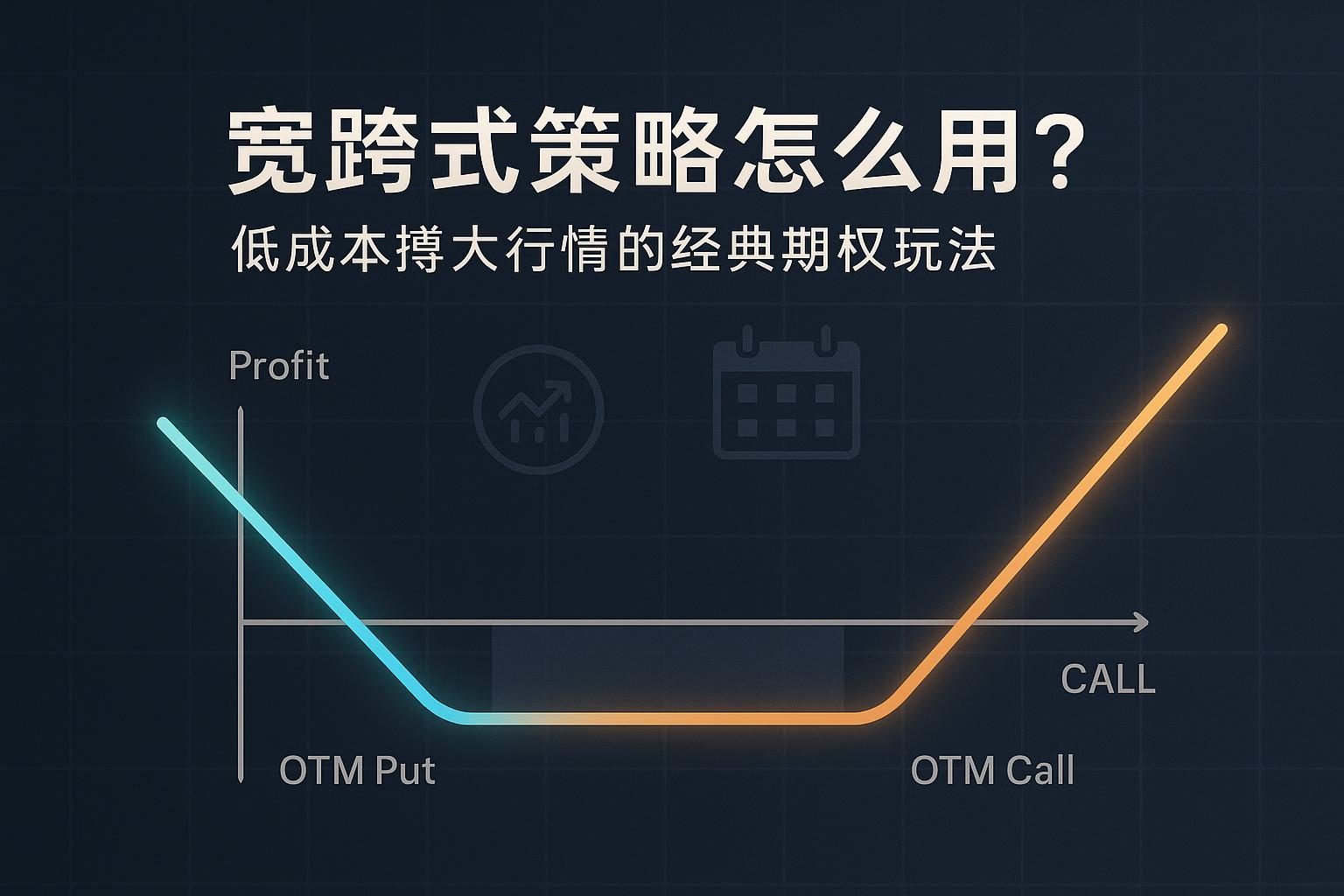
If you expect a “big move” but are unsure of the direction, the strangle strategy is a highly cost-effective choice: with low premiums, you can capture significant price breakouts in either direction. This guide will walk you through executing a buy or sell strangle trade on a Chinese-friendly platform, providing a complete process for “low-cost parameters,” “validation and risk management,” and “troubleshooting.”
- Time and Difficulty: Preparation and order placement take about 10–20 minutes; moderate difficulty (requires basic options knowledge).
- Target Audience: Individual investors familiar with call/put options, strike prices, and expiration dates.
- What You’ll Gain: Profit-loss structure and formulas, when to use buy/sell strangles, parameter selection checklist, operational steps, visualization validation, and risk management strategies.
1. Understanding the Strangle: Two Approaches and Profit-Loss Structure
- Long Strangle: Simultaneously buy a lower strike out-of-the-money (OTM) put option and a higher strike OTM call option, with the same expiration and underlying asset. The maximum loss is the total premium paid, with profits possible from a significant breakout in either direction. See Futu Learning Center’s Long Strangle tutorial (2023) (based on Futu Learning Center Long Strangle Guide).
- Short Strangle: Simultaneously sell a lower strike OTM put option and a higher strike OTM call option, with the maximum gain being the total premium collected. Risks can escalate sharply in extreme one-sided moves, requiring margin and strict risk management. See Futu Learning Center’s Short Strangle (2023) (based on Futu Learning Center Short Strangle Guide).
- Difference from Straddle: A straddle typically uses the same at-the-money (ATM) strike price, with higher costs but greater sensitivity to small moves; a strangle uses OTM strikes for both legs, lowering costs but requiring larger price breakouts. For a comparison, refer to Moomoo’s Chinese tutorial (2024) (see Moomoo Straddles vs Strangles comparison page).
Profit-Loss Break-Even Points (for Long Strangle):
Lower Break-Even Point = Put Strike Price − Total Premium Paid
Upper Break-Even Point = Call Strike Price + Total Premium Paid
Maximum Loss = Total Premium Paid
2. When to Use: Event-Driven vs. Range-Bound Pullback
- Long Strangle (Low-Cost High-Volatility Play): Ideal before earnings reports, policy announcements, or macro data releases when direction is uncertain but volatility is expected to increase; beware of “IV crush” post-event when implied volatility (IV) may drop rapidly. For a Chinese explanation of “post-earnings IV crush,” refer to Moomoo (2025) (see Moomoo Post-Earnings IV Crush tutorial page).
- Short Strangle (Collect Premiums + Bet on Time and IV Decline): Suitable for range-bound markets with expected IV declines, profiting from time decay (Theta), but requires clear stop-loss and protective measures.
3. Greeks and IV: Operational Impacts
- Long Strangle:
- Theta is negative, with longer holding periods leading to greater losses; align expiration with event windows.
- Vega is positive, benefiting from IV increases and harmed by decreases.
- Gamma is positive, becoming more sensitive to price changes near strike prices, enhancing the ability to capture large moves.
- Short Strangle:
- Theta is positive, benefiting from time decay; however, Gamma risk spikes near expiration.
- Vega is negative, benefiting from IV declines and harmed by increases.
For a deeper understanding of profit-loss curves and scenario simulations, use platform P&L curve tools. Moomoo provided a detailed Chinese tutorial in 2025 (see Moomoo Options P&L Curve Tutorial).
4. Low-Cost Parameter Selection Formula and Checklist (Buy/Sell)
Below are commonly used, adjustable parameter principles to balance cost and win rate. Adjust flexibly based on the underlying’s historical volatility and current IV percentile.
- Long Strangle:
- Expiration: Choose the nearest expiration within 2–7 days post-event to avoid excessive Theta decay from prolonged holding.
- Strike Prices: Select more out-of-the-money strikes (e.g., 5–10% away from the current price) to significantly reduce total premiums, but larger breakouts are needed.
- IV Percentile: Be cautious at extremely high IV; low-to-mid percentiles with expected IV expansion are more cost-effective.
- Entry Validation: Calculate break-even points for both sides and compare with historical average event-driven volatility to ensure coverage.
- Short Strangle:
- Expiration: Avoid overly short expirations (to mitigate high Gamma) or overly long ones (excessive time exposure); 2–6 weeks is common.
- Strike Prices: Choose farther OTM strikes (e.g., 10–15% from the current price) to widen the safety zone, but premiums decrease; set a minimum premium threshold.
- Margin: Monitor combined margin requirements and risk status, setting an upper limit.
- Protection: Add wings to form an “iron condor” if needed to cap losses.
5. Execution: A Replicable Strangle Trading Workflow
The following demonstrates an “event-driven long strangle”; short strangle steps are similar but require extra attention to margin and protective wings.
- Select Underlying and Event Window
- Choose highly liquid, mature options markets for the underlying (e.g., mainstream U.S. stocks or ETFs).
- Identify the event date (earnings, policy, or data release) and window: Plan to open the position before the event and exit per the plan after it lands.
- Choose Expiration and Strike Prices
- Select the nearest expiration within 2–7 days post-event;
- Strike Prices: On the trading interface, add a put (lower strike) and a call (higher strike), both OTM.
- Estimate Premiums and Break-Even Points
- Record the total premium for both legs;
- Calculate break-even points for both sides (see Section 1 formula);
- Use platform P&L charts to simulate scenarios with price ±10% and IV ±5 points, confirming the required breakout is achievable based on historical data and past event volatility.
- Place and Confirm Order
- Use the “combined order/custom combination” feature on a Chinese-friendly platform to submit both legs at once, checking Greeks and dynamic P&L curves;
- Reconfirm margin and risk status before submission. Futu’s support page explains combination orders and margin checks (2024) (see Futu Support: U.S. Stock Options Combination Orders and Margin).
- Position Monitoring and Trigger Conditions
- If the price rapidly breaks out in either direction, follow the plan to take profits or trail;
- If volatility falls short or IV crush occurs post-event, execute a quick exit;
- Set a hard stop-loss (e.g., exit if floating loss reaches X% of total premiums).
- Exit and Review
- Close the position upon reaching profit-loss targets or post-event per the plan;
- Record parameters and outcomes, evaluate IV and Theta impacts, and optimize for the next trade.
6. Risk Management: Margin, Assignment, and Gamma Risk
- Combined Margin: Margin calculations vary by broker; always refer to the order interface and help center. Futu’s 2024 support documents provide query paths and notes (see Futu Support: Combined Margin Explanation).
- Early Assignment (American Style): U.S. stock options can be assigned anytime before expiration; short strangles must prepare for underlying stock or cash obligations. Moomoo’s 2024–2025 support pages clearly explain European vs. American differences and exercise/settlement (see Moomoo Support: European vs. American Differences and Moomoo Support: Exercise and Settlement).
- Gamma Risk and 0DTE: Near expiration (especially 0DTE), Gamma is very high, and short strangles can incur rapid losses in gaps or fast moves. Saxo’s 2024 Chinese article outlines 0DTE risks (see Saxo 0DTE Risks (Part 1)).
7. Troubleshooting: What to Do in These Situations
- Insufficient Volatility or IV Crush Post-Event (Long Strangle)
- Exit immediately per the plan to avoid dual erosion from Theta and Vega;
- If further volatility is expected, retain one side (spread or single leg) short-term while reducing total exposure.
- Rapid One-Sided Breakout, Uncontrolled Risk (Short Strangle)
- Trigger stop-loss or add wings to form an “iron condor” to cap losses;
- Alternatively, buy a hedge leg (option or spread in the breakout direction) to reduce tail risk.
- Margin/Risk Status Alerts
- Reduce or close positions promptly to avoid forced liquidation;
- If continuing the position, consider rolling to a farther expiration, but evaluate roll costs and cumulative risk.
8. Visualization Validation and Tool Recommendations
- Platform-Built P&L Curves: Use price, time, and IV sliders for scenario testing to confirm profit-loss windows and risk exposure. See Moomoo’s Chinese tutorial (2025) (see Moomoo Options P&L Curve Tutorial).
- Third-Party Simulations: OptionStrat (English) quickly builds Strangle/Straddle/Iron Condor charts; Xueqiu strategy tools are suitable for Chinese discussions and auxiliary charting (select high-quality sources and verify data accuracy).
9. Advanced and Alternatives: Straddle, Iron Condor, Protected Strangle
- Straddle: Same ATM strike price, higher cost but more sensitive to smaller moves, suitable for “very large” expected event volatility and willingness to pay higher premiums (see Section 1 links for tutorials).
- Iron Condor: Add farther OTM buy legs on both sides of a short strangle to limit risk and reward; protection methods are systematically explained in Chinese tutorials (Moomoo, 2024) (see Moomoo Iron Condor Tutorial).
- Protected Strangle: Add farther OTM buy legs on both sides of the base strangle, forming a “winged” defensive strangle for scenarios concerned about tail risk. Futures research materials also discuss short strangle vs. iron condor comparisons (Xingzheng Futures, 2025) (see Xingzheng Futures Short Strangle vs. Iron Condor Comparison PDF).
10. Beginner Warnings and Action Checklist (Ready to Apply)
- Pre-Entry Validation (Three Checks):
- Does the event window match the expiration date (2–7 days post-event)?
- Do break-even points align with historical/event average volatility?
- Is the current IV percentile reasonable (extremely high IV favors sellers or adding protective wings)?
- Position Monitoring (Two Checks):
- Long Strangle: Is the price nearing one leg, is IV behaving as expected, and is Theta decay acceptable?
- Short Strangle: Are there signs of a one-sided breakout, rising Gamma risk, or increasing margin/assignment risk?
- Exit and Troubleshooting (Two Actions):
- Exit post-event per the plan;
- Execute wing addition/hedging/closure immediately upon stop-loss or risk status triggers.
Conclusion: Turning “Method” into “Process” and “Discipline”
The core value of a strangle lies in “uncertain direction but predictable volatility.” The buy side uses limited losses to capture two-way big moves, while the sell side profits from time and IV declines but bears tail risk. Embedding this guide’s parameter checklist, validation methods, monitoring, and troubleshooting into your trading process will truly bring “low-cost high-move trading” to life.
To ensure safe and efficient execution, thoroughly review platform official help and educational resources, and test the process in simulation or small positions first:
- Futu (2023–2024) Chinese materials on Long/Short Strangle and combined margin (see links in Sections 1, 5, 6).
- Moomoo (2024–2025) Chinese pages on straddle/strangle comparison, P&L curves, IV crush, assignment, and settlement (see links in Sections 1, 2, 3, 6, 8).
- Saxo (2024) Chinese article on 0DTE risks (see link in Section 6).
Wishing you smooth trading—start with a small position and strict risk management for your first strangle.
The success of the Strangle strategy hinges on accurate volatility forecasts and execution efficiency. Especially during IV collapse, when a quick exit is required, the commissions and slippage on both legs of the contract can instantly erode your premium. If you are looking for a financial platform that minimizes execution friction while enabling highly efficient global capital flow, choose BiyaPay.
BiyaPay provides robust backend support for your option strategies. You can trade US and Hong Kong stocks on one platform without a foreign account, benefiting from zero commission on contract order placement. This perfectly matches the low-cost and high-efficiency demands of the Strangle strategy. Furthermore, BiyaPay offers real-time exchange rate checks and conversion services, supporting seamless exchange between 30+ fiat currencies and 200+ cryptocurrencies, with remittance fees as low as 0.5%, ensuring same-day transfer and arrival of funds. Register quickly with BiyaPay today to eliminate execution costs with FinTech and focus purely on strategy discipline and analysis.
*This article is provided for general information purposes and does not constitute legal, tax or other professional advice from BiyaPay or its subsidiaries and its affiliates, and it is not intended as a substitute for obtaining advice from a financial advisor or any other professional.
We make no representations, warranties or warranties, express or implied, as to the accuracy, completeness or timeliness of the contents of this publication.
Related Blogs of

Top 10 U.S. Tech Stocks Most Worth Owning in 2025 Recommended by UBS and Citi


2025 Latest US Stock Account Opening Tutorial: Complete Online Application in 5 Steps


Weekly US Stock Index Futures Review and Outlook: What Investors Should Focus On

Overcoming Human Weaknesses: Detailed Guide to Beginner-Friendly Automated US Stock Trading Strategies

Choose Country or Region to Read Local Blog
 Australia
 Austria
 Belgium
 Canada
 Cyprus
 Czech Republic
 Denmark
 Estonia
 Finland
 France
 Germany
 Greece
 Hong Kong
 India
India Indonesia
 Ireland
 Italy
Italy Japan
Japan Latvia
 Lithuania
 Luxembourg
 Malaysia
 Malta
Malta Morocco
 Nepal
Nepal Netherlands
 New Zealand
 Norway
 Pakistan
 Philippines
 Poland
 Portugal
 Romania
 Singapore
 Slovakia
 Slovenia
 South Africa
 South Korea
 Spain
Spain Sweden
 Thailand
 The United States
 Turkey
 United Arab Emirates
 United Kingdom
 Vietnam
Contact Us




BIYA GLOBAL LLC is a licensed entity registered with the U.S. Securities and Exchange Commission (SEC No.: 802-127417); a certified member of the Financial Industry Regulatory Authority (FINRA) (Central Registration Depository CRD No.: 325027); regulated by the Financial Industry Regulatory Authority (FINRA) and the U.S. Securities and Exchange Commission (SEC).
BIYA GLOBAL LLC is registered with the Financial Crimes Enforcement Network (FinCEN), an agency under the U.S. Department of the Treasury, as a Money Services Business (MSB), with registration number 31000218637349, and regulated by the Financial Crimes Enforcement Network (FinCEN).
BIYA GLOBAL LIMITED is a registered Financial Service Provider (FSP) in New Zealand, with registration number FSP1007221, and is also a registered member of the Financial Services Complaints Limited (FSCL), an independent dispute resolution scheme in New Zealand.