Is theCash - Secured Put Option Strategy Reliable? Insights into Investment Wisdom from Buffett's Classic Moves



Understand It in One Sentence
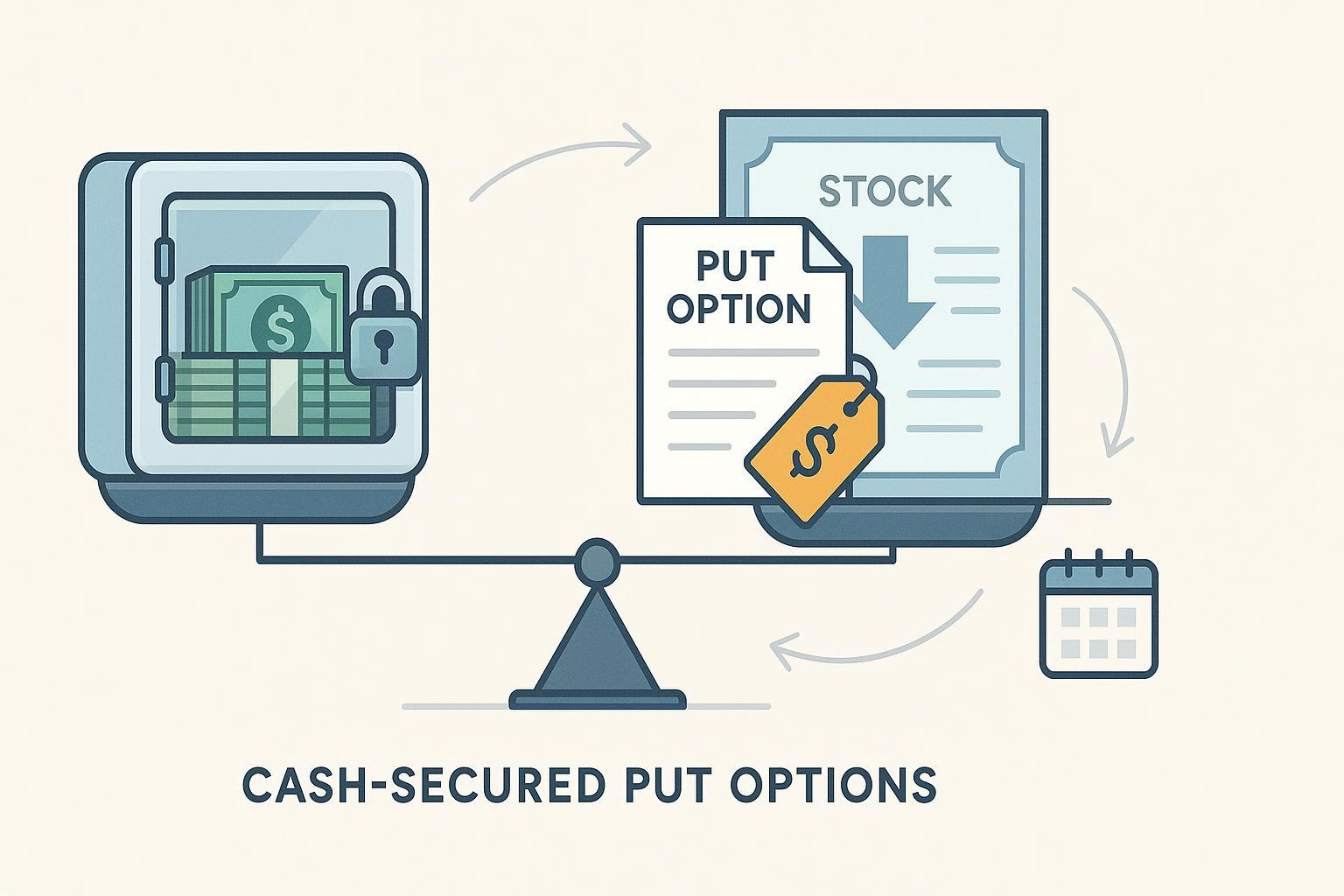
Think of it as “placing a deposit on a stock you like”: you agree to buy at a certain price, collect a “deposit” (premium) upfront, and set aside enough cash. If the option is exercised at expiration (assigned), you buy at the agreed strike price; if not (price above strike), you keep the “deposit.” This is the cash-secured put strategy.
More formally: an investor sells a put option while reserving enough cash in the account to cover the potential purchase obligation, reducing credit and margin call risks. Unlike “naked put selling,” the core of cash-secured puts is “full cash coverage.” For key points on definitions, assignment, and early exercise, refer to Schwab’s 2025 educational article—Schwab’s “Definition and Risk Highlights of Cash-Secured Puts”.
Risk/Return Structure, Crystal Clear
- Maximum Profit: The premium collected at opening (excluding taxes and commissions). This is clearly stated in Schwab’s strategy guide (2025). See the Schwab link above.
- Maximum Loss (Theoretical): If the underlying drops to zero, loss ≈ (strike price − premium) × contract shares (excluding taxes and commissions). This aligns with industry standards and Schwab/OIC teachings.
- Break-Even Point: Strike price − premium.
Impact of Greek Letters (Understanding the Role of “Time” and “Market Sentiment” on Price):
- Theta (Time Decay): Typically positive for sellers, as time passing favors the seller.
- Vega (Implied Volatility Sensitivity): Usually negative for short puts, as rising IV increases option prices, which is unfavorable to sellers. For how time value and implied volatility affect option prices, see the Options Industry Council’s explanation of price behavior (long-maintained database): OIC’s “Option Price Behavior: Impact of Time and Volatility”.
Note: The above are general relationships, still influenced by factors like underlying gaps, dividends, liquidity, and trading costs.
Three Outcomes with One Set of Numbers
Assume you sell one put option:
- Strike price = $50/share,
- Premium collected = $2/share,
- Contract size = 100 shares,
- Cash reserved = 50 × 100 = $5,000 (cash-secured).
Three common outcomes at expiration (excluding taxes/commissions):
- Price at expiration ≥ $50: Option expires worthless, you keep the full premium, net profit = 2 × 100 = $200.
- Price at expiration ≈ $48: If assigned below the strike price, you buy 100 shares at $50, but with the $2/share premium, your effective cost basis = $48/share.
- Price at expiration drops significantly (e.g., $30 or lower): If assigned, you face a paper loss; in the extreme case of the underlying going to zero, loss ≈ (50 − 2) × 100 = $4,800.
This calculation reveals the essence: cash-secured puts aren’t a “sure win”; they transform the idea of “buying at a lower price” into a disciplined path of “earning premiums with time and potentially acquiring at a lower cost.”
When to Use It? Three Key Decisions
- Underlying Selection: Use only for high-quality assets or broadly diversified indices you’re willing to hold long-term. Fundamentals must withstand short-term volatility and black swan events.
- Strike Price Selection: Typically choose “slightly out-of-the-money” (below current price), close to your desired purchase price. Farther from the current price means lower premiums and lower assignment odds; closer means higher premiums but higher assignment risk.
- Expiration Date Selection: Longer terms usually yield higher premiums but tie up cash longer; shorter terms allow more flexible rolling but require more frequent operations. Decide based on your capital turnover and management capacity.
Two paths post-assignment:
- Wheel Strategy: After acquiring shares, sell covered calls to continue “collecting rent.”
- Rolling: Before or after assignment, buy back the original contract and sell a new one to adjust strike price/expiration, but beware of added risks and costs.
Risk Checklist: It’s Reliable, But Not “Risk-Free”
- Single-Asset Black Swan: In extreme downturns, the effective cost basis is lower, but losses can still be significant.
- Implied Volatility Mismatch: High IV at opening yields attractive premiums, but if IV rises further, short-term paper losses worsen; seller advantage emerges only with time decay and IV decline.
- Liquidity and Slippage: Wide bid-ask spreads or low depth increase trading costs and execution uncertainty.
- Early Exercise and Assignment: American-style puts are more likely to be exercised early when deep in-the-money or before dividends, requiring sellers to have cash and contingency plans ready. See Schwab’s 2025 guide for practical reminders: refer to the Schwab link above.
- Capital Lockup and Opportunity Cost: Locked cash may miss other opportunities, requiring clear position sizing and reserve planning.
- Taxes and Compliance: Varies by jurisdiction; this article does not provide tax advice—consult local regulations and professionals.
Relation to Covered Calls: In and Out, Rotatable
Cash-secured puts focus on “buying low while collecting time premiums”; covered calls focus on “selling high while continuing to collect rent.” The two can rotate in practice: sell puts to acquire stock → sell calls to “rent out” the position until exercised, then return to selling puts based on valuation. This is a mindset of balancing “price + time” in one account.
Lessons from Buffett’s Classic Moves
Berkshire Hathaway disclosed selling long-term index put options around 2007, with ongoing discussions of valuation and risk in subsequent shareholder letters. You can find the first systematic disclosure in Berkshire’s 2007 Shareholder Letter (PDF). In 2008, Buffett clarified these were long-term index puts, exercisable only at expiration (European-style), with original terms of 15–20 years, and discussed accounting valuation impacts (2008): see “2008 Letter Comments on Contract Structure and Black-Scholes Valuation”. By 2010, he bluntly called Black-Scholes “wildly inappropriate” for ultra-long-term options, urging readers to distinguish paper fluctuations from actual cash flows (2010): see Berkshire’s 2010 Shareholder Letter.
From these verifiable materials, three “learnable” disciplines emerge:
- Sell only on broadly diversified or high-quality assets you’re willing to hold long-term.
- Prioritize ample cash and liquidity, tolerating interim paper fluctuations.
- View valuation models and accounting fluctuations with a long-term perspective, avoiding short-term paper losses as permanent.
Avoid these “unlearnable” pitfalls:
- Treating premiums as “stable income” on concentrated stocks, ignoring massive nominal exposure in extreme downturns.
- Blindly applying institutional-grade, ultra-long-term index puts to retail accounts or single stocks, ignoring diversification and scale differences.
- Ignoring implied volatility, liquidity, and capital lockup, sliding into “frequent small gains, occasional big losses.”
When Not to Use It?
- You aren’t genuinely willing to buy the underlying at the chosen strike price.
- The underlying has unclear fundamentals or looming major uncertainties (earnings, regulations, lawsuits, delisting risks, etc.).
- Insufficient cash reserves in the account, risking passivity due to volatility or assignment.
- Lack of basic understanding or monitoring capability for IV, early exercise, or liquidity risks.
Summary (As of 2025)
The cash-secured put is a disciplined “trade time for price” buying tool: you use premiums to offset future purchase costs but must have the cash and mindset to handle assignment and short-term volatility. Is it reliable? Yes, when used with clear boundaries, strict capital management, and only on assets you’re willing to hold long-term; if treated as a “guaranteed profit machine,” the market will eventually teach you a lesson.
Risk Warning: This article is for general education and does not constitute investment advice. Options are not suitable for all investors; fully understand the risks before trading and consult licensed professionals if necessary.
The success of the Cash-Secured Put strategy hinges on discipline, capital backing, and cost control. Even with a long-term perspective and deep cash reserves like Buffett, frequent rolling and management operations still incur trading friction. If you aim to apply this investment wisdom to your global portfolio, you need a modern platform that significantly reduces friction costs and maximizes capital efficiency.
BiyaPay is the tool designed to make your efforts more fruitful. It allows you to simultaneously participate in both US and Hong Kong stock trading on one platform, enjoying zero commission on contract order placement for ultra-low trading costs—perfectly aligning with your demand for strict cost control. More importantly, BiyaPay offers real-time exchange rate checks and conversion services, supporting seamless exchange between 30+ fiat currencies and 200+ cryptocurrencies, with wire transfer fees as low as 0.5%. This ensures you can manage cross-border capital flow with maximum efficiency and minimum cost, supporting same-day transfer and arrival. Register quickly with BiyaPay today to leverage financial technology in practicing master-level investment discipline and global allocation.
*This article is provided for general information purposes and does not constitute legal, tax or other professional advice from BiyaPay or its subsidiaries and its affiliates, and it is not intended as a substitute for obtaining advice from a financial advisor or any other professional.
We make no representations, warranties or warranties, express or implied, as to the accuracy, completeness or timeliness of the contents of this publication.
Related Blogs of

Another Major Drop! Why Is the A-Share Index Falling Non-Stop – Where Exactly Is the Problem?


Beginner’s Guide: What to Do When a Stock Hits Limit-Down? Can You Still Trade?


A-Share Beginner’s Guide: Master Market Hours and Trading Rules in One Article


Stop Relying Only on the Shanghai Composite: How the Shenzhen Component and ChiNext Indices Reveal New A-Share Opportunities

Choose Country or Region to Read Local Blog
 Australia
 Austria
 Belgium
 Canada
 Cyprus
 Czech Republic
 Denmark
 Estonia
 Finland
 France
 Germany
 Greece
 Hong Kong
 India
India Indonesia
 Ireland
 Italy
Italy Japan
Japan Latvia
 Lithuania
 Luxembourg
 Malaysia
 Malta
Malta Morocco
 Nepal
Nepal Netherlands
 New Zealand
 Norway
 Pakistan
 Philippines
 Poland
 Portugal
 Romania
 Singapore
 Slovakia
 Slovenia
 South Africa
 South Korea
 Spain
Spain Sweden
 Thailand
 The United States
 Turkey
 United Arab Emirates
 United Kingdom
 Vietnam
Contact Us




BIYA GLOBAL LLC is a licensed entity registered with the U.S. Securities and Exchange Commission (SEC No.: 802-127417); a certified member of the Financial Industry Regulatory Authority (FINRA) (Central Registration Depository CRD No.: 325027); regulated by the Financial Industry Regulatory Authority (FINRA) and the U.S. Securities and Exchange Commission (SEC).
BIYA GLOBAL LLC is registered with the Financial Crimes Enforcement Network (FinCEN), an agency under the U.S. Department of the Treasury, as a Money Services Business (MSB), with registration number 31000218637349, and regulated by the Financial Crimes Enforcement Network (FinCEN).
BIYA GLOBAL LIMITED is a registered Financial Service Provider (FSP) in New Zealand, with registration number FSP1007221, and is also a registered member of the Financial Services Complaints Limited (FSCL), an independent dispute resolution scheme in New Zealand.