What is the options roulette strategy? Revealing the logic and risks behind stable returns



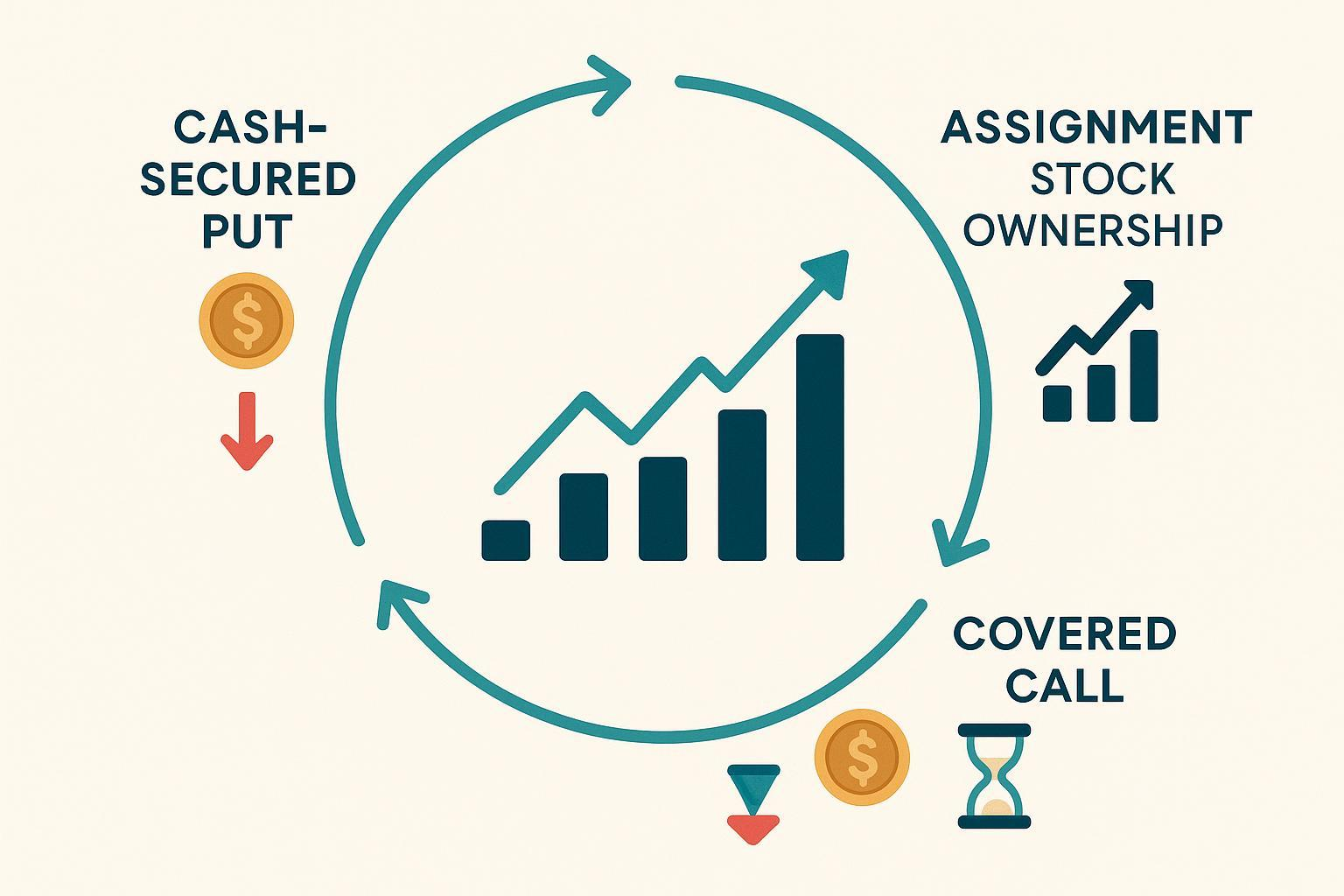
The options “Wheel Strategy” is a seller-focused framework aimed at generating consistent cash flow: first, sell a cash-secured put; if assigned, acquire stocks; then shift to selling a covered call, and repeat the cycle. In simple terms, it trades time for premium income but comes with the cost of bearing downside risk and capped upside potential.
You might be wondering: Is it truly “stable”? When should you move to the next step? What are the hidden risks? Below, we’ll break down the complete process, parameter references, and authoritative mechanisms to help you understand the “wheel” clearly (based on U.S. stock American-style options as of 2025-10-14).
The Seamless Process of the Wheel Strategy
- Step 1: Sell a Cash-Secured Put. Reserve sufficient cash to buy the underlying at the strike price if assigned. If the option expires out-of-the-money (OTM) and is not assigned, you keep the premium and can sell another put; if in-the-money (ITM), you buy 100 shares per contract at the strike price.
- Step 2: After Holding Shares, Sell a Covered Call. While holding the stock, sell an equivalent number of call options to collect premiums. If the call is exercised at expiration, the stock is sold at the strike price; if not exercised, you retain the stock and can continue selling calls.
- Step 3: Repeat. If the call is exercised, return to the starting point (sell another put); if not exercised, manage by rolling or adjusting based on market conditions.
For this core transition from “short put to covered call,” readers can refer to tastylive’s 2023 educational program and articles for systematic demonstrations of the process and cost basis handling: see “The Wheel Strategy (tastylive 2023)” and “How to Convert a Short Put into a Covered Call (tastylive 2023).”
How to Select Underlyings and Parameters (Example, Not Advice)
The following ranges are common empirical values, not standard answers. Adjust based on personal preferences and risk management capabilities:
- Liquidity and Spread: Prioritize contracts with high trading volume, sufficient open interest (OI), and tight bid-ask spreads. Empirically, the spread should not account for a large portion of the premium (e.g., ≤10–20%).
- Delta and Strike Price:
- Selling puts typically uses Delta ≈ 0.15–0.30 (balancing premium and assignment probability).
- For covered calls after assignment, use Delta ≈ 0.20–0.35 (to avoid early exercise while maintaining cash flow).
- Days to Expiration (DTE): 30–45 days is often considered a “sweet spot” for manageable time decay.
- Implied Volatility (IV) and Events: Prefer moderately high IV but avoid gaps and IV spikes caused by major events like earnings.
Note: These thresholds are common rules of thumb from educational platforms. Execution should align with the underlying’s characteristics, liquidity, and personal goals.
Where Do Profits Come From? What Are the Costs?
- Profit Sources:
- Net premiums from multiple rounds of selling puts/calls.
- If the covered call is exercised, potential profit from the difference between the stock’s purchase price and the call’s strike price.
- Dividends may be earned during the stock-holding phase (but see “dividend and early exercise” risk).
- Main Costs and Frictions:
- Transaction costs: Commissions, fees, and slippage; wider spreads dilute profits more.
- Opportunity cost: Covered calls cap upside, forfeiting gains beyond the strike price.
- Management costs: Costs of rolling or re-entering positions.
- Capital tie-up: Cash for puts and stock holdings tie up funds.
- Tax and account rules: Vary by broker/jurisdiction; verify independently.
Key Mechanisms to Understand (American-Style Options)
- Exercise and Assignment Can Occur Before Expiration: American-style option holders can exercise at any point during the contract’s life. Assignments are randomly allocated by the clearinghouse (OCC) to clearing members, then distributed by brokers using approved methods (random or FIFO, etc.). For process details, see the OIC’s “Options Exercise FAQ (OIC, 2025 Update).”
- Automatic Exercise Threshold (Expiration): The OCC’s “Exercise-by-Exception” policy typically applies a threshold of “in-the-money by ≥$0.01/share” for stock options. See “OCC Information Memo #56321 (2025).”
- Dividends and Early Exercise (Covered Call Related): Call holders may exercise early before the ex-dividend date to capture dividends, sacrificing remaining time value. The OIC notes that early exercise is generally not recommended, except in specific cases like the day before the ex-dividend date. See “Covered Call (OIC Strategy Page, Recently Maintained).”
Five Core Risks and Management Approaches
- Systematic and Individual Stock Downside Risk: If the stock price continues to fall after a short put is assigned, unrealized losses increase.
- Management: Limit position size per stock; diversify; or use a “defined risk” variant (e.g., short put paired with a lower-strike long put to form a credit spread), sacrificing some premium for a capped maximum loss.
- Volatility Expansion (IV Spike): Increases pressure on short puts/covered calls, making rolling or closing positions more difficult.
- Management: Avoid major events like earnings; enter positions gradually; extend expiration (roll) if needed to wait for IV to subside.
- Liquidity and Spread Costs: Wide spreads erode premiums; executing in high-liquidity periods is more advantageous.
- Management: Select high-liquidity underlyings and contracts; use limit orders; avoid forced trades near market close.
- Early Assignment and Dividends: Covered calls, especially deep in-the-money, face higher early exercise risk before ex-dividend dates.
- Management: Before ex-dividend, evaluate closing or rolling up the strike/extending expiration; or accept exercise and restart the wheel. See “OIC Exercise FAQ (2018/2025 Maintained).”
- Operational and Compliance Risks: Unfamiliarity with broker exercise/assignment processes, automatic exercise thresholds, or notification timing can lead to unintended outcomes.
- Management: Understand broker rules, settlement timelines, and order deadlines in advance; confirm with customer service if needed.
A Numerical Mini-Case Study (Illustrative, Not Advice)
- Initial Setup: Underlying stock price at $50.
- Step 1 (Sell Put): Sell a 30 DTE, Delta ≈ 0.25 put at $47 strike, collecting $1.20/share ($120/contract) premium. If assigned, effective purchase cost ≈ $47 − $1.20 = $45.80.
- Step 2 (Covered Call): After holding shares, sell a 30 DTE, Delta ≈ 0.30 call at $50 strike, collecting $0.90/share. If exercised at expiration, sell stock at $50, realizing a $4.20/share gain ($50 − $45.80), plus accumulated premiums; if not exercised, continue rolling calls.
- Details: Account for commissions, slippage, potential dividend impacts, and capital tie-up. Annualized returns should be calculated based on actual net cash flow and holding period, not simply extrapolated from nominal premiums.
To dive deeper into the “short put to covered call transition and management,” refer to “How to Convert a Short Put into a Covered Call (tastylive 2023)” for a demonstration of cost basis and execution timing; also, “The Wheel Strategy (tastylive 2023)” provides a visual overview of multi-cycle management.
What It’s Not, and Who It’s For
- It’s not a “risk-free arbitrage”; premiums cannot fully offset extreme downside risks, and upside is capped by covered calls.
- Suitable For: Investors bullish on long-term fundamentals, willing to hold quality stocks at a “discount,” and comfortable trading capped upside for steady cash flow; those able to execute disciplined multi-cycle management.
- Not Suitable For: Investors unable to tolerate significant drawdowns, those seeking uncapped upside, or those unfamiliar with exercise/assignment/margin mechanics.
Learning Path and Compliance Notes
- Start by mastering the full exercise and assignment process and timing before implementing seller strategies. The OIC’s investor-focused resources, updated over years, serve as a foundation from beginner to advanced levels, such as “Options Exercise FAQ (OIC, 2025 Update)” and “Covered Call (OIC Strategy Page).”
- Options are not suitable for all investors; examples are for educational purposes only and do not constitute investment advice. Broker fees, assignment rules, automatic exercise thresholds, and notification mechanisms vary by broker; for automatic exercise threshold principles, see “OCC Information Memo #56321 (2025).”
References and Further Reading (Process and Practical Demonstrations):
- Wheel process and multi-cycle management: See “The Wheel Strategy (tastylive 2023).”
- Short put to covered call transition example: See “How to Convert a Short Put into a Covered Call (tastylive 2023).”
- Exercise/assignment and dividend early exercise logic: See “OIC Exercise FAQ (2018/2025 Maintained)” and “Covered Call (OIC Strategy Page).”
- Automatic exercise threshold mechanism: See “OCC Information Memo #56321 (2025).”
The success of the Wheel Strategy hinges on your ability to effectively reduce transaction friction and precisely control capital usage. Frequent selling, rolling, and adjusting operations mean that high commissions and slippage can constantly erode your premium gains. Instead of letting trading costs consume your strategy’s profit, choose a global financial portal designed to help you truly save and grow.
BiyaPay offers the ultimate solution for optimizing your trading expenses: You can simultaneously engage in US and Hong Kong stocks and option trading on a single platform, benefiting from zero commission on contract order placement to minimize your Wheel Strategy execution costs. Furthermore, BiyaPay provides real-time exchange rate checks and conversion services, supporting seamless exchange between 30+ fiat currencies and 200+ cryptocurrencies, with wire transfer fees as low as 0.5%. This allows for same-day transfer and arrival of funds. You can not only manage your option positions effortlessly but also seamlessly engage in stocks asset allocation. Register quickly with BiyaPay today to elevate your asset management to a new global standard with ultra-low costs and high efficiency.
*This article is provided for general information purposes and does not constitute legal, tax or other professional advice from BiyaPay or its subsidiaries and its affiliates, and it is not intended as a substitute for obtaining advice from a financial advisor or any other professional.
We make no representations, warranties or warranties, express or implied, as to the accuracy, completeness or timeliness of the contents of this publication.
Related Blogs of

Volume-Price Rising Together or Diverging? Complete A-Share Practical Trading Strategy Guide


Another Major Drop! Why Is the A-Share Index Falling Non-Stop – Where Exactly Is the Problem?


Beginner’s Guide: What to Do When a Stock Hits Limit-Down? Can You Still Trade?


Like a Snowball: Let Shanghai Stock Market Index Make Your Money Work for You
Choose Country or Region to Read Local Blog
 Australia
 Austria
 Belgium
 Canada
 Cyprus
 Czech Republic
 Denmark
 Estonia
 Finland
 France
 Germany
 Greece
 Hong Kong
 India
India Indonesia
 Ireland
 Italy
Italy Japan
Japan Latvia
 Lithuania
 Luxembourg
 Malaysia
 Malta
Malta Morocco
 Nepal
Nepal Netherlands
 New Zealand
 Norway
 Pakistan
 Philippines
 Poland
 Portugal
 Romania
 Singapore
 Slovakia
 Slovenia
 South Africa
 South Korea
 Spain
Spain Sweden
 Thailand
 The United States
 Turkey
 United Arab Emirates
 United Kingdom
 Vietnam
Contact Us




BIYA GLOBAL LLC is a licensed entity registered with the U.S. Securities and Exchange Commission (SEC No.: 802-127417); a certified member of the Financial Industry Regulatory Authority (FINRA) (Central Registration Depository CRD No.: 325027); regulated by the Financial Industry Regulatory Authority (FINRA) and the U.S. Securities and Exchange Commission (SEC).
BIYA GLOBAL LLC is registered with the Financial Crimes Enforcement Network (FinCEN), an agency under the U.S. Department of the Treasury, as a Money Services Business (MSB), with registration number 31000218637349, and regulated by the Financial Crimes Enforcement Network (FinCEN).
BIYA GLOBAL LIMITED is a registered Financial Service Provider (FSP) in New Zealand, with registration number FSP1007221, and is also a registered member of the Financial Services Complaints Limited (FSCL), an independent dispute resolution scheme in New Zealand.