What Does NVIDIA Do? From Graphics Cards to AI and Investment



Image Source: unsplash
NVIDIA is a company that started by designing graphics processing units (GPUs) and has now become the core engine driving the artificial intelligence (AI) revolution, while building a future AI ecosystem through strategic investments.
It is often referred to as the “arms dealer of the AI era.”
This metaphor aptly reflects its market position. As of October 2025, the company has a market capitalization exceeding $4.5 trillion, becoming the world’s most valuable company. Its gaming graphics card business, as the starting point, still holds as high as 94% market share.
Key Points
- NVIDIA has evolved from a graphics card company into a leader in the AI era, with a market cap exceeding $4.5 trillion.
- NVIDIA has three core businesses: gaming graphics cards, data centers, and professional applications, with the data center business being its primary revenue source.
- NVIDIA’s success lies in the parallel computing power of its GPUs and the CUDA software platform, which forms a powerful ecosystem.
- NVIDIA is actively shaping the future of artificial intelligence through investments in AI large models, AI infrastructure, and AI applications.
- Through its strategy of “hardware sales, software ecosystem, and strategic investments,” NVIDIA has become a key infrastructure provider in the AI era.
NVIDIA’s Core Businesses
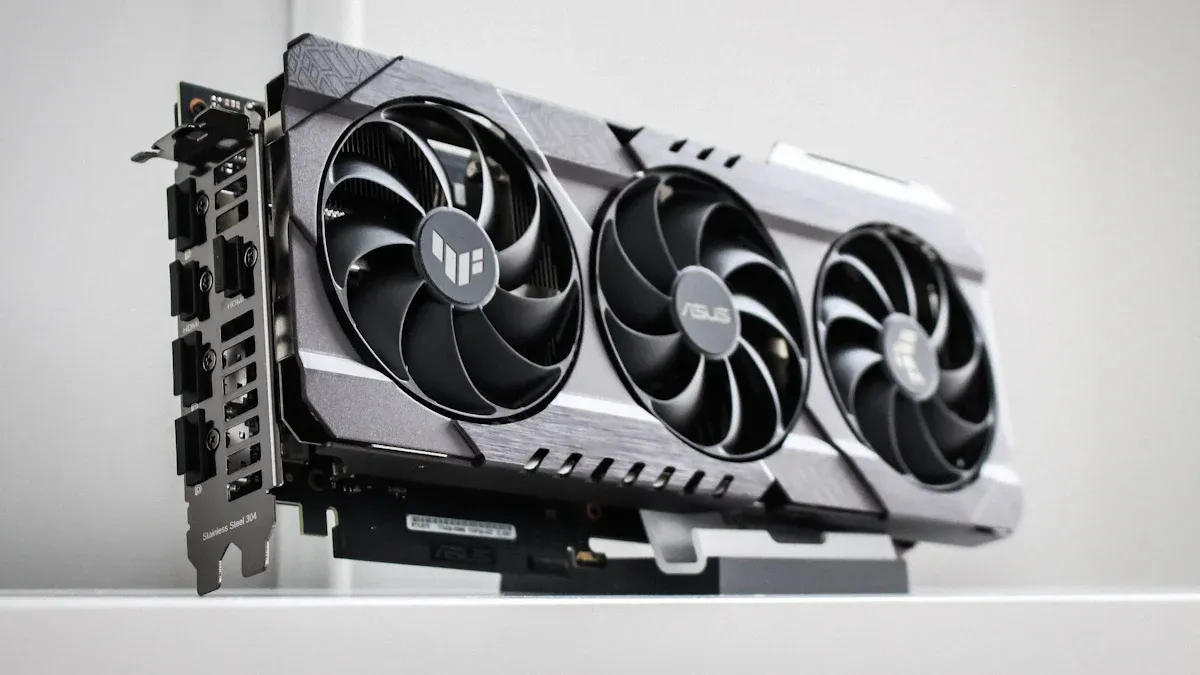
Image Source: unsplash
NVIDIA’s commercial empire is built on three core pillars: gaming, data centers, and professional applications. These three businesses not only demonstrate the company’s technological evolution path but also form the solid foundation of its current market leadership.
If you’re moving from “understanding the business” to “evaluating an investment,” close the loop with a simple workflow: start with BiyaPay’s Stock Lookup to review revenue mix, margins, and peer comparisons; if you prefer a small, staged entry, open the unified Trading Entry to watch order book depth and intraday volatility before scaling; for cross-market funding and fee transparency, see the website for multi-asset conversion and compliance notes.
Gaming Graphics Cards: The Starting Point and Cornerstone
The gaming business is NVIDIA’s starting point and the cradle of its technological innovation. The company’s GeForce series graphics cards have long been the top choice for gamers worldwide. It not only brings stable revenue and a huge user base to the company but, more importantly, provides a testing ground and driving force for developing more advanced computing technologies. Each iteration of the GeForce graphics cards pushes the boundaries of graphics technology.
Today, the latest GeForce RTX series graphics cards integrate multiple cutting-edge technologies, continuously defining the visual standards for PC gaming.
These technological innovations have established its absolute dominance in the graphics field:
- Architectural Foundation: Based on the advanced Ada Lovelace architecture, providing excellent energy efficiency.
- Ray Tracing: Using third-generation RT cores, specifically for hardware-accelerated real-time ray tracing, making light and shadow effects in game scenes infinitely close to the real world.
- AI Graphics: Using fourth-generation Tensor cores, focused on deep learning, supporting AI enhancement technologies like DLSS, which can significantly increase game frame rates without sacrificing image quality.
Data Centers: The Engine of the AI Era
If the gaming business is NVIDIA’s past and present, then the data center business defines its present and future. As the AI wave sweeps the world, high-performance computing chips for training and running large AI models have become the most scarce resource. NVIDIA’s GPUs, with their powerful parallel computing capabilities, have become the undisputed “arms” in this competition.
From H100 to the latest Blackwell architecture, its data center GPUs are the core engines driving the training of large language models for companies like OpenAI and Google. The explosive growth of this business has completely reshaped the company’s revenue structure.
| Fiscal Year | Data Center Revenue Share |
|---|---|
| 2023 | 55.63% |
| 2024 | 78.01% |
| 2025 | 88.27% |
The data shows that in fiscal year 2025, data center business revenue reached $115.19 billion, accounting for nearly 90% of total revenue, becoming the company’s absolute core. Its performance improvements are equally impressive, with the Blackwell architecture’s GB200 system achieving 3.4 times the single-GPU performance of the previous-generation H200 system when processing large language models, greatly shortening AI model training times.
Professional Applications: Empowering Various Industries
In addition to gaming and AI training, the company’s technology is creating value in a wide range of professional fields, demonstrating the breadth of its business.
Professional Visualization is its traditional strength. From film special effects production to architectural engineering design, NVIDIA RTX™ GPUs provide professionals with powerful rendering and simulation capabilities. In the past decade, all films nominated for the Oscar for Best Visual Effects used its GPU technology in production, which is enough to prove its benchmark status in the industry.
Automotive and Robotics is another rapidly growing segment. The company provides a full suite of solutions for smart vehicles, from in-car infotainment systems to autonomous driving computing platforms (DRIVE AGX). At the same time, its Jetson platform powers various autonomous robots. These emerging businesses are creating entirely new demand for GPUs.
| Business Segment | Q2’26 Revenue (million USD) | Year-over-Year Growth |
|---|---|---|
| Professional Visualization | 601 | 32% |
| Automotive/Robotics | 586 | 69% |
This data shows that the professional applications segment is in a high-growth channel, with strong sales of its autonomous driving platform and the launch of new-generation professional graphics cards opening up new growth curves for the company.
NVIDIA’s AI Evolution Path
Image Source: unsplash
NVIDIA’s ability to become the king of the AI era is no accident. Its success is not solely dependent on powerful chips but stems from its forward-looking judgment of technology trends, long-term strategic investments, and a combination punch that deeply binds hardware, software, and ecosystem. This evolution path clearly shows how it transformed from a hardware company into the definer of AI infrastructure.
Technological Foundation: The Parallel Computing Advantage of GPUs
The core of the AI revolution is data and computing power. AI models, especially deep learning models, involve massive matrix operations in their training process. The characteristic of this computing task is that it is simple, repetitive, and can be performed synchronously on a large scale. This perfectly matches the architectural design of GPUs.
CPUs (central processing units) are designed to handle complex serial tasks, with a few powerful cores excelling at logical judgment and general computing. GPUs (graphics processing units), on the other hand, have thousands of relatively small cores, inherently designed for parallel processing of massive data.
Simply put, a CPU is like an experienced professor who can solve various complex problems; a GPU is like a phalanx of thousands of students who can quickly complete a large number of simple calculations simultaneously.
The table below clearly shows the differences between the two in AI computing:
| Feature | CPU (Central Processing Unit) | GPU (Graphics Processing Unit) |
|---|---|---|
| Core Architecture | Few powerful cores | Thousands of cores optimized for parallelism |
| Processing Method | Sequential processing, suitable for single-threaded tasks | Parallel processing, suitable for multi-threaded tasks |
| AI Performance | Slower when handling large-scale deep learning tasks | Optimized for high-speed AI computing |
| Memory Bandwidth | Limited, designed for general computing | High bandwidth, efficiently handles large datasets |
Initially, developers used the general computing capabilities of GPUs to accelerate scientific computing. The company keenly captured this trend and began targeted optimizations at the hardware level. A milestone innovation was the introduction of Tensor Cores. This is a hardware unit specifically designed for AI matrix operations.
- The first-generation Tensor Cores in the V100 GPU improved deep learning performance by up to 5 times compared to the previous generation.
- With architectural evolution, the fourth-generation Tensor Cores in the Hopper architecture, combined with FP8 precision, achieved several times the performance leap over the previous generation when training trillion-parameter models.
This evolution from general parallel computing to dedicated AI hardware has given NVIDIA’s GPUs an unmatched hardware advantage in the AI computing power competition.
Ecosystem Moat: The Power of the CUDA Platform
If powerful GPUs are NVIDIA’s sharp sword, then the CUDA platform is its impregnable moat. CUDA (Compute Unified Device Architecture) is a parallel computing platform and programming model. It allows developers to directly harness the powerful computing power of GPUs using high-level languages like C++, without needing to understand complex underlying hardware.
The emergence of CUDA greatly lowered the barrier to GPU programming, attracting millions of developers worldwide to join in. This formed a positive cycle:
- Developers use CUDA to develop applications and algorithms.
- A massive number of applications and research results are built on the CUDA platform.
- New AI practitioners must choose NVIDIA GPUs that support CUDA to utilize these results.
- This further consolidates CUDA’s ecosystem position, making it difficult for competitors to catch up.
Centered on CUDA, the company has also built a vast software library and toolset called CUDA-X AI, covering almost all aspects of AI development.
- Basic Acceleration Libraries: For example
cuDNN(Deep Neural Network library) provides underlying acceleration for mainstream AI frameworks like TensorFlow and PyTorch;cuBLASis used to optimize linear algebra computations. - Advanced Solutions: For example,
TensorRTis used to optimize AI model inference performance, andTritonis a high-performance AI model deployment server.
Currently, over 400 libraries are built on CUDA, with over one million developers using this platform. Once developers become accustomed to this ecosystem, the migration cost becomes extremely high, transforming hardware advantages into an insurmountable ecosystem barrier.
Hardware-Software Integration: Providing Complete Solutions
NVIDIA’s ultimate strategy is to go beyond chip sales and provide a “full-stack” solution from hardware to software. It understands that customers need more than just a GPU; they need the ability to quickly solve problems and create value. To this end, it integrates its products into an organic whole.
This full-stack solution mainly includes:
- Hardware Layer:
- High-Performance GPUs: From consumer-grade RTX series to data center-grade Hopper and Blackwell architecture GPUs.
- Integrated Systems: For example, DGX supercomputers, which pre-integrate and optimize GPUs, networking, and storage, providing enterprises with “out-of-the-box” AI infrastructure.
- Edge Computing Platforms: For example, the Jetson series, providing AI computing power for terminal devices like autonomous driving and robotics.
- Software Layer:
- Core Platform: Based on CUDA.
- Enterprise Suite: NVIDIA AI Enterprise, which packages various AI tools and frameworks including TensorRT and Triton, and provides enterprise-level support, simplifying the development, deployment, and management of AI applications.
- Pre-trained Models and Services: Provides optimized pre-trained models and NIM (NVIDIA Inference Microservices) and other microservices, allowing enterprises to more conveniently build their own generative AI applications.
This “hardware + software + ecosystem” model means the company is no longer just a “shovel seller” but has become a partner that helps customers “mine gold.” By providing complete solutions, it deeply participates in the customer’s value creation process, thereby locking in its core position in the industry chain.
Future Layout: Investment Portfolio Analysis
NVIDIA’s ambitions go far beyond selling hardware. Through its venture capital arm NVentures, it is actively using capital to shape the future AI landscape. This investment strategy not only brings financial returns but, more importantly, aims to create a continuously expanding demand ecosystem for its chips.
Investing in AI Brains: Betting on Large Models
The company adopts a “cast a wide net” strategy, investing in multiple leading AI large model companies. This ensures that no matter which “AI brain” ultimately wins, its underlying infrastructure will be inseparable from NVIDIA’s computing power support.
This strategy is like an arms dealer funding all warring parties simultaneously, ensuring its weapons are always essential.
It was not only the main investor in Inflection AI’s $1.3 billion funding round in June 2023 but also participated in Cohere’s $270 million Series C funding. Its investment portfolio also includes star startups like Mistral AI. By supporting these “thinkers” in the AI field, the company deeply binds itself to the forefront of AI technology development.
Investing in AI Infrastructure: Consolidating the Computing Ecosystem
To give GPUs more places to shine, the company is also heavily investing in AI infrastructure. This includes directly purchasing and supporting companies that can consume large quantities of its chips.
A typical case is cloud service provider CoreWeave. This company’s cloud platform is entirely built on NVIDIA accelerators, and NVIDIA has also invested over $3 billion in it. In addition, the company is looking to the longer-term future, investing in companies like Redwood Materials, a battery recycling company, to address the huge energy challenges of future data centers.
Investing in AI Applications: Creating Future Demand
The ultimate goal of investment is to create new markets. The company actively supports application-oriented enterprises that can land AI technology, opening up entirely new application scenarios for its chips.
- Autonomous Driving: Invested in UK autonomous driving company Wayve, promoting the application of “embodied intelligence” in transportation.
- Robotics: Invested in humanoid robotics company Figure AI, which reached a valuation of $39 billion after receiving the investment.
- Biopharmaceuticals: Invested $50 million in drug development company Recursion Pharmaceuticals, using AI to accelerate new drug discovery.
These investments are injecting momentum into fields like autonomous driving, robotics, and life sciences, and every breakthrough in these fields means more demand for GPUs.
NVIDIA has long transcended the traditional definition of a “graphics card company.” Through its trinity strategy of “hardware sales, software ecosystem, and strategic investments,” it has successfully transformed from the gaming market to become the infrastructure company that defines and drives the entire AI era.
It is not only the current AI king but is also actively using its technology and capital to shape the future form of artificial intelligence.
*This article is provided for general information purposes and does not constitute legal, tax or other professional advice from BiyaPay or its subsidiaries and its affiliates, and it is not intended as a substitute for obtaining advice from a financial advisor or any other professional.
We make no representations, warranties or warranties, express or implied, as to the accuracy, completeness or timeliness of the contents of this publication.
Related Blogs of

A-Share Beginner’s Guide: Master Market Hours and Trading Rules in One Article


In-Depth Review: After ChiNext Dropped Over 1% and Rebounded, Who Will Be Tomorrow’s A-Share Leader?


Beginner’s Guide: What to Do When a Stock Hits Limit-Down? Can You Still Trade?


How to Wire Transfer USD from Industrial and Commercial Bank of China to OCBC Singapore? This Guide is All You Need

Choose Country or Region to Read Local Blog
 Australia
 Austria
 Belgium
 Canada
 Cyprus
 Czech Republic
 Denmark
 Estonia
 Finland
 France
 Germany
 Greece
 Hong Kong
 India
India Indonesia
 Ireland
 Italy
Italy Japan
Japan Latvia
 Lithuania
 Luxembourg
 Malaysia
 Malta
Malta Morocco
 Nepal
Nepal Netherlands
 New Zealand
 Norway
 Pakistan
 Philippines
 Poland
 Portugal
 Romania
 Singapore
 Slovakia
 Slovenia
 South Africa
 South Korea
 Spain
Spain Sweden
 Thailand
 The United States
 Turkey
 United Arab Emirates
 United Kingdom
 Vietnam
Contact Us




BIYA GLOBAL LLC is a licensed entity registered with the U.S. Securities and Exchange Commission (SEC No.: 802-127417); a certified member of the Financial Industry Regulatory Authority (FINRA) (Central Registration Depository CRD No.: 325027); regulated by the Financial Industry Regulatory Authority (FINRA) and the U.S. Securities and Exchange Commission (SEC).
BIYA GLOBAL LLC is registered with the Financial Crimes Enforcement Network (FinCEN), an agency under the U.S. Department of the Treasury, as a Money Services Business (MSB), with registration number 31000218637349, and regulated by the Financial Crimes Enforcement Network (FinCEN).
BIYA GLOBAL LIMITED is a registered Financial Service Provider (FSP) in New Zealand, with registration number FSP1007221, and is also a registered member of the Financial Services Complaints Limited (FSCL), an independent dispute resolution scheme in New Zealand.