



There are six main types of orders when trading digital currencies: Limit Order, Market Order, Advanced Limit, Take Profit & Stop Loss, Bi-directional Take Profit & Stop Loss, and Trailing Take Profit & Stop Loss.
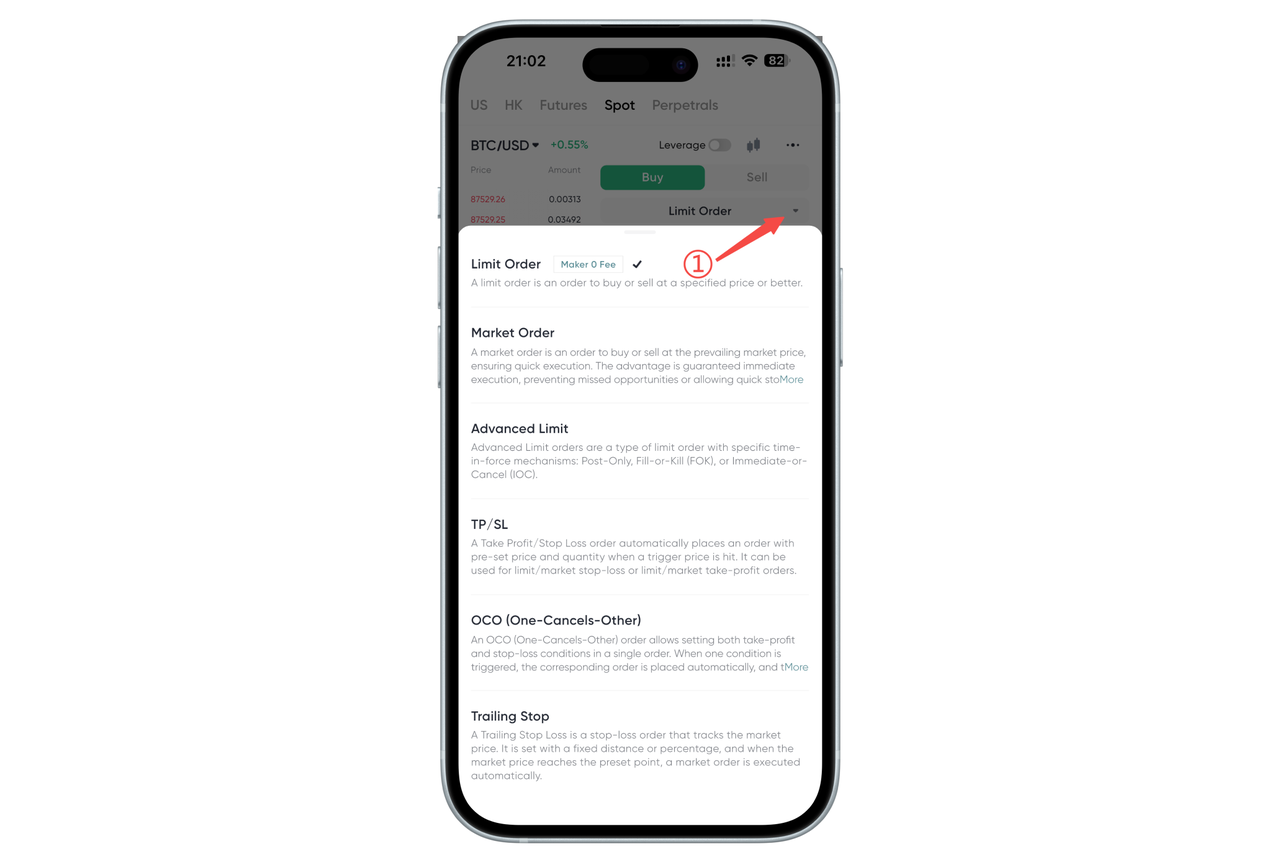
How to select digital currency spot trading order types on the App:
On the trading page, click the default Limit Order type to choose other order types.
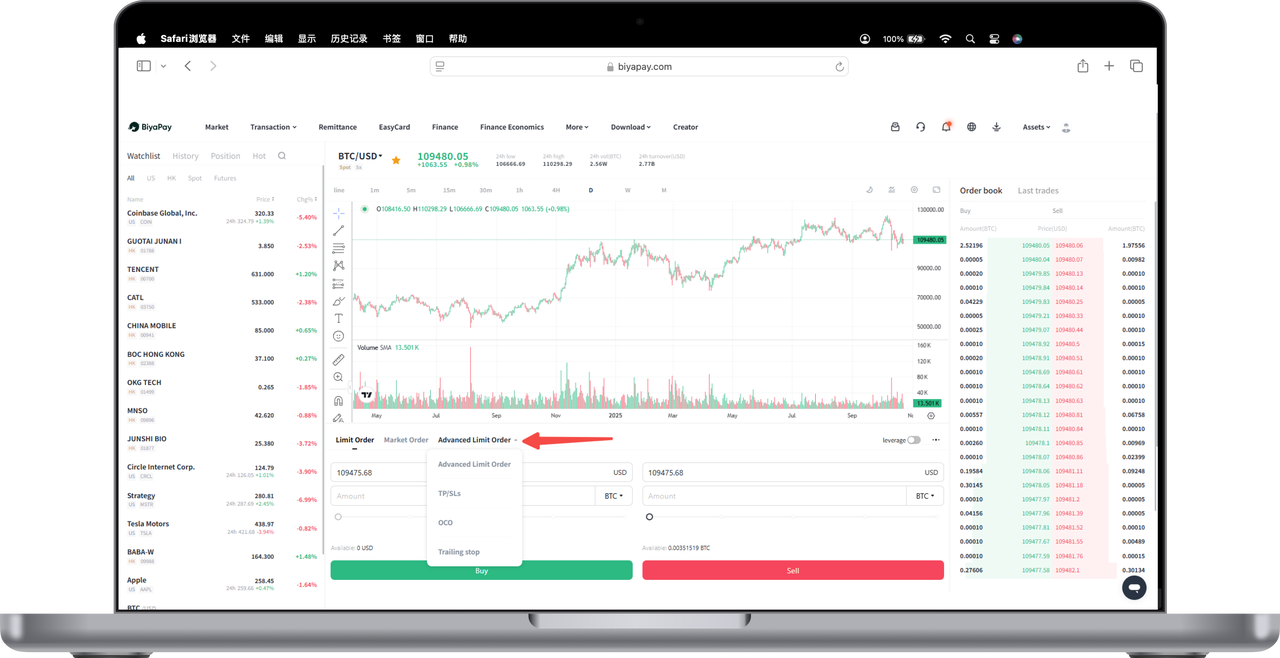
How to select digital currency spot trading order types on the Web:
On the trading page, click the default Advanced Limit Order type to choose other order types.
Below is a detailed introduction to the rules of these six order types:
1. Limit Order
A Limit Order is executed only when the price reaches a specified or better price.
2. Market Order
A Market Order is an order to buy or sell an asset immediately at the current market price.
3. Advanced Limit
Order freezing is based on limit order rules.
- Maker Only
Only placing orders; cannot take orders. The order enters the order book; if it would immediately match with an existing order, the order is canceled.
- Fill or Kill
If the order quantity is less than or equal to the currently available quantity for execution, it will be filled. If the order quantity is greater than the available quantity, it will be canceled.
- Immediate or Cancel
If the order is triggered, any partial fills are executed immediately, and the remaining quantity is canceled.
4. Take Profit & Stop Loss
A "Take Profit & Stop Loss" order means pre-setting a trigger price, and after triggering, the order price and quantity are set. When the latest price reaches the trigger price, an order will be placed at the preset order price, which can be a market or limit order. You can set only take profit, only stop loss, or both take profit + stop loss.
- Take Profit & Stop Loss Buy Orders. Can be executed by amount or quantity.
Assets are frozen immediately after placing the order. If the order price is market price and executed by quantity, the frozen amount equals trigger price × quantity. If the order price is limit price and executed by quantity, the frozen amount equals order price × quantity. If the order price is market price and executed by amount, the frozen amount is used to buy at the take profit or stop loss trigger price. If the available balance is insufficient after take profit & stop loss ends, buying is not possible.
- Take Profit & Stop Loss Sell Orders. Can only be executed by quantity.
Assets equal to the entered quantity are frozen immediately after placing the order. The order will be triggered and sold at whichever price is reached first: take profit trigger price or stop loss trigger price. After triggering, the order is placed. If the available balance is insufficient after take profit & stop loss ends, selling is not possible.
5. Bi-directional Take Profit & Stop Loss
- Bi-directional Take Profit & Stop Loss Buy Orders. Can be executed by amount or quantity.
The take profit trigger price must be below the market price, and the stop loss trigger price must be above the market price. Assets are frozen immediately after placing the order. If the order price is market price and executed by quantity, the higher trigger price is used as the standard, and the frozen amount equals trigger price × quantity. If the order price is limit price and executed by quantity, the higher order price is used as the standard, and the frozen amount equals order price × quantity. If the order price is market price and executed by amount, the frozen amount is used to buy at whichever trigger price is reached first: take profit or stop loss. After triggering, the order is placed. If the available balance is insufficient after take profit & stop loss ends, buying is not possible.
- Bi-directional Take Profit & Stop Loss Sell Orders. Can only be executed by quantity.
The take profit trigger price must be above the market price, and the stop loss trigger price must be below the market price. Assets equal to the entered quantity are frozen immediately after placing the order. The order will be triggered and sold at whichever price is reached first: take profit trigger price or stop loss trigger price. After triggering, the order is placed. If the available balance is insufficient after take profit & stop loss ends, selling is not possible.
6. Trailing Take Profit & Stop Loss
Trailing Take Profit & Stop Loss is a stop order that tracks market price. You pre-set a price distance or ratio, and when the market price reaches the preset point, a market order is automatically executed.
Trailing Take Profit & Stop Loss can only be market orders and can only be either take profit or stop loss, not both.
You can choose an activation price or not. If no activation price is chosen, the order is activated immediately after placing. If an activation price is chosen, the order is activated when the market price reaches or exceeds the activation price. Without activation, there is no trigger price.
Activation
-
If the activation price equals the latest transaction price at order placement, the order is activated immediately.
-
If the activation price is greater than the latest transaction price at order placement, the order is activated when the new latest transaction price ≥ activation price.
-
If the activation price is less than the latest transaction price at order placement, the order is activated when the new latest transaction price ≤ activation price.
Trigger
-
Buy: Latest price ≥ trigger price
-
Sell: Latest price ≤ trigger price
Trigger price calculation:
-
Buy: Lowest price + callback distance; Lowest price × (1 + callback ratio)
-
Sell: Highest price - callback distance; Highest price × (1 - callback ratio)
Trailing Take Profit & Stop Loss buy orders can only be by amount; sell orders can only be by quantity. Neither buy nor sell orders freeze assets.
After placing the order, the trigger price changes with the market price.
-
Buy trigger price = Historical lowest price - callback ratio
-
Sell trigger price = Historical highest price - callback ratio
If the buy/sell quantity or amount is sufficient, the order is executed according to the placed quantity. If the sell asset is insufficient, sell all available. If the buy amount is insufficient, buy all available.
Example: User sets to sell 1 BTC, but only has 0.5 BTC at trigger time, so sells 0.5 BTC.
User sets to buy BTC with 1000 USDT, but only has 500 USDT at trigger time, so buys 500 USDT.
Example 1 (Sharp Rise to Sell at Peak): User wants to sell BTC without choosing an activation price; the latest transaction price is 30,000. Parameters can be set as: [Callback Amount] 2,000, [Quantity] 1 BTC. After placing the order, if BTC rises to a high of 40,000 and then retraces to 38,000, reaching the callback condition (40,000 - 2,000 = 38,000), the system will help the user sell at market price at 38,000.
Example 2 (Sharp Drop to Buy at Bottom): User wants to buy BTC; the latest transaction price is 40,000. Parameters can be set as: [Callback Ratio] 5%, [Activation Price] 30,000, [Quantity] 1 BTC. After placing the order, if BTC drops to 30,000, the order is activated, then continues to drop to 20,000 and rebounds to 20,000 × (1 + 5%) = 21,000, reaching the callback condition (5%), the system will help the user buy at market price at 21,000.

联系我们



