What key points should be noted when sending money to Uruguay?




Image Source: unsplash
Whenremitting to Uruguay, you face a core challenge: how to find the best balance between cost, speed, and security? A successful remittance is far more than just funds arriving. It means the entire process is economical, efficient, and fully compliant.
You are not facing this process alone. In recent years,funds remitted to Uruguay have steadily increased, highlighting the importance of efficient remittances.
| Year | Remittance Amount (USD) |
|---|---|
| 2021 | 129,538,295 |
| 2022 | 136,015,210 |
| 2023 | 139,415,590 |
Key Takeaways
- Compare the total cost of remittance, includingfees and exchange rate spreads, to find the most cost-effective method.
- Choose the appropriate remittance channel, such as online services for fast speed, bank wire transfers for greater security, and cash pickup points for convenience without a bank account.
- Select regulated remittance providers and enable two-factor authentication to protect your funds.
- Prepare complete recipient information and your identity proof to ensure smooth remittance.
- Understand Uruguay’s receiving habits; directly remitting USD is usually simpler, and confirm if the recipient needs to pay local fees.
Remittance Costs: Fees and Exchange Rates

Image Source: pexels
When remitting to Uruguay, your primary concern is likely the cost. The real cost is not just the explicitly stated fee. It consists of two parts: open fees and hidden exchange rate spreads. Understanding both is the first step to saving expenses.
Compare Actual Exchange Rates
You first need to understand the “mid-market exchange rate.” This is the “real” rate used when banks and large institutions trade currencies. For example, the current mid-market rate might be 1 USD = 39.301 Uruguayan Pesos.
However, almost no remittance provider will give you this rate directly. They add a profit margin on top, offering a less favorable rate for you. This difference is a hidden cost.
Expert Tip: When comparing services, do not just look at advertised low fees. You should compare the provider’s offered rate with the real-time mid-market rate; the smaller the difference, the lower the hidden cost you actually pay.
Identify All Fees
Fees are usually more straightforward but come in various forms. You need to note the following types:
- Fixed Fees: A fixed amount charged regardless of how much you remit.
- Percentage Fees: Charged as a certain percentage of the remittance amount.
- Hybrid Fees: Combining fixed and percentage fees.
Some online platforms, such asXe, may not charge extra fees for $1,000 transfers with specific payment methods. But you still need to verify before confirming, as fees vary by payment method and amount.
Large Remittance Discounts: If you plan to remit over $25,000, many providers offer more competitive rates or dedicated support. Proactively contact them for consultation; you may get unexpected discounts.
Calculate Total Cost
To make the wisest choice, you should calculate the total cost of each remittance. A simple calculation method is:
Total Cost = Explicit Fees + Exchange Rate Spread Cost
Where “Exchange Rate Spread Cost” equals (Mid-Market Rate - Provider Rate) × USD Amount You Send.
Through this calculation, you will find that a service claiming “zero fees” may cost you more due to poor exchange rates. Always add up all fees and rate spreads to find the truly cost-effective option.
Before finalizing the total cost, take two quick steps: First, use BiyaPay’s exchange rate comparison tool to place the provider’s quote side by side with the mid-market rate, making the “spread” cost explicit. Second, pre-validate beneficiary details—such as the Uruguayan bank’s SWIFT/BIC and, where applicable, IBAN/account format—to reduce returns or delays caused by incomplete information.
If you need flexibility between USD and UYU, BiyaPay’s cross-border remittance route supports multi-currency conversion with transparent fees and timing shown before you confirm, making it straightforward to benchmark against bank wires or cash pickup services. Operating under multiple regulatory regimes (including U.S. MSB and New Zealand FSP registrations), BiyaPay suits users who want to balance cost and speed while remaining compliant.
Sending Money to Uruguay: Choosing the Best Channel
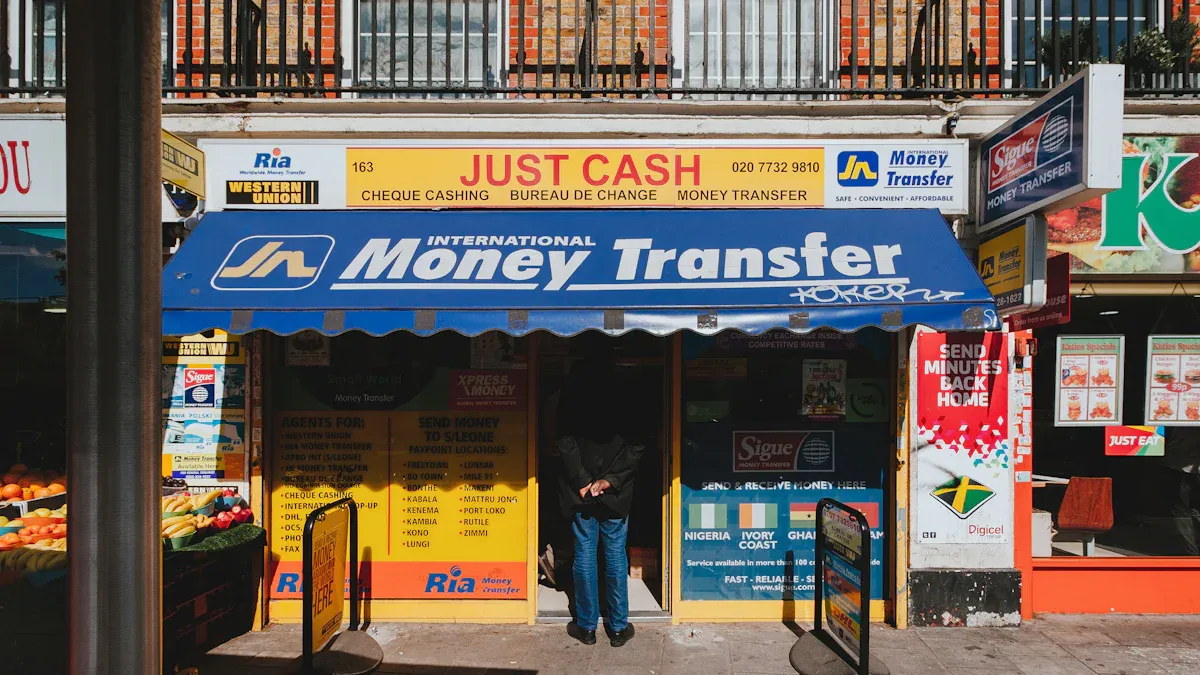
Image Source: unsplash
After understanding the cost structure, the next step is choosing the right remittance channel. Different channels have their pros and cons in speed, fees, and convenience. You need to choose based on your specific needs.
Traditional Bank Wire Transfer
Bank wire transfer is one of the most traditional and reliable methods. You can initiate the remittance through your regular bank, and funds will directly enter the recipient’s Uruguayan bank account.
- Advantages: High security, suitable for large transfers. The bank’s standardized process gives you peace of mind.
- Disadvantages: Usually the highest fees, and longer processing time, possibly 3-5 business days. Exchange rates are often less competitive than specialized remittance services.
Online Remittance Services
Online remittance platforms are currently the most popular choice, achieving a good balance in cost and speed. When using online services to remit to Uruguay, you can usually get better rates and lower fees.
These services are very fast. For example,XE Money Transfer states most transactions can be completed on the same day.Xoom even mentions funds can be deposited into the recipient’s Visa debit card in minutes. You just need to operate on the website or mobile app, which is very convenient.
Cash Agent Pickup Points
If your recipient does not have a bank account or needs cash urgently, remitting through cash agent pickup points is the best solution.
Applicable Scenarios: This option is ideal for providing emergency funds to family traveling in Uruguay or supporting relatives without bank access.
Providers like Ria Money Transfer have partner locations across Uruguay. Your recipient can pick up cash in minutes with valid ID and transaction code. However, this method’s fees and exchange rate costs are usually higher than online transfers.
Security Assurance: Compliance and Risk Prevention
Fund security is a link you absolutely cannot overlook when remitting to Uruguay. Choosing a reliable channel not only protects your funds but also ensures the entire process complies with regulations, avoiding unnecessary trouble.
Choose Regulated Institutions
Your first line of defense is selecting a remittance provider officially regulated. Being regulated means the institution must comply with strict operational and security standards.
In Uruguay,the financial system is open and transparent. Its core regulatory body is theCentral Bank of Uruguay (BCU), which oversees all banks and financial institutions to ensure market stability and consumer fund safety. Choosing services regulated by BCU or equivalent institutions in your region provides solid protection for your remittance.
Beware of Remittance Scams
Cyber fraud methods are endless, and financial transactions are their main target. You need to proactively protect your account information. A reliable remittance platform provides advanced security features to help you.
Security Tip: EnableTwo-Factor Authentication (2FA) 2FA adds an extra layer of security to your account. Even if someone steals your password, they cannot log in without the second verification. When choosing a service, confirm it supports at least one of the following 2FA methods:
- SMS Verification Code: Sends a one-time password to your phone.
- Authenticator App: Uses apps like Google Authenticator to generate dynamic passwords.
- Biometric Verification: Logs in via fingerprint or facial recognition.
Understand Remittance Limits
Remittance limits mainly fall into two categories: government regulations for anti-money laundering (AML) purposes and the provider’s own business restrictions.
According to Uruguayan AML regulations, banks and institutions mustrecord transactions over $10,000. For transactions involving lawyers or real estate agents, additional reporting may be required over $15,000.
Meanwhile, each remittance provider has its own limits. For example,XE.com allows online remittances up to $535,000. These limits are usually far higher than daily personal needs, but for large transfers, confirm with the provider in advance.
Preparation: Required Documents and Information
Before initiating a remittance, thorough preparation ensures the process goes smoothly. Accurate information and complete documents are the foundation of successful remittance, effectively avoiding delays or failures due to errors.
Recipient Core Information
To ensure funds accurately reach the recipient, you need to provide clear and complete recipient information. Be sure to verify the following details with the recipient:
- Recipient Full Name: Must exactly match the name on their bank account.
- Recipient Address: Complete residential address.
- Bank Name: Full name of the Uruguayan bank where the recipient’s account is held.
- Bank Account Number: The recipient’s bank account number.
- SWIFT/BIC Code: This is the international standard code to identify the bank, usuallyconsisting of 8 to 11 characters, specifying country, city, bank, and specific branch.
Sender Identity Proof
As the sender, you also need to prove your identity. This is part of the AML and KYC procedures all compliant institutions must follow. Usually, you need to provide a valid government-issued ID, such as:
- Driver’s license
- Passport
For online remittances, you may need to upload clear scans or photos of these documents.
Declare Remittance Purpose
You must clearly declare the remittance purpose. For personal remittances, this may be simple, such as “family living expenses,” “gift,” or “travel expenses.” However, when remitting to Uruguay for business purposes, it becomes much more complex.
Business Remittance Special Tip: Business payments require detailed authenticity proof documents, such as business contracts, invoices, and a completed “Foreign Remittance Application Form.” Uruguay uses a mandatory electronic invoice system called CFE; you may need to provide e-Invoice or Export e-Invoice. For high-value trade, letters of credit (L/C), though complex, provide higher payment assurance.
Additionally, if remitting for purchasing controlled items like medicines, you may need to provide local import permits in Uruguay.
Local Receiving Notes in Uruguay
After successfully sending funds, ensuring the recipient smoothly receives them in Uruguay is equally important. Understanding local receiving habits and regulations helps your recipient avoid unnecessary trouble and get funds quickly.
Currency Choice: USD or Pesos
You need to know that Uruguay has a highly dollarized economy. USD is widely used in daily transactions, savings, and pricing. Therefore, when remitting, you can usually choose between USD and Uruguayan Pesos (UYU).
Practical Advice: Directly remitting USD is usually the simpler and more popular choice. This avoids the recipient’s secondary currencyconversion at a local bank, saving conversion fees and locking in fund value.
If your recipient needs Uruguayan Pesos immediately, you can choose to remit Pesos directly. But be sure to compare the provider’s USD to Pesos rate for competitiveness.
Local Bank Requirements
To ensure funds credit smoothly, your recipient needs some preparation. Remind them to note the following:
- Account Status: Ensure the receiving bank account is active and in good standing.
- Receiving Fees: Some Uruguayan banks may charge a small fee for receiving international remittances. The recipient should consult their bank in advance.
- Large Amounts: For larger remittances, the bank may temporarily freeze funds for verification, requiring the recipient to provide a source of funds explanation.
Potential Tax Issues
Good news: your recipient usually does not need to pay taxes on received personal remittances.
💡 Tax Knowledge:Uruguay’s tax system follows the territorial principle. This means the government only taxes income generated within its territory. Since personal remittances come from abroad, they are not considered taxable income in Uruguay.
This tax policy provides great convenience for family remittances. Your relatives and friends can receive the full amount you send without worrying about fund reduction due to taxes.
Remitting to Uruguay can be very simple. Before clicking “send,” use this final checklist to quickly verify:
- Compare Total Cost: Calculate fees and exchange rate spreads.
- Confirm Remittance Speed: Choose a channel meeting your timing needs.
- Verify Institution Credentials: Ensure the provider is officially regulated.
- Prepare Accurate Information: Double-check all recipient and your details.
- Understand Local Regulations: Confirm currency choice and receiving requirements.
Thorough preparation makes your remittance process efficient and smooth. Following this guide, you can easily complete every remittance to Uruguay.
FAQ
What Is the Fastest Way to Send Money to Uruguay?
Online remittance services are usually the fastest. Some services can even deposit funds into the recipient’s bank account or debit card in minutes. Cash pickup services are also quick, suitable for emergencies.
How to Ensure the Best Exchange Rate?
Before remitting, compare different providers. Contrast their offered rates with the real-time “mid-market rate.” The smaller the difference, the better the rate you get.
Does the Recipient in Uruguay Need to Pay Fees to Receive Remittances?
It depends on the recipient’s bank. Some Uruguayan banks may charge a small fee for receiving international remittances. Suggest your recipient consult their bank for specific fee policies.
Are There Amount Limits for Remittances to Uruguay?
Yes. Uruguayan regulations require recording transactions over $10,000. Also, each remittance provider has its own per-transaction or daily limits; confirm with the provider before remitting.
*This article is provided for general information purposes and does not constitute legal, tax or other professional advice from BiyaPay or its subsidiaries and its affiliates, and it is not intended as a substitute for obtaining advice from a financial advisor or any other professional.
We make no representations, warranties or warranties, express or implied, as to the accuracy, completeness or timeliness of the contents of this publication.
Related Blogs of

US Stock Broker Opening Guide: Fees, Security, and App Experience Comparison (Futu vs Tiger vs Firstrade)


In-Depth Analysis of US GDP: Comprehensive Insights from Consumption to Investment


US-China Trade War Enters New Phase: How the Tech Industry Can Respond to Supply Chain Impacts


2026 Latest US Stock Broker Review: Which is Better in Features and Fees - IB, Futu, or Tiger Securities
Choose Country or Region to Read Local Blog
 Australia
 Austria
 Belgium
 Canada
 Cyprus
 Czech Republic
 Denmark
 Estonia
 Finland
 France
 Germany
 Greece
 Hong Kong
 India
India Indonesia
 Ireland
 Italy
Italy Japan
Japan Latvia
 Lithuania
 Luxembourg
 Malaysia
 Malta
Malta Morocco
 Nepal
Nepal Netherlands
 New Zealand
 Norway
 Pakistan
 Philippines
 Poland
 Portugal
 Romania
 Singapore
 Slovakia
 Slovenia
 South Africa
 South Korea
 Spain
Spain Sweden
 Thailand
 The United States
 Turkey
 United Arab Emirates
 United Kingdom
 Vietnam
Contact Us




BIYA GLOBAL LLC is a licensed entity registered with the U.S. Securities and Exchange Commission (SEC No.: 802-127417); a certified member of the Financial Industry Regulatory Authority (FINRA) (Central Registration Depository CRD No.: 325027); regulated by the Financial Industry Regulatory Authority (FINRA) and the U.S. Securities and Exchange Commission (SEC).
BIYA GLOBAL LLC is registered with the Financial Crimes Enforcement Network (FinCEN), an agency under the U.S. Department of the Treasury, as a Money Services Business (MSB), with registration number 31000218637349, and regulated by the Financial Crimes Enforcement Network (FinCEN).
BIYA GLOBAL LIMITED is a registered Financial Service Provider (FSP) in New Zealand, with registration number FSP1007221, and is also a registered member of the Financial Services Complaints Limited (FSCL), an independent dispute resolution scheme in New Zealand.