Analysis of the Influencing Factors and Trends of the Exchange Rate of the US Dollar against the Offshore Chinese Yuan




Image Source: pexels
The current global economic environment is complex and volatile, with the USD to offshore CNH exchange rate (USD/CNH) experiencing significantly heightened fluctuations. Its trajectory is not determined by a single factor.
Exchange rate fluctuations result from the interplay of multiple forces. External USD strength cycles and internal Chinese economic fundamentals together form its core drivers. Additionally, market sentiment and policy expectations also significantly influence the short-term direction of the exchange rate.
Key Takeaways
- The USD to offshore CNH exchange rate is influenced by multiple factors, including USD strength cycles and Chinese economic fundamentals.
- The Federal Reserve’s monetary policy and US economic data, such as inflation and employment, directly affect the USD’s value.
- China’s stable economic growth and trade surplus provide critical support for the CNH exchange rate.
- US-China interest rate differentials and geopolitical conflicts impact capital flows and market sentiment, thereby altering the exchange rate.
- Future exchange rates will exhibit two-way fluctuations, requiring businesses and investors to actively manage risks rather than focusing solely on one-sided trends.
Core External Drivers: USD Cycle and Global Risks
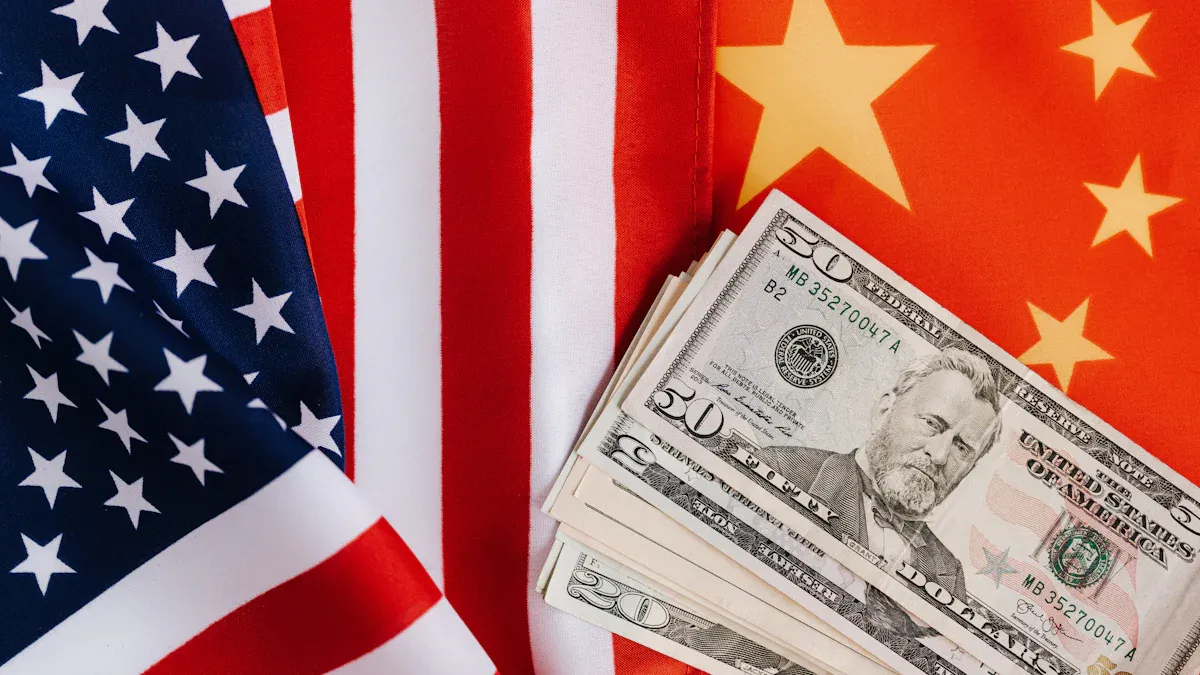
Image Source: pexels
As the world’s primary reserve and settlement currency, the USD’s strength cycle acts as a “master switch” influencing global asset prices. Therefore, analyzing fluctuations in the USD to offshore CNH exchange rate must begin with its external core drivers—USD cycles and global risks. These external factors collectively shape the global supply and demand for the USD and its value trajectory.
Federal Reserve Monetary Policy and Interest Rate Expectations
The Federal Reserve’s monetary policy is the most direct factor influencing the USD’s value. Changes in interest rates directly alter the cost and return of holding USD, guiding the direction of global capital flows.
Every decision by the Fed tugs at the nerves of global markets. Its policy stance, interest rate changes, and forward guidance collectively form the basis of market expectations.
Currently, the Fed’s policy stance and market expectations for the future exhibit the following characteristics:
- Dovish Policy Stance: The Fed’s current monetary policy leans dovish. To address economic changes, it has cut rates by a cumulative 1% in the second half of 2024.
- Interest Rate Path Monitoring: Entering 2025, due to uncertainties in tariff policies and inflation remaining above target, the Fed opted to keep rates unchanged early in the year. However, with weakening labor market data, Chair Powell described the September 17, 2025, rate cut as a “risk management cut.”
- Balance Sheet Reduction: The Fed is simultaneously reducing its bond holdings, with its balance sheet shrinking from a 2022 peak of nearly $9 trillion to $6.6 trillion.
- Strong Market Expectations for Rate Cuts: Markets widely expect the Fed to continue its rate-cutting path. Data shows an 89% likelihood of a 0.25% rate cut at the October 2025 meeting, with further cuts likely in December.
These dovish signals and expectations increase the USD supply, reducing its attractiveness and exerting downward pressure on the USD exchange rate.
USD Index (DXY) Strength Cycle
The USD Index (DXY) is a composite measure of the USD’s exchange rate against a basket of major currencies, directly reflecting its relative strength in global markets. DXY’s cyclical fluctuations profoundly impact all non-USD currencies, including the CNH.
Looking back at recent years, the DXY has shown significant cyclical characteristics:
- Historical Highs: The DXY hit peaks in 2022 and earlier this year, reaching levels two standard deviations above its 20-year moving average.
- Recent Significant Weakness: In the first half of this year, the DXY performed exceptionally poorly, losing approximately 11%. This marks the worst start since the 1970s and the largest six-month decline since 2017.
The DXY’s strength transitions typically align with global economic cycles and Fed policy cycles. When the DXY enters a downward phase, it generally indicates USD weakness relative to other currencies, creating room for appreciation in currencies like the CNH.
US Key Economic Data Interpretation
US economic data is a critical basis for the Fed’s monetary policy decisions and serves as a “barometer” for market assessments of the US economy’s health. Inflation data (CPI, PPI) and employment data (Non-Farm Payrolls) are particularly crucial.
- Inflation Indicators: The Consumer Price Index (CPI) measures price changes at the consumer level, while the Producer Price Index (PPI) tracks price changes from the producer perspective. PPI is often a leading indicator for CPI, as production cost changes eventually pass through to consumers.
- Labor Market Signals: Recent employment data shows a cooling US labor market. In August 2025, US Non-Farm Payrolls added only 22,000 jobs, far below the market’s expectation of 75,000. Additionally, data for the prior two months was revised downward.
- Sectoral Divergence: Job growth was concentrated in healthcare and social assistance.
- Layoffs in Some Sectors: Federal government, mining, wholesale trade, and manufacturing saw declines in employment.
Weak economic data, particularly a cooling labor market, reinforces market expectations for Fed rate cuts, pressuring the USD and benefiting non-USD currencies.
Geopolitical Conflicts and Market Safe-Haven Sentiment
Changes in the global geopolitical landscape are another key variable affecting exchange rates. When international relations tense or regional conflicts erupt, market uncertainty spikes. In such environments, global investors tend to shift funds to assets considered “safe havens.”
Due to its unique global status, the USD typically serves as the primary safe-haven currency during crises. Thus, heightened geopolitical risks often trigger safe-haven sentiment, leading to capital inflows into USD assets, pushing up the USD exchange rate in the short term and exerting depreciation pressure on emerging market currencies like the CNH.
Internal Factors Affecting the USD to Offshore CNH Exchange Rate
Unlike external factors driven by global macroeconomics and monetary policy, internal forces affecting the exchange rate are rooted in China’s economic health, capital flow patterns, and policy orientation. These internal factors collectively form the intrinsic support for the CNH’s value. Notably, the offshore CNH market, with its more internationalized participants and fewer regulations, typically reacts more swiftly and sensitively to capital flows and investor sentiment than the onshore CNY market.
China’s Economic Fundamentals and Growth Resilience
A country’s economic fundamentals are the fundamental determinant of its currency’s value. Robust economic growth, strong industrial output, and active business activity boost investor confidence, providing solid support for the domestic currency.
Economic data is the thermometer of fundamental health. Recently released macroeconomic data shows China’s economy exhibiting considerable resilience.
- GDP Growth Exceeds Expectations: In Q3 2025, China’s economy grew 1.1% quarter-on-quarter, significantly above the market’s expected 0.8%. The first and second quarters also recorded steady growth of 1.2% and 1.0%, respectively.
- Accelerating Industrial Output: Industrial added value is the economy’s “engine.” In September 2025, this figure rose 6.5% year-on-year, surpassing the previous 5.2% and market expectations of 5.0%. A 0.64% month-on-month increase marked a seven-month high.
- Manufacturing Sentiment: Although the official manufacturing PMI in September 2025 was 49.80, below the expansion-contraction line, strong industrial output provides robust economic support.
These data indicate that, despite external challenges, China’s economic engine maintains strong momentum. This fundamental resilience forms a critical foundation for CNH exchange rate stability, effectively countering some external pressures.
US-China Interest Rate Differential and Cross-Border Capital Flows
Interest rate differentials are a core driver of global capital flows. When US interest rates exceed China’s, a “US-China interest rate inversion” occurs. This may prompt capital outflows from China to seek higher returns in USD-denominated assets, pressuring the CNH exchange rate.
In recent years, foreign direct investment (FDI) inflows to China have slowed. Balance of payments data shows net FDI inflows dropped from a 2021 peak of $344 billion to $18.6 billion in 2024. However, cross-border capital flows are complex, with portfolio investments (e.g., stocks and bonds) also critical. EPFR data indicates increased volatility in fund flows tracking Chinese markets, reflecting cautious sentiment among some long-term asset managers.
| Indicator | Latest Value | Unit | Reference Date |
|---|---|---|---|
| Capital Flows | -1369.75 | USD Billion | June 2025 |
The table shows that the capital account recorded a net outflow in Q2 2025. However, China’s vast financial market remains attractive. As of the end of 2024, China’s bond market was worth $24.6 trillion, the second largest globally, with foreign investors holding approximately $578.7 billion in CNH bonds, indicating persistent global allocation demand.
Central Bank Reference Rate and Policy Signals
The People’s Bank of China (PBOC) sets a daily USD/CNY reference rate, a core tool for managing exchange rate expectations. The reference rate’s setting and its deviation from market forecasts are interpreted as the official stance on exchange rate levels and volatility.
Since August 2023, the PBOC has significantly strengthened exchange rate management. By consistently setting stronger reference rates, it aims to stabilize market expectations and prevent a one-sided depreciation mindset. This indicates that, during certain periods, exchange rate stability is a priority policy goal.
| Date | PBOC Reference Rate | Market Expectation | Difference |
|---|---|---|---|
| September 10, 2025 | 7.1062 | 7.1359 | Significantly Stronger |
As shown, the PBOC set the reference rate at 7.1062, well below the market’s expected 7.1359. Analysts view this as the PBOC setting a “floor” for the CNH, signaling determination to control volatility and maintain currency stability.
Trade Policy and Export-Import Performance
Trade surplus is a traditional pillar supporting the CNH exchange rate. When China’s exports exceed imports, businesses earn significant foreign currency, which they convert into CNH for domestic operations, increasing CNH demand and boosting its value.
China has consistently maintained a large trade surplus in recent years.
- 2023 Trade Surplus: $386.04 billion
- 2022 Trade Surplus: $577.85 billion
- As of September 2025, monthly trade surplus: $90.45 billion
However, trade policy, particularly tariffs, is a key variable affecting the USD to offshore CNH exchange rate. Historical data shows a strong correlation between tariffs and exchange rates.
The chart clearly illustrates that from 2018-2020, as the US effective tariff rate on Chinese exports (bar chart) rose, the USD/CNH rate (line chart) also increased, indicating CNH depreciation. For example, when tariffs peaked at 21% in September 2019, the USD/CNH rate broke above 7.2.
In 2025, trade tensions escalated again. The US significantly raised tariffs multiple times, reaching a staggering 104% total rate, directly pushing the USD/CNH rate to a historic low of 7.42855. While CNH depreciation can partially offset tariff impacts on export prices, it poses other economic challenges. In response, the PBOC manages depreciation pace through reference rate adjustments to balance export competitiveness and financial stability.
Future Trends and Risk Scenarios
Image Source: unsplash
Looking ahead, the USD to offshore CNH exchange rate’s path is not linear but the result of multiple forces. Short-term fluctuations and long-term trends will be driven by different dominant factors, with markets needing to remain vigilant for various potential risks.
Short-Term Trend Forecast (3-6 Months)
Over the next 3 to 6 months, the exchange rate market is expected to remain highly volatile. Ongoing US-China tariff conflicts are the primary source of volatility, with any tariff adjustments likely to trigger sharp market reactions. Investors will closely monitor the following key economic events and data releases:
- China’s Key Data: China’s Q3 GDP and non-manufacturing PMI data will be critical indicators of economic health.
- Central Bank Policy Moves: The Fed’s rate cut decisions and whether the PBOC adjusts its “moderately loose” monetary policy will directly impact interest rate differentials and capital flow expectations.
The outcomes of these events will collectively determine short-term market sentiment and the exchange rate’s fluctuation range.
Long-Term Trend Outlook (1-2 Years)
From a 1- to 2-year perspective, the exchange rate’s trajectory will increasingly revert to the relative strength of the two economies’ fundamentals. China’s economic resilience provides fundamental support for the CNH.
Economists believe that sustained policy support, more flexible exchange rate management, and a commitment to high-quality development collectively form a stable foundation for the CNH’s value.
Exports grew year-on-year in the first half despite tariff pressures, demonstrating China’s strong adaptability. As long as China maintains steady growth, its fundamental strengths will help offset external pressures, ensuring long-term CNH stability.
Potential Upside Risk Analysis
The USD/CNH exchange rate faces significant upside risks, meaning the CNH faces depreciation pressure. These risks primarily stem from external environmental changes.
- Fed Turning Hawkish: If US inflation data consistently exceeds expectations, it could force the Fed to adopt a more hawkish stance than markets anticipate, boosting the USD.
- Escalating Trade Tensions: If geopolitical negotiations falter or the US threatens further tariff hikes, it will directly impact market sentiment, triggering safe-haven flows into the USD and pushing up the USD/CNH rate.
Potential Downside Risk Analysis
Meanwhile, factors could drive the USD/CNH rate downward, presenting appreciation opportunities for the CNH.
- Fed Accelerating Easing: If US economic data, particularly the labor market, deteriorates sharply, it could prompt the Fed to initiate a more aggressive rate-cutting cycle. This would significantly weaken the USD’s appeal.
- US Economic Recession: A sharp US economic downturn or recession could lead global capital to reassess the safety of USD assets, potentially causing significant CNH appreciation relative to the USD.
Overall, short-term fluctuations in the USD to offshore CNH exchange rate are more constrained by US-China monetary policy divergence and market sentiment, while the long-term direction depends on the relative strength of the two economies’ fundamentals.
Historical experience suggests that two-way exchange rate fluctuations will be the norm, and businesses and investors must abandon one-sided thinking. Facing uncertainty, proactive risk management is critical.
When building a hedging or conversion plan, prioritize “data accuracy” and “execution simplicity.” BiyaPay, a multi-asset wallet for cross-border payments and asset management, provides practical, FX-oriented tools: start with the Currency Converter to assess real-time USD/CNH moves and implied costs, then align execution with the macro catalysts discussed in this article; if your workflow involves cross-border payables/receivables, place the order directly via Remittance to avoid discrepancies from switching platforms; to verify beneficiary bank identifiers, use BiyaPay’s SWIFT Lookup.
Operationally, BiyaPay emphasizes correctness up front: validation of critical fields (beneficiary name, SWIFT/ABA, account number) and guided steps help reduce returns caused by formatting errors or missing details. For treasury teams that monitor FX continuously, keeping rate checks and execution in one workflow can lower manual reconciliation costs.
BiyaPay operates across multiple jurisdictions under relevant registrations (including US MSB and New Zealand FSP), making it suitable for teams that need to handle funds and information prudently amid volatile markets.
- Use financial derivatives (e.g., forwards and options) for hedging.
- Closely monitor key economic data releases and policy changes to address sudden volatility.
FAQ
What’s the Difference Between Offshore CNH and Onshore CNY?
Offshore CNH is traded outside mainland China. It is more influenced by international capital flows and market sentiment, with higher volatility. Onshore CNY is traded within mainland China, with its exchange rate subject to stricter guidance and management.
Why Do Fed Interest Rate Decisions Affect the CNH Exchange Rate?
Fed rate hikes increase the appeal of USD assets. Global capital tends to flow to the US for higher returns, increasing depreciation pressure on the CNH. Conversely, Fed rate cuts weaken the USD, providing appreciation room for the CNH.
How Do Tariffs Affect the USD to Offshore CNH Exchange Rate?
Tariffs increase the cost of Chinese exports. The market may push for CNH depreciation to partially offset this impact. Depreciation makes Chinese goods cheaper in USD terms, helping maintain export competitiveness.
Will the CNH Continue to Depreciate?
A sustained one-sided exchange rate trend is unlikely. Short-term fluctuations are influenced by US-China policies and market sentiment. Long-term direction depends on the relative strength of the two economies’ fundamentals. Analysts suggest two-way fluctuations will be the norm, and businesses and investors should manage risks effectively.
*This article is provided for general information purposes and does not constitute legal, tax or other professional advice from BiyaPay or its subsidiaries and its affiliates, and it is not intended as a substitute for obtaining advice from a financial advisor or any other professional.
We make no representations, warranties or warranties, express or implied, as to the accuracy, completeness or timeliness of the contents of this publication.
Related Blogs of

2025 Taiwan Stock Market Year-End Review and 2026 Outlook: Can the AI Boom Continue?


Say Goodbye to Panic: Master the Winning Rules for Stock Investing in a Bear Market


Say Goodbye to Bank Queues: Latest 2025 Bank of China App Guide for Converting Cash to Exchange

Understand the Core Differences Between the Nasdaq Composite Index and Nasdaq 100 Index in One Article
Choose Country or Region to Read Local Blog
 Australia
 Austria
 Belgium
 Canada
 Cyprus
 Czech Republic
 Denmark
 Estonia
 Finland
 France
 Germany
 Greece
 Hong Kong
 India
India Indonesia
 Ireland
 Italy
Italy Japan
Japan Latvia
 Lithuania
 Luxembourg
 Malaysia
 Malta
Malta Morocco
 Nepal
Nepal Netherlands
 New Zealand
 Norway
 Pakistan
 Philippines
 Poland
 Portugal
 Romania
 Singapore
 Slovakia
 Slovenia
 South Africa
 South Korea
 Spain
Spain Sweden
 Thailand
 The United States
 Turkey
 United Arab Emirates
 United Kingdom
 Vietnam
Contact Us




BIYA GLOBAL LLC is a licensed entity registered with the U.S. Securities and Exchange Commission (SEC No.: 802-127417); a certified member of the Financial Industry Regulatory Authority (FINRA) (Central Registration Depository CRD No.: 325027); regulated by the Financial Industry Regulatory Authority (FINRA) and the U.S. Securities and Exchange Commission (SEC).
BIYA GLOBAL LLC is registered with the Financial Crimes Enforcement Network (FinCEN), an agency under the U.S. Department of the Treasury, as a Money Services Business (MSB), with registration number 31000218637349, and regulated by the Financial Crimes Enforcement Network (FinCEN).
BIYA GLOBAL LIMITED is a registered Financial Service Provider (FSP) in New Zealand, with registration number FSP1007221, and is also a registered member of the Financial Services Complaints Limited (FSCL), an independent dispute resolution scheme in New Zealand.