How Much Is the Bank of China Cash to Spot Exchange Fee? Comprehensive Money-Saving Techniques Revealed




Image Source: pexels
You may be looking for the fixed handling fee rate when handling Bank of China cash to spot exchange business.
Please Note: This fee is not a fixed percentage. It actually stems from the spread between the bank’s “cash buying rate” and “spot buying rate,” which is usually between 1% and 3%.
Understanding this hidden cost is the first step to saving money for you. Mastering its calculation method and rules can help you effectively reduce unnecessary expenses.
Key Points
- Bank of China cash to spot exchange has no fixed handling fee; the fee comes from the spread between the bank’s “cash buying rate” and “spot buying rate.”
- You can calculate the fee using the formula “Fee Amount = (Spot Buying Rate - Cash Buying Rate) × Foreign Currency Cash Amount.”
- The most money-saving method is to decide whether conversion is needed based on foreign currency usage; if only for cash deposit/withdrawal, no conversion is required.
- The daily cash to spot exchange amount cannot exceed the equivalent of $5,000 USD; exceeding requires proof of source, and do not split transactions.
- When handling business, prepare valid ID; you can choose counter or smart counter.
Cash to Spot Exchange Fee: Fee Structure and Calculation
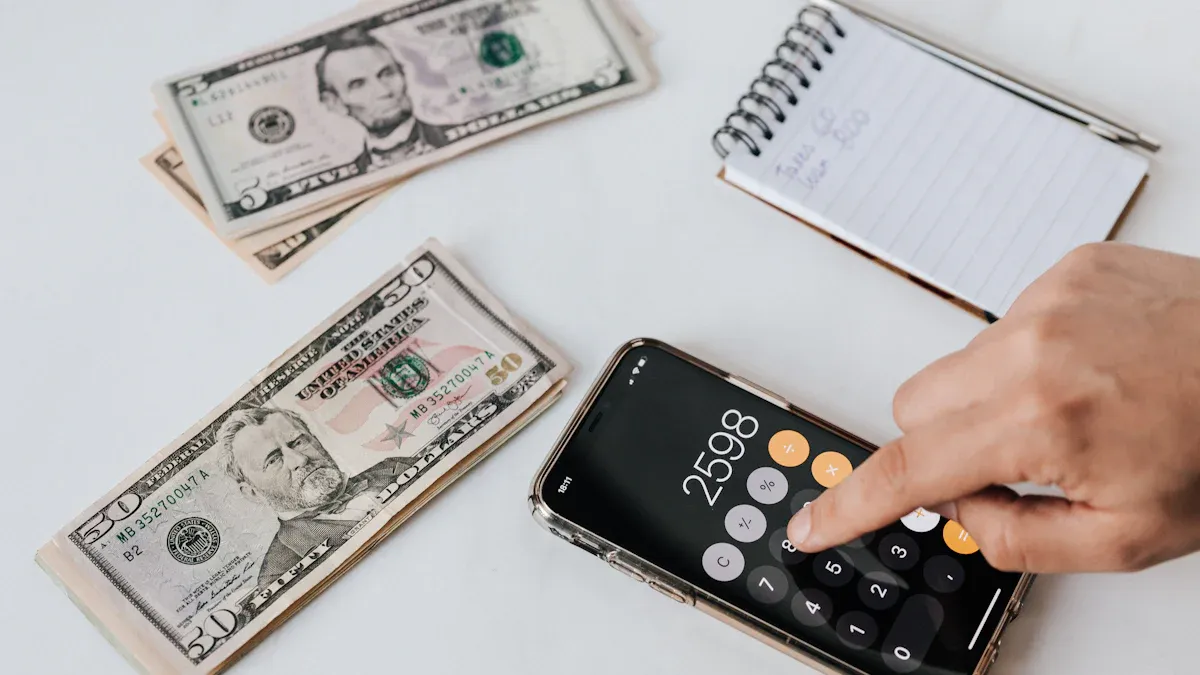
Image Source: pexels
The true nature of this “fee” is actually a spread in the bank’s foreign exchange rates. Understanding this spread allows you to take control of the costs.
Core: Spread Between Cash Buying Rate and Spot Buying Rate
When you deposit foreign currency cash into the bank, the bank uses the “cash buying rate” for calculation. If you want to convert this money into freely transferable “spot exchange,” the bank is essentially “buying” this money from you at the “spot buying rate” and depositing it as remittance.
Cash Buying Rate is always lower than Spot Buying Rate. This spread is the actual cost you bear.
Why Is There This Spread?
Banks incur additional costs and risks when handling foreign currency cash, which are reflected in the prices. Main reasons include:
- Physical Costs: Banks need to pay for transportation, storage, insurance, and anti-counterfeiting verification to manage physical currency.
- Capital Occupation: Foreign currency cash in inventory cannot generate interest like electronic remittances, occupying bank funds.
- Market Risk: If the exchange rate falls while the bank holds cash, it faces direct loss risks.
- Profit Model: Banks profit through the spread between buy and sell prices, which is one of the basic models of banking business.
Therefore, the fee generated when handling Bank of China cash to spot exchange business is not an additional service fee charged by the bank but a necessary spread to cover its costs and risks.
Fee Calculation Formula and Examples
You can use a simple formula to accurately calculate this fee. This allows you to know the cost before handling the business.
Calculation Formula
Fee Amount = (Spot Buying Rate - Cash Buying Rate) × Foreign Currency Cash Amount
Calculation Example
Suppose you have 1,000 USD cash and want to handle Bank of China cash to spot exchange.
We query the bank’s foreign exchange rate on that day (note that rates change in real time; this is only an example):
- USD Spot Buying Rate: 6.85
- USD Cash Buying Rate: 6.80
Now, let’s calculate your “fee”:
- Calculate Spread: 6.85 - 6.80 = 0.05
- Calculate Total Cost: 0.05 × 1,000 USD = 50
This means converting 1,000 USD cash to spot exchange requires bearing a cost equivalent to about 50 RMB. This amount is directly deducted from your total after exchange, not charged as a separate fee.
How to Save Money? Three Major Techniques to Reduce Fees

Image Source: pexels
After understanding the fee calculation method, the real key is how to cleverly reduce or even avoid this expense. Rather than passively accepting spread losses, proactive planning is better. The following three major techniques will help you become a smarter currency user.
Technique 1: Plan Usage and Avoid Conversion
The most effective money-saving method is to avoid unnecessary “cash to spot” operations from the source. Before handling business, ask yourself a core question: How do I plan to use this foreign currency in the future?
- If for consumption in mainland China or future outbound travel: You can directly deposit foreign currency cash into the bank’s cash account. When you need money, withdraw from the account. This way, your money remains in “cash” status, naturally requiring no conversion fees.
- If for overseas remittance or online payment: In this case, “cash to spot” is necessary. For example, paying overseas tuition, remitting to family abroad, or funding investments like US stocks.
Advanced Technique: Explore Alternative Payment Solutions
For specific digital payment scenarios, you can explore alternatives beyond banks. For example, some emerging fintech platforms can help you manage digital assets and make global payments. Using tools like Biyapay may allow you to complete payments directly, bypassing traditional banks’ complex “cash to spot” processes, which might be a shortcut to saving costs.
Technique 2: Pay Attention to Bank Promotions
Banks offer different exchange rate benefits for different client levels. If you are a bank’s VIP or wealth management client, you may already have “hidden privileges” to save this fee.
You can proactively contact your relationship manager or check mobile banking membership benefits to see if you qualify for the following benefits:
- Become a Wealth Management Client: High-net-worth clients usually enjoy better rate spreads.
- Participate in Bank’s Wealth Plans: Some banks offer rate benefits for clients purchasing specific wealth products.
The following are examples of possible client tier benefits offered by banks:
| Client Type | Foreign Currency Exchange Benefits | Counter Service Fees |
|---|---|---|
| Wealth Management Client | Up to 60 points rate benefit for HKD exchange to specified currencies | Waive RMB/foreign currency account counter deposit/withdrawal fees |
| Smart Wealth Client | Up to 30 points rate benefit for HKD exchange to specified currencies | Waive RMB/foreign currency account counter deposit/withdrawal fees |
Please Note: The above table is for illustration only. Specific benefit policies and spread reductions are subject to your bank’s latest announcement. Proactive inquiry ensures your benefits are maximized.
Technique 3: Reasonably Plan Handling Amount
“Cash to spot” business is strictly restricted by foreign exchange management policies. Understanding and complying with these rules not only makes your business handling smoother but also helps avoid unnecessary trouble.
The most critical regulation is about daily handling limits.
Core Policy: Daily Limit Restriction
According to mainland China’s foreign exchange management regulations, individuals handling cash to spot exchange business:
- Daily cumulative amount at or below equivalent of $5,000 USD, you can handle directly with valid personal ID.
- Daily cumulative amount exceeding equivalent of $5,000 USD, you must provide relevant cash source proof materials to the bank, such as overseas withdrawal records or customs declarations.
Therefore, the simplest strategy is daily handling amount not exceeding $5,000 USD.
However, there is an important reminder: Do not attempt to “split” transactions to evade regulation.
Bank systems monitor abnormal transaction behavior. If you handle, for example, $9,000 by doing $4,500 each day for two consecutive days, this pattern may be flagged by the system as “structured transactions” or “splitting transactions”.
The following behaviors may trigger the bank’s anti-money laundering monitoring system:
- Customers deliberately control deposit, withdrawal, or exchange amounts below reporting thresholds.
- Fund transfers are broken into multiple small operations, inconsistent with legitimate needs like salary cycles or pensions.
Once your account behavior is deemed suspicious, you may face transaction rejection, enhanced account monitoring, or even usage restrictions. Compliant handling is the safest and wisest choice.
Bank of China Cash to Spot Exchange: Handling Guide
After mastering money-saving techniques, familiarizing yourself with the specific handling process can make it twice as effective with half the effort. This detailed guide will lead you to complete operations easily.
Required Materials Checklist for Handling
Preparing complete materials is the first step for smooth business handling. You need to prepare corresponding documents based on your identity.
- If you are a Chinese citizen:
- If you are a foreign national:
- You need to provide a passport as valid personal identification.
Important Tip If the amount you handle is large, the bank may require additional documents to prove the legitimate source of this foreign currency cash.
Handling Channels and Process
You can choose the most suitable handling method based on your time and needs. Currently, Bank of China cash to spot exchange business is mainly handled through the following two channels.
| Handling Channel | Convenience | Features |
|---|---|---|
| Counter Handling | ⭐⭐⭐ | Suitable for complex business or needing manual consultation. |
| Smart Counter | ⭐⭐⭐⭐⭐ | Quick operation, no long queues, suitable for standard, small-amount business. |
Basic Counter Handling Process:
- Go to any Bank of China branch, get a number at the foreign exchange business window.
- Explain to bank staff that you need to handle Bank of China cash to spot exchange business.
- Submit your foreign currency cash and the valid ID mentioned above.
- Bank staff will process for you; after completion, funds will be deposited as spot exchange into your account.
Amount Limits and Notes
Before handling business, you must understand relevant foreign exchange management regulations, especially amount limits.
Core Policy: Daily Limit Restriction
According to mainland China’s foreign exchange management regulations, individuals handling cash to spot exchange business:
- Daily cumulative amount at equivalent of $5,000 USD (inclusive) or below, you can handle directly with valid personal ID.
- Daily cumulative amount exceeding equivalent of $5,000 USD, you must provide relevant cash source proof materials to the bank, such as customs declarations or overseas withdrawal records.
To ensure smooth transactions, please comply with regulations. Avoid “splitting transactions” to evade regulation; this behavior may bring unnecessary risks to your account. Compliant handling makes your fund usage safer and more reassuring.
You now understand that the cost of “cash to spot” is not a fixed handling fee but stems from the bank’s “cash-spot rate spread.” Through advance planning, you can effectively save this expense.
The most important money-saving strategy is to decide whether conversion is needed based on your future fund usage. This is the best method to fundamentally avoid fees.
Before handling business, please pay attention to the daily limit equivalent to $5,000 USD and choose the most suitable handling channel and strategy based on your situation.
FAQ
Is There a Fixed Fee Rate for Cash to Spot Exchange?
No. This business does not charge a fixed percentage handling fee. The cost you bear comes from the spread between the bank’s “spot buying rate” and “cash buying rate.” This spread is directly reflected in your total after conversion, not as a separate fee.
Can All Bank of China Branches Handle This?
Most branches that handle foreign exchange business support this service. However, some small sub-branches may have limited business scope. You can check in advance through the bank’s mobile app or customer service phone to confirm the target branch’s service capabilities and avoid unnecessary trips.
If I Have Two Cards, Can Limits Be Stacked?
No. The daily equivalent $5,000 USD limit is calculated per individual. The regulatory system identifies your ID information. No matter how many bank cards you use, the daily cumulative handling total cannot exceed this limit.
Does This Regulation Only Apply to USD?
No. This regulation applies to all foreign currencies. The bank converts currencies like JPY, EUR, etc., to equivalent USD at the day’s rate for limit calculation. The daily cumulative total also cannot exceed equivalent $5,000 USD.
*This article is provided for general information purposes and does not constitute legal, tax or other professional advice from BiyaPay or its subsidiaries and its affiliates, and it is not intended as a substitute for obtaining advice from a financial advisor or any other professional.
We make no representations, warranties or warranties, express or implied, as to the accuracy, completeness or timeliness of the contents of this publication.
Related Blogs of
How to Choose a US Stock Trading Platform? 2025 Low-Commission High-Efficiency Broker Summary


2025 Taiwan Stock Market Year-End Review and 2026 Outlook: Can the AI Boom Continue?

Ultimate Guide to Applying for a Schengen Visa in the USA in 2025: Understand the Process, Documents, and Timeline in One Article

Learn Investing from Zero: Start by Understanding Hang Seng Index Constituents

Choose Country or Region to Read Local Blog
 Australia
 Austria
 Belgium
 Canada
 Cyprus
 Czech Republic
 Denmark
 Estonia
 Finland
 France
 Germany
 Greece
 Hong Kong
 India
India Indonesia
 Ireland
 Italy
Italy Japan
Japan Latvia
 Lithuania
 Luxembourg
 Malaysia
 Malta
Malta Morocco
 Nepal
Nepal Netherlands
 New Zealand
 Norway
 Pakistan
 Philippines
 Poland
 Portugal
 Romania
 Singapore
 Slovakia
 Slovenia
 South Africa
 South Korea
 Spain
Spain Sweden
 Thailand
 The United States
 Turkey
 United Arab Emirates
 United Kingdom
 Vietnam
Contact Us




BIYA GLOBAL LLC is a licensed entity registered with the U.S. Securities and Exchange Commission (SEC No.: 802-127417); a certified member of the Financial Industry Regulatory Authority (FINRA) (Central Registration Depository CRD No.: 325027); regulated by the Financial Industry Regulatory Authority (FINRA) and the U.S. Securities and Exchange Commission (SEC).
BIYA GLOBAL LLC is registered with the Financial Crimes Enforcement Network (FinCEN), an agency under the U.S. Department of the Treasury, as a Money Services Business (MSB), with registration number 31000218637349, and regulated by the Financial Crimes Enforcement Network (FinCEN).
BIYA GLOBAL LIMITED is a registered Financial Service Provider (FSP) in New Zealand, with registration number FSP1007221, and is also a registered member of the Financial Services Complaints Limited (FSCL), an independent dispute resolution scheme in New Zealand.