The Secret of US Stock Pre-Market Trading: How Top Traders Use Data to See Through the Market First




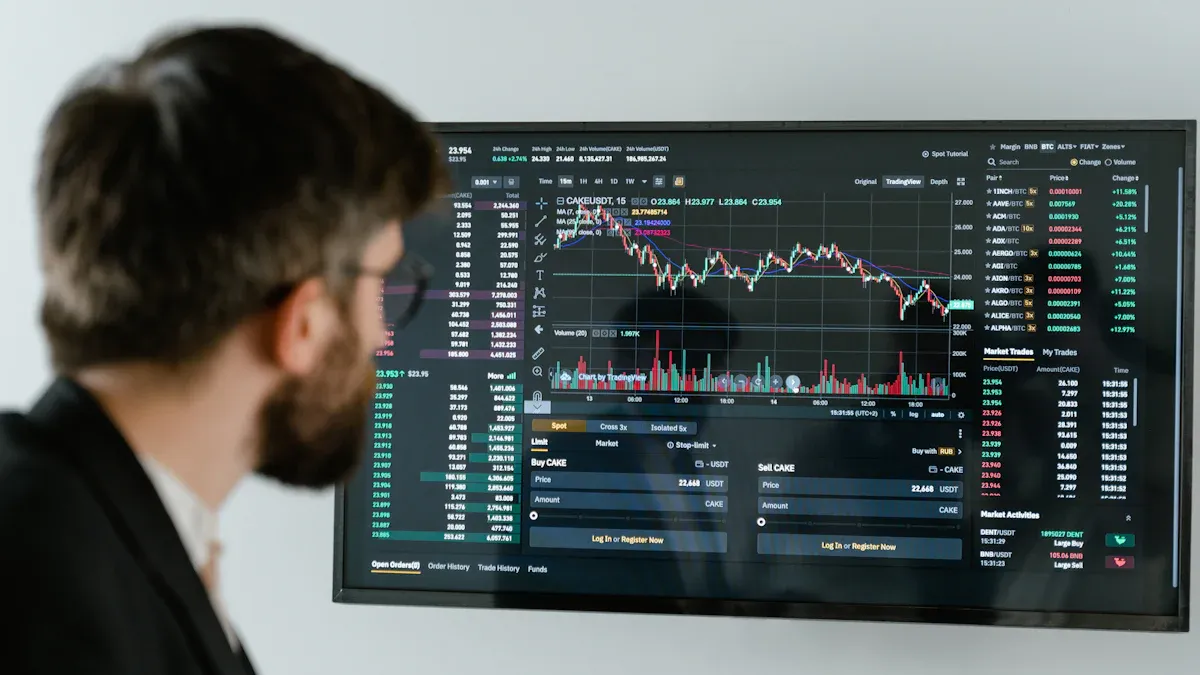
Image Source: pexels
Have you ever treated a US stock pre-market move as a guaranteed outcome for the regular session?
For elite traders, pre-market data is not a crystal ball for predicting the future. It is a thermometer that measures current market sentiment and validates their trading hypotheses.
The real key lies in learning how to distinguish truly valuable signals from seemingly chaotic information instead of being led by market noise.
Key Takeaways
- Pre-market data acts as a thermometer for market sentiment, helping traders validate ideas rather than predict the future.
- Interpreting volume and price gaps helps you understand market participation and expectation gaps.
- The impact of news and earnings depends on the difference from market expectations, not the news itself.
- Index futures allow you to grasp overall market sentiment and determine whether the day will be a tailwind or headwind.
- Analyzing institutional ratings and large-player activity provides deeper market insights to spot opportunities and risks.
The Core of US Pre-Market Trading: Reading Price-Volume Relationships
Building on the idea of treating pre-market data as a “thermometer,” the price-volume relationship consists of the two most important scales on that thermometer: price and volume. Together they paint a true picture of the market before the opening bell. Mastering their interaction is the first step to separating signal from noise.
Elite traders don’t just ask: “Is this stock up or down pre-market?” They ask: “How many people are behind this move? How strong is their conviction?”
The answer lies in the price-volume relationship.
Volume: The Primary Indicator of Market Activity
Volume directly reflects participant engagement. During US pre-market hours, unusually high volume usually means the stock is in the spotlight—possibly due to fresh earnings, major news, or sector developments.
Think of pre-market volume as an “attention meter.”
- High volume: Indicates significant disagreement between bulls and bears at current levels, with large capital actively changing hands. This often foreshadows sharp moves after the open. For example, highly active stocks like Apple (AAPL) average about 573,000 shares in pre-market over the past 30 days. When any stock’s pre-market volume far exceeds its 30-day average, it demands your full attention.
- Low volume: Suggests low interest or widespread wait-and-see attitude. Price moves on thin volume have limited predictive value because they may be driven by just a handful of trades without broad market consensus.
In practice, it helps to view “previous close → pre-market price → volume” on the same baseline. You can use BiyaPay’s stock info lookup to pull the key snapshot quickly, then return here to judge whether pre-market volume is truly abnormal versus its usual behavior.
If you’re planning capital across multiple currencies, check the fiat FX converter & comparison first to estimate conversion cost, and manage the workflow from the official site or register. BiyaPay is positioned as a multi-asset wallet and operates with U.S. MSB status and New Zealand FSP registration, which fits a “tool-driven” approach to organizing cross-market data and trading hypotheses.
Price Gaps: Measuring Expectation Gaps
A price gap occurs when a stock’s pre-market price jumps significantly above or below the previous day’s close. This gap is the market’s fastest and most direct reaction to overnight information.
The gap itself is a powerful signal—it tells you that market expectations have been broken.
- Gap up: Typically triggered by better-than-expected positive news, such as beating earnings, new product launches, or regulatory approvals.
- Gap down: Usually caused by worse-than-expected negative news, such as missing earnings, executive scandals, or lawsuits.
When analyzing gaps, focus not only on direction but also on magnitude. A 10% gap up carries far stronger sentiment than a 1% move. The size directly measures how large the “expectation gap” created by the news really is.
Price-Volume Divergence: Spotting Potential Reversals
This is one of the most subtle yet often overlooked aspects of pre-market analysis. When price direction and volume trend diverge—a situation called “price-volume divergence”—it frequently signals weakening momentum or an impending reversal.
Price can be manipulated with small money, but volume doesn’t lie.
The most common pre-market trap is “low-volume rallies” or “low-volume declines.” Imagine a stock up 5% pre-market on unusually thin volume. This suggests the rally lacks solid buying support. Once regular trading begins and selling pressure appears, the price can quickly reverse.
Data backs this up. Studies show pre-market momentum has surprisingly low correlation with intraday performance.
| Stock | Probability of Intraday Continuation After Pre-Market Rise (%) | Overall Pre-Market vs. Intraday Consistency (%) |
|---|---|---|
| Amcor (AMCR) | N/A (shows strong reversal tendency) | Below 50% (tends to reverse) |
| Corteva Inc. | N/A (recommended to short after pre-market rise) | N/A |
| JD.com (JD) | Below 60% | N/A |
| Baidu (BIDU) | Below 60% | N/A |
Overall data reveals that stocks rising pre-market have nearly a 50% chance of reversing lower during regular hours. This means blindly chasing pre-market gaps is roughly a coin flip. Therefore, always verify that volume expands with the gap. A gap backed by massive volume is far more reliable than one on light volume.
News and Earnings: Catalysts for Volatility
Image Source: pexels
Once you’ve mastered price-volume relationships and can gauge market “temperature,” the next step is to uncover the root cause driving it all: information. News and earnings reports are the catalysts that ignite sentiment and trigger violent swings.
However, elite traders process information completely differently from retail investors. They are not swayed by sensational headlines; instead, they act like detectives—assessing “expectation gaps” and tracing ripple effects. This skill is especially critical during US pre-market hours.
The market doesn’t trade the news itself—it trades the difference between the news and expectations.
This sentence is the core of everything in this section.
News Classification and Impact Assessment
Thousands of news items appear daily—you can’t read them all. The key is learning to categorize and evaluate potential impact. Professional tools like RavenPack classify news into dozens of types, but for practical purposes you can simplify into three major categories:
- Company-specific news: Earnings, M&A, product launches, executive changes, etc. These have the most direct and easiest-to-assess impact.
- Macroeconomic news: Interest rate decisions, CPI, unemployment rate, etc. These affect the entire market rather than individual stocks.
- Geopolitical news: Trade wars, regional conflicts, export bans, etc. These often deliver the strongest immediate shock and uncertainty.
When you see a news item, the first question should always be: “What was the market expecting?”
For example, when the US government announced solar industry subsidies, the market broadly expected a positive impact. But when final guidelines were released, analysts discovered the rules were even more favorable than anticipated, with looser tax-credit eligibility. This “better-than-expected” positive triggered massive gains.
| Index/Company | Intraday Gain |
|---|---|
| MAC Global Solar Index | 4% |
| Sunrun | 9% |
| First Solar | 8.6% |
This perfectly illustrates how expectation gaps drive price. Conversely, a company can report strong earnings yet fall pre-market if results—though good—fell short of Wall Street’s loftier forecasts.
Tracking Supply-Chain Ripple Effects
The impact of major news often spreads like ripples from a stone dropped in a lake. Elite traders never limit their view to the company directly named in the headline.
Take recent US chip export restrictions on China as a classic geopolitical example.
- Direct impact: China’s advanced chip manufacturing is hampered.
- Ripple effects: The ban hits revenue expectations for semiconductor equipment makers.
- ASML: While cutting-edge EUV machines were successfully restricted, China massively increased purchases of less-advanced DUV machines to circumvent restrictions, resulting in 70% of ASML’s 2024 DUV sales coming from China. This shows how markets find workarounds under geopolitical pressure.
- Applied Materials (AMAT): The company warned that China demand dropped from 35% to 29% due to restrictions and expected weakness to persist for several quarters. The stock plunged after hours.
Trader’s Note: When a company you hold releases news, spend five minutes thinking: Who are its upstream suppliers? Who are its downstream customers? Which competitors benefit or suffer? Developing this “supply-chain thinking” lets you spot opportunities and risks earlier than others.
Despite restrictions, data shows that in 2024, China still accounted for nearly 39% of total revenue for major equipment makers (including Applied Materials, Lam Research, KLA, ASML, etc.). This highlights how deeply interdependent the supply chain remains—you must interpret news impact from multiple angles.
Reading Between the Lines in Earnings Calls
If earnings numbers are the “past tense,” then the post-earnings conference call is the “future tense.” It’s a direct dialogue between management and analysts packed with hidden messages.
Be especially wary of “abnormally high positive tone (exaggerated language).”
Research finds that when management excessively uses optimistic, positive words—especially when disproportionate to actual financial metrics—it often predicts negative future returns.
Seasoned investors listen carefully to what management says, but they care more about what management doesn’t say and how they say it.
For example, before the financial crisis, Lehman Brothers’ CFO used “strong” 24 times and “great” 14 times in one call while using “challenging” only 6 times. This disproportionate optimism was seen by many short sellers as a red flag—possibly management trying to mask underlying problems with upbeat language.
When listening to earnings calls, pay attention to:
- Specific vs. vague: Does management give concrete guidance like “we expect next-quarter revenue growth of 10-14%” or only vague statements like “we are very optimistic about the future”?
- Tone shifts: Do executives become evasive or defensive when answering tough questions about competition or cost pressures?
- Keyword frequency: Are words like “strong,” “great,” or “unbelievable” overused?
Learning to read these subtleties helps you prepare before the market detects trouble.
Index Futures: Gauging Macro Market Sentiment
Once you can interpret individual stock micro-stories from price-volume and news, index futures become your telescope for macro sentiment. In the time-critical US pre-market window, futures direction often sets the tone for the entire regular session.
Elite traders glance at futures before analyzing individual stocks. It’s like checking the weather forecast before sailing—it helps you avoid sudden storms.
Linkage Between Futures and Individual Stocks
Most stocks move in sympathy with the broader market. Think of the market as an ocean and individual stocks as boats. Even a boat with a strong engine (great fundamentals) struggles against massive waves (market panic).
S&P 500 futures (ticker ES) and Nasdaq 100 futures (ticker NQ) are the two most important macro gauges. Their direction directly reflects overall expectations for the economy and tech sector. Watching them tells you whether the day will be a tailwind or headwind.
Reading Market Sentiment from Futures Premium/Discount
Futures prices don’t move randomly—they have an interesting relationship with “fair value,” which factors in carrying costs like interest and dividends.
- Futures premium: When the futures price is above fair value, sentiment leans bullish—buyers are willing to pay more.
- Futures discount: When below fair value, sentiment leans bearish.
The size of the premium or discount acts as a thermometer for sentiment strength.
Trader’s Note: How to calculate premium? Simply compare market price to theoretical fair value. Here’s a simplified example:
Item Value (USD) Futures Fair Value 1156.68 Actual Futures Price 1157.00 Premium Amount 0.32
This tiny premium reflects mild optimism at that moment.
Using Futures to Shape Opening Strategies
Futures direction helps you craft smarter opening plans. For example, if your stock is soaring pre-market on strong earnings but S&P 500 futures are falling, that’s a warning. Your stock may be strong, but broad selling pressure could cap its upside.
Advanced traders also watch VIX futures. A sharp rise in VIX futures premium means institutions are buying protection, expecting higher future volatility. This is a strong caution signal—even if indices look calm, consider reducing risk.
Advanced Insights: Institutional Ratings & Whale Tracking

Image Source: pexels
After mastering price-volume, news, and futures, elite traders go further—trying to track “smart money.” Institutional and whale behavior is often hidden in rating reports, block trades, and options flow, providing deeper market insight.
Hidden Meaning Behind Investment Bank Rating Changes
When a bank downgrades a stock, your first instinct might be to panic-sell. Elite traders think the opposite: does this create a buying opportunity?
Morgan Stanley strategist Mike Wilson once noted that a Moody’s US credit downgrade causing a market drop would actually present a “buy-the-dip” opportunity.
Historical data supports this view. Every major pullback has proven temporary in hindsight. For long-term investors, fear-driven declines are prime entry points.
| Market Event | Drawdown | Recovery Time |
|---|---|---|
| 2008 Financial Crisis | 57% | Within 4 years |
| Dot-com Bubble (2000) | 49% | Within 5 years |
| COVID-19 Crash (2020) | 34% | Within 6 months |
Thus, read the subtext of rating changes instead of reacting only to headlines.
Decoding Pre-Market Block Trades
Pre-market block trades are large off-exchange transactions negotiated privately between institutions. They don’t immediately appear in public quotes but reveal true institutional intent.
Trader’s Note: A block trade executed far above the current price is a strong bullish signal—someone is willing to pay a premium to acquire shares immediately. Conversely, a block far below market price can be a warning.
Options Market Hedging Sentiment
The options market is the most sensitive gauge of fear. Before major events (earnings, FDA decisions, etc.), watch options activity to see if institutions are preparing for risk.
- Institutions closely monitor spikes in put option activity before events.
- Such “unusual options activity” often precedes sharp moves.
- Especially large volume in short-dated, out-of-the-money puts typically means institutions are buying cheap downside insurance.
When you see this hedging, stay cautious even if price looks stable.
Elite traders’ analysis is a systematic integration from macro to micro. Treat pre-market analysis as probability assessment, not precise prediction. To help you build the habit, here’s a “Pre-Market Data Checklist”:
- Check macro sentiment: Are index futures showing tailwind or headwind?
- Scan for individual stock anomalies: Any unusual price-volume or major news in your watchlist/holdings?
- Build a trade plan: Based on sentiment, define clear entry/exit points, stop-loss, and risk-reward ratio.
You can use tools like Biyapay to manage your plans and execute quickly when opportunities arise.
FAQ
What are the exact pre-market trading hours?
US pre-market trading generally runs from 4:00 AM to 9:30 AM Eastern Time. However, exact hours vary by broker. Confirm with your broker to participate accurately.
How much pre-market volume counts as “high”?
There’s no absolute threshold. Compare current pre-market volume to the stock’s 30-day average pre-market volume. Significantly above average indicates high attention.
Should I trade during pre-market?
For beginners, observation is recommended. Pre-market liquidity is poor and price swings can be extreme. Entering without a complete strategy carries very high risk.
Where can I find important pre-market news?
Follow major financial news outlets that have dedicated market update sections:
- Bloomberg
- Reuters
- MarketWatch
Many trading platforms also integrate real-time news for quick access.
*This article is provided for general information purposes and does not constitute legal, tax or other professional advice from BiyaPay or its subsidiaries and its affiliates, and it is not intended as a substitute for obtaining advice from a financial advisor or any other professional.
We make no representations, warranties or warranties, express or implied, as to the accuracy, completeness or timeliness of the contents of this publication.
Related Blogs of

What is the 012 Bank Code? Essential Knowledge for Bank of China (Hong Kong) Transfers


How Do You Pay for the OpenAI API? Prepaid Setup, Top-Ups, and Billing Explained


Complete List of Standard Chartered Branch Codes: Latest Hong Kong Branch Information


How to Pay for Claude Pro: Payment Methods, Subscription Steps, Renewals, and Troubleshooting
Choose Country or Region to Read Local Blog
 Australia
 Austria
 Belgium
 Canada
 Cyprus
 Czech Republic
 Denmark
 Estonia
 Finland
 France
 Germany
 Greece
 Hong Kong
 India
India Indonesia
 Ireland
 Italy
Italy Japan
Japan Latvia
 Lithuania
 Luxembourg
 Malaysia
 Malta
Malta Morocco
 Nepal
Nepal Netherlands
 New Zealand
 Norway
 Pakistan
 Philippines
 Poland
 Portugal
 Romania
 Singapore
 Slovakia
 Slovenia
 South Africa
 South Korea
 Spain
Spain Sweden
 Thailand
 The United States
 Turkey
 United Arab Emirates
 United Kingdom
 Vietnam
Contact Us




BIYA GLOBAL LLC is registered with the Financial Crimes Enforcement Network (FinCEN), an agency under the U.S. Department of the Treasury, as a Money Services Business (MSB), with registration number 31000218637349, and regulated by the Financial Crimes Enforcement Network (FinCEN).
BIYA GLOBAL LIMITED is a registered Financial Service Provider (FSP) in New Zealand, with registration number FSP1007221, and is also a registered member of the Financial Services Complaints Limited (FSCL), an independent dispute resolution scheme in New Zealand.