Pros and cons of living in Norway



Image Source: pexels
Wondering if living in Norway fits your lifestyle? You’ll find both amazing upsides and real challenges. Many expats say Norway offers a strong economy, low crime, and free education, but daily life can feel expensive and the weather tough. Check out this table for a quick look at the most common pros and cons of living in Norway:
| Pros | Cons |
|---|---|
| Free, high-quality education | High cost of living |
| Safe, peaceful environment | Harsh winters, limited daylight |
| Strong social welfare system | Difficult job market for non-Norwegian speakers |
| Beautiful natural scenery | Social barriers and integration challenges |
| Good work-life balance | Expensive travel and housing |
Some expats report mixed feelings about healthcare, especially when visiting general practitioners. As you read, think about which pros and cons matter most to you. The best place to live in Norway depends on what you value.
Key Takeaways
- Norway offers a high quality of life with strong healthcare, free education, and beautiful nature that supports a peaceful lifestyle.
- The cost of living in Norway is high, especially for housing, food, and entertainment, but wages often help balance these expenses.
- Learning Norwegian improves job opportunities and social integration, as many jobs require the language despite widespread English skills.
- Norway has safe neighborhoods, low crime rates, and excellent public transport, making daily life comfortable and secure.
- Long, dark winters and strict bureaucracy can be challenging, so consider your personal needs before moving to Norway.
Living in Norway: Quick Facts
Image Source: pexels
Currency & Cost
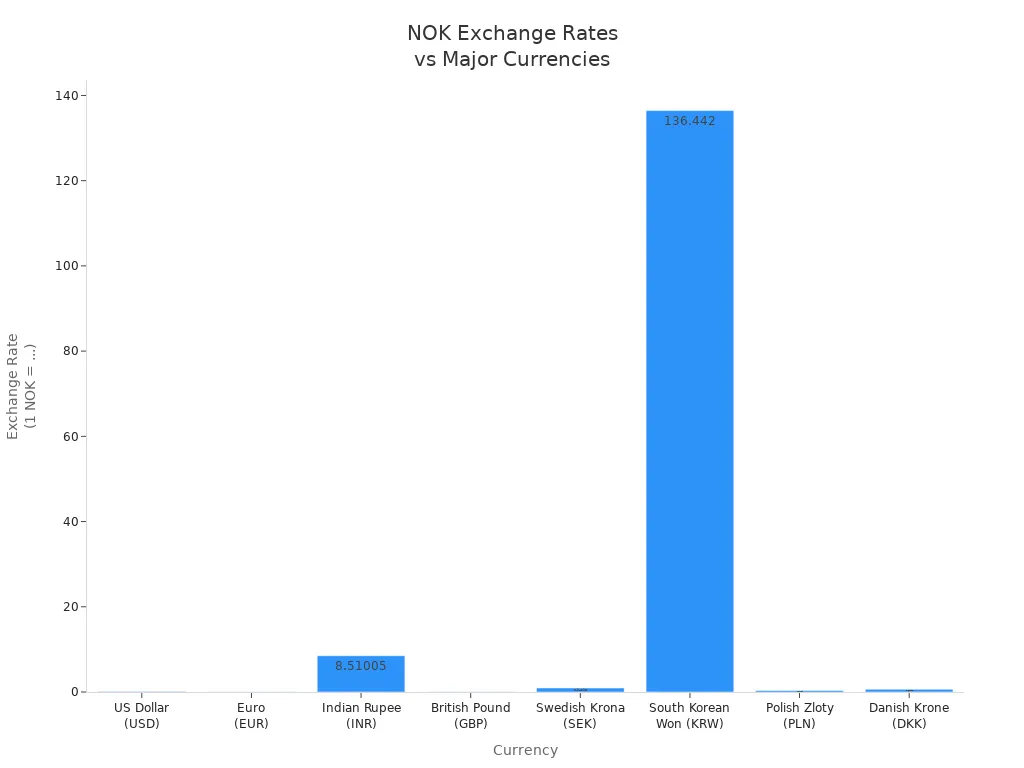
When you move to Norway, you’ll use the Norwegian krone (NOK) for all your purchases. If you’re an expat, you’ll want to know how much your money is worth. Here’s a quick look at how 1 NOK compares to major world currencies:
| Currency | Exchange Rate (1 NOK =) |
|---|---|
| US Dollar (USD) | 0.0981 |
| Euro (EUR) | 0.0846 |
| British Pound (GBP) | 0.0735 |
| Japanese Yen (JPY) | 14.5534 |
| Australian Dollar (AUD) | 0.1503 |
| Canadian Dollar (CAD) | 0.1347 |
| Swiss Franc (CHF) | 0.0788 |
| Chinese Yuan (CNY) | 0.7042 |
For example, if you buy something for 100 NOK, that’s about $9.81 USD. This helps you compare prices when you’re budgeting as an expat.
The cost of living in Norway is higher than in many other European countries. Groceries like milk and wine can cost much more—milk is about 76% more expensive than in France, and wine is 84% higher. Housing and entertainment also cost more. However, you’ll find that high wages help balance out these expenses for many people living in Norway.
Language & Population
Norwegian is the main language in Norway, with two written forms: Bokmål and Nynorsk. Almost everyone you meet will speak Norwegian, but you’ll notice that about 90% of Norwegians also speak English well. This makes it easier for expats to get by, especially when you first arrive.
Norway has a population of around 5.5 million people. Many expats come from Poland, Sweden, Lithuania, Romania, and Ukraine. You’ll find a mix of cultures, especially in bigger cities.
Major Cities
Most expats choose to live in one of Norway’s main cities. Here’s a quick look at the biggest ones:
| City | Population (2025 estimate) |
|---|---|
| Oslo | 580,000 – 673,000 |
| Bergen | 213,000 – 280,000 |
| Stavanger | 121,000 – 145,000 |
Oslo is the capital and the largest city. Bergen is famous for its beautiful scenery and history. Stavanger is known for its oil industry and friendly expat community. Each city offers something different, so you can find the best fit for your lifestyle when living in Norway.
Pros and Cons of Living in Norway
High Quality of Life
When you think about living in Norway, the high quality of life stands out right away. Norway ranks second in the world for standard of living, just behind Switzerland. You get to enjoy a strong economy, a clean environment, and a society that values well-being. The country’s Human Progress Index score is among the highest globally, showing how much Norwegians value comfort and happiness.
| Rank | Country | Human Progress Index (HPI) | HPI Tier |
|---|---|---|---|
| 1 | Switzerland | 97.9 | Very High |
| 2 | Norway | 97.87 | Very High |
| 3 | Iceland | 97.47 | Very High |
You will notice that the high standard of living in Norway comes from more than just money. People here enjoy world-leading education, exceptional healthcare, and high quality homes. The scenery is beautiful, and the air and water are clean. Many expats say their lifestyle improves after moving here, thanks to the balance between work and free time.
Safety & Low Crime
Norway is a safe and peaceful country. You can walk around most neighborhoods at night without worry. The low crime rate makes daily life less stressful for families and individuals. In 2023, Norway’s murder rate was only 0.72 per 100,000 people, which is about half of Sweden’s rate. This means you can feel secure whether you live in a big city or a small town. Many expats choose Norway for this reason, especially if they have children.
Nature & Outdoors
If you love the outdoors, living in Norway will fit your lifestyle perfectly. The scenery is breathtaking, with mountains, fjords, and forests everywhere you look. About 17.8% of Norway’s land is protected as national parks, nature reserves, and other areas. This means you have easy access to hiking, skiing, and exploring stunning natural scenery all year round.
| Category | Number of Areas | Area Covered (km²) | Percentage of Mainland Area |
|---|---|---|---|
| National Parks | 24 | 21,650 | Included in total |
| Landscapes | 153 | 14,071 | Included in total |
| Nature Reserves | 1,701 | 3,418 | Included in total |
| Natural Memorials | 102 | N/A | Included in total |
| Smaller Protected Areas | 98 | N/A | Included in total |
| Total Protected Areas | N/A | N/A | 12.1% of Norway’s mainland area |
You will find that the scenery changes with the seasons, offering new adventures every month. Many expats say the stunning natural beauty is one of the biggest pros of living in Norway. The scenery is not just for looking at—you can make it part of your daily lifestyle.
Healthcare & Education
Norway offers universal healthcare and a great education system. You get access to good healthcare no matter where you live. The country’s excellent healthcare system covers hospital care, doctor visits, and medicine. While you might wait longer for some treatments, you do not have to worry about huge medical bills. For example, the average wait for hospital treatment is about 60 days, but the government works to make this shorter.
Education is another big plus. Norway’s world-leading education system is free for everyone, including expat children. Schools focus on creativity, critical thinking, and well-being. Many expats say their kids thrive in this environment. You will find that both healthcare and education help support a high standard of living.
Work Culture & Wages
Working in Norway feels different from many other countries. People value an incredible work-life balance. You will notice that most jobs offer flexible hours and generous vacation time. The average annual wage is about 637,800 NOK (around $59,000 USD), which helps cover the high cost of living. Wages are set through collective bargaining, so you can expect fair pay even without a minimum wage law.
| Category | Norway (USD) | United States (USD) |
|---|---|---|
| Cost of living (single) | 2,210 | 2,504 |
| Monthly rent (single) | 1,189 | 1,592 |
| Food expenses | 726 | 646 |
| Monthly salary after tax | 3,813 | 4,443 |
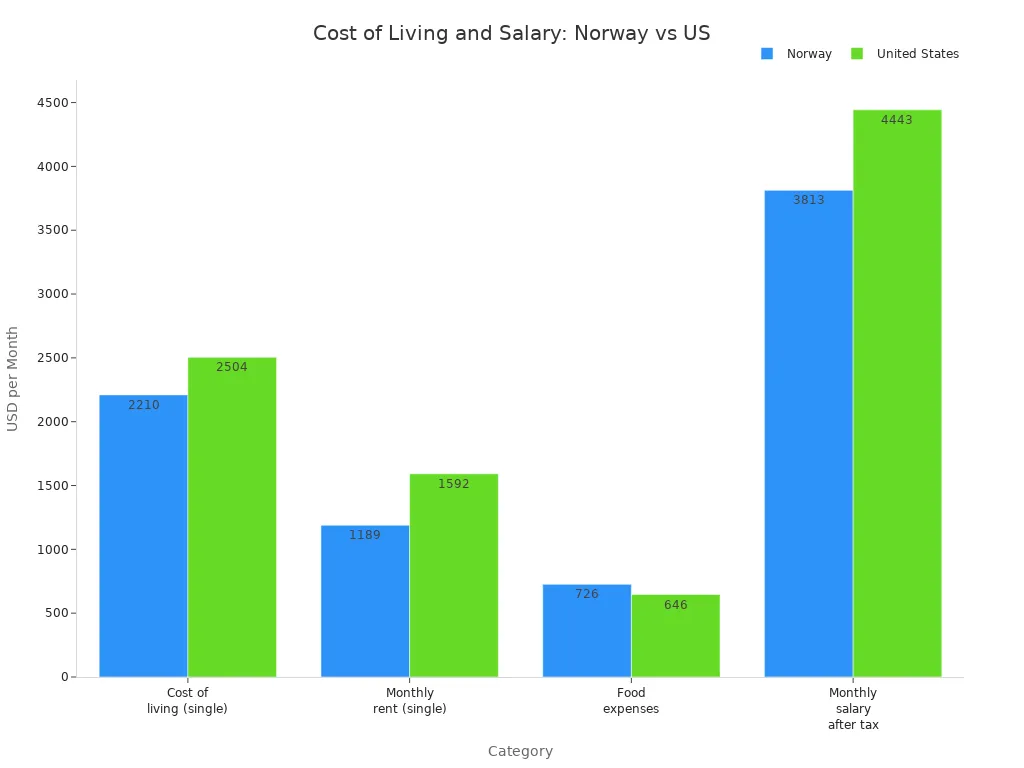
You will see that the high wages help balance out the cost of living. Many expats find that working in Norway gives them more time for family, hobbies, and enjoying the scenery.
Public Transport
Getting around in Norway is easy, especially in big cities. Oslo, Bergen, Stavanger, and Trondheim all have well-developed public transport networks. You can use trains, trams, buses, and even ferries. Oslo’s T-bane is the country’s only rapid transit system, and it connects many neighborhoods. Public transport is reliable, clean, and safe. Many expats use it every day, which helps reduce the need for a car and supports a clean environment.
Social Welfare
Norway’s social welfare system is one of the most generous in the world. You get support if you lose your job, become sick, or retire. The Norwegian Labour and Welfare Administration (NAV) manages benefits like unemployment, sickness, pensions, and family allowances. Universal healthcare is part of this system, so you do not have to worry about medical costs. Families receive allowances for children up to 18 years old, which helps with the cost of raising a family.
| Component | Description | Eligibility / Notes |
|---|---|---|
| Norwegian Labour and Welfare Administration (NAV) | Central agency administering unemployment benefits, sickness benefits, pensions, child benefits, qualification programs, temporary accommodation, and health services. | Administers benefits to eligible individuals based on specific criteria. |
| National Health Insurance System | Compulsory membership guarantees free medical care, compensation for doctors’ fees, free medicine, and allowances for lost wages. | All Norwegians are members; salaried employees compulsory, self-employed optional. |
| People’s Pension | Established in 1967 to ensure reasonable living standards after retirement; covers old age, disability, and loss of support. | Funded by individuals, employers, municipalities, and the state. |
| Family Allowances | Paid for all children up to 18 years of age. | All families with children under 18 are eligible. |
| Unemployment Benefits | Paid by NAV; duration and amount depend on previous income; up to 104 weeks for higher incomes. | Eligibility: lost over 50% working hours, lost income, income thresholds in last 12 or 36 months, under age 67. |
You will find that this safety net is a big reason why many expats choose Norway. It helps create a high standard of living and makes it easier to handle life’s ups and downs.
Inclusivity & Openness
Norway is known for being open and inclusive. The government works hard to make sure everyone feels welcome, no matter where you come from. You will see that Norway values participatory decision-making, and local communities often have a say in important issues. The Sámediggi (Sami Parliament) and other groups help make sure indigenous voices are heard.
- Norway’s culture values trust, openness, and sharing risks.
- Local governments try new ideas to improve social policies.
- The country shares best practices to help all communities.
- Norway once topped the world’s happiest countries list, showing how inclusivity supports well-being.
- Projects like the national walking strategy help people of all ages feel included.
Many expats say they feel accepted and respected here. Norway’s focus on human rights, gender equality, and reducing discrimination helps create a welcoming lifestyle for everyone. This is one of the biggest pros for people looking for a new home.
Cons of Living in Norway

Image Source: unsplash
High Cost of Living
You will notice right away that the cost of living in Norway is high. Groceries, rent, and entertainment can take up a big part of your budget. For example, if you live in Oslo, a furnished apartment in the city center can cost between $1,180 and $1,770 USD per month (using the exchange rate of 1 NOK ≈ $0.0981 USD). Groceries for a family can reach $980 USD monthly, and entertainment adds even more. Here’s a quick look at average monthly costs in Norway’s largest cities:
| City | Household Type | Rent (USD) | Groceries (USD) | Entertainment (USD) |
|---|---|---|---|---|
| Oslo | Bachelors | $880 - $1,275 | $295 - $490 | ~$345 |
| Bergen | Bachelors | $880 - $1,175 | $196 - $392 | ~$245 |
| Stavanger | Bachelors | $686 - $980 | $295 - $588 | ~$294 |
| Trondheim | Bachelors | $784 - $980 | $295 - $490 | ~$392 |
You may find that even simple things like eating out or going to the movies cost more than in other countries. Many expats say this is one of the biggest cons of living in Norway.
Weather & Climate
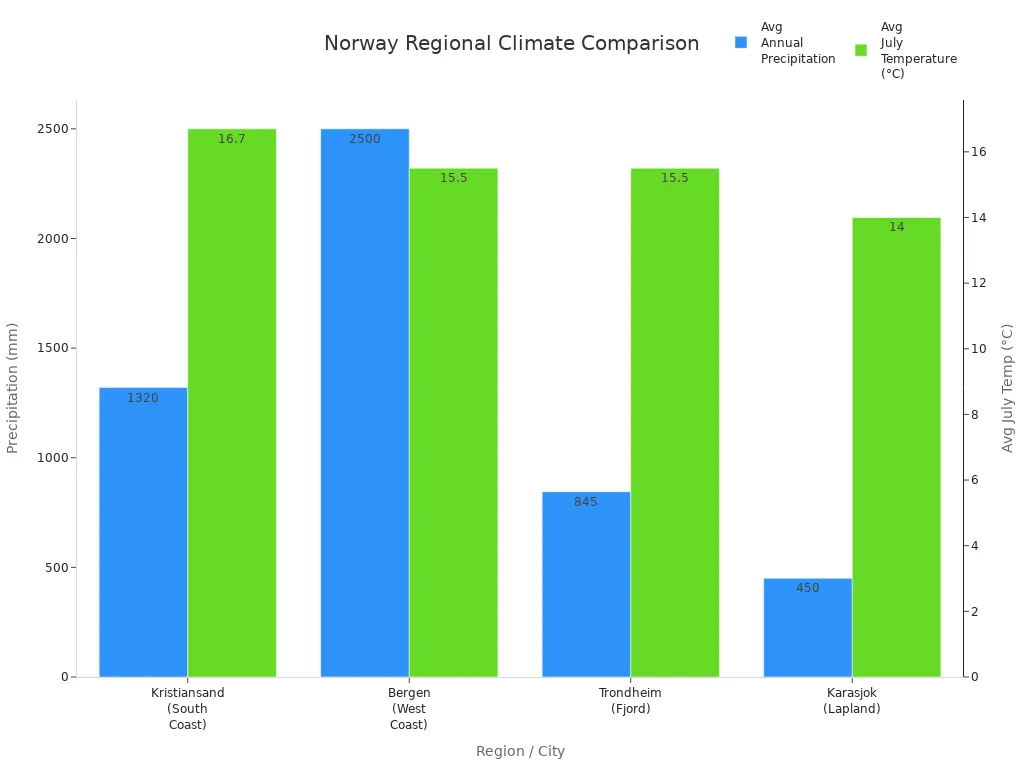
The weather in Norway can be tough, especially if you come from a warmer place. Winters are long and dark, with lots of rain or snow depending on where you live. Bergen, for example, gets rain on more than 150 days each year. In the north, you might see temperatures drop below -15°C (5°F) in winter. Summers are short and mild, but you may still need a jacket. The weather in Norway can affect your mood and daily plans.
Language Barrier
If you do not speak Norwegian, finding a job can be hard. Even though many people speak English, most employers want you to know Norwegian, especially for low-skilled jobs. The job market is small and competitive. Skilled workers in IT or engineering have better chances, but learning the language will help you a lot. Many expats find this one of the main cons when working in Norway.
Social Integration
Making friends in Norway can take time. Norwegians are friendly but may seem reserved at first. You might feel lonely, especially during the dark winter months. Joining clubs or learning Norwegian can help, but social integration is a real challenge for many expats.
Bureaucracy
Moving to Norway means dealing with a lot of paperwork. You must show language skills, pass tests about Norwegian society, and prove you can support yourself. The rules for getting permanent residence or citizenship are strict. Policy changes can happen while you are waiting, which adds stress. Many expats say these bureaucratic hurdles are one of the cons of living in Norway.
Housing & Rent
Finding a place to live can be difficult and expensive. In Oslo, a one-bedroom apartment costs between $1,180 and $1,770 USD per month. Bergen and Stavanger are a bit cheaper, but still pricey. The demand for housing is high, so you may need to search for a while before you find a good place.
High Taxes
Norway has high taxes to support its social welfare system. The ordinary income tax rate is 23%, and you also pay national insurance contributions. The total tax on labor can reach over 50% for high earners. You get good public services, but you will see a big part of your paycheck go to taxes.
| Tax Component | Rate / Description |
|---|---|
| Ordinary income tax rate | 23% (flat rate) |
| National insurance contributions | 8.2% for wage income |
| Maximum marginal tax rate on labor | 53.2% |
Distance & Travel
Norway feels far from the rest of Europe. Flights to London or Germany take about two hours, and a trip to Italy takes over three hours. Travel costs add up quickly, making it harder to visit family or explore other countries. This distance is one of the cons you should consider if you love to travel.
| Route | Average Flight Time |
|---|---|
| London to Oslo | ~2 hours |
| Germany to Norway | ~2 hours |
| Norway to Italy | ~3 hours 10 min |
Living in Norway has many pros and cons. The high cost of living, tough weather, and social challenges can make daily life harder for an expat. Think about what matters most to you before making the move.
Living in Norway gives you many benefits, like safety, high trust, and beautiful nature. You also face challenges, such as high costs and cold winters. Think about what matters most to you:
- Can you handle expensive rent and food?
- Do you enjoy outdoor activities and a peaceful lifestyle?
- Are you ready for long, dark winters and a slower pace?
Check your finances, career goals, and social needs. Each person’s situation is unique. If you have more questions, the FAQ section covers topics like visas, jobs, and daily life.
FAQ
How do you get a visa to live in Norway?
You need to apply for a residence permit before you move. Most people use the skilled worker, student, or family immigration routes. Check the Norwegian Directorate of Immigration website for the latest requirements and fees.
Is healthcare really free in Norway?
You get public healthcare, but you pay a small fee for doctor visits and prescriptions. Once you reach an annual limit (about $300 USD), everything else is free for the rest of the year.
Do you need to speak Norwegian to find a job?
Most jobs require Norwegian, especially in healthcare, education, and customer service. Some tech and engineering roles use English. You will have more options if you learn Norwegian.
Can you open a bank account in Norway as a foreigner?
Yes, you can open a bank account. You need a Norwegian ID number and proof of address. Many expats use Hong Kong banks or international banks for transfers. Always check the latest exchange rates when moving money (1 NOK ≈ $0.0981 USD).
Living in Norway comes with incredible benefits — but also steep living costs. For expats, one hidden challenge is moving money across borders: whether it’s sending support home, paying tuition, or converting currencies for daily life. With BiyaPay, you gain real-time transparent exchange rates, multi-currency & crypto conversion, and fees as low as 0.5% — so you keep more of your income.
BiyaPay also supports same-day transfers in most countries worldwide, making it easier to balance Norway’s high expenses with efficient, low-cost financial management.
Register today at BiyaPay and make your money go further in Norway.
*This article is provided for general information purposes and does not constitute legal, tax or other professional advice from BiyaPay or its subsidiaries and its affiliates, and it is not intended as a substitute for obtaining advice from a financial advisor or any other professional.
We make no representations, warranties or warranties, express or implied, as to the accuracy, completeness or timeliness of the contents of this publication.
Related Blogs of

Best Free Real-Time US Stock Quote Websites Besides Yahoo Finance


In-Depth Analysis of US Stock Pre-Market Trading: Unveiling the Secrets of the Market Before Opening


2025 US Stock Market Opening Hours Guide: What Time in Beijing Time? Daylight Saving and Standard Time Notes


Profit Expansion is the Core Driver: Analyzing the Growth Engines of the US Stock Market in 2026

Choose Country or Region to Read Local Blog
 Australia
 Austria
 Belgium
 Canada
 Cyprus
 Czech Republic
 Denmark
 Estonia
 Finland
 France
 Germany
 Greece
 Hong Kong
 India
India Indonesia
 Ireland
 Italy
Italy Japan
Japan Latvia
 Lithuania
 Luxembourg
 Malaysia
 Malta
Malta Morocco
 Nepal
Nepal Netherlands
 New Zealand
 Norway
 Pakistan
 Philippines
 Poland
 Portugal
 Romania
 Singapore
 Slovakia
 Slovenia
 South Africa
 South Korea
 Spain
Spain Sweden
 Thailand
 The United States
 Turkey
 United Arab Emirates
 United Kingdom
 Vietnam
Contact Us




BIYA GLOBAL LLC is a licensed entity registered with the U.S. Securities and Exchange Commission (SEC No.: 802-127417); a certified member of the Financial Industry Regulatory Authority (FINRA) (Central Registration Depository CRD No.: 325027); regulated by the Financial Industry Regulatory Authority (FINRA) and the U.S. Securities and Exchange Commission (SEC).
BIYA GLOBAL LLC is registered with the Financial Crimes Enforcement Network (FinCEN), an agency under the U.S. Department of the Treasury, as a Money Services Business (MSB), with registration number 31000218637349, and regulated by the Financial Crimes Enforcement Network (FinCEN).
BIYA GLOBAL LIMITED is a registered Financial Service Provider (FSP) in New Zealand, with registration number FSP1007221, and is also a registered member of the Financial Services Complaints Limited (FSCL), an independent dispute resolution scheme in New Zealand.