Stock Market Holiday Closures You Need to Know in 2025




Image Source: unsplash
You need to know exactly when the stock market is closed in 2025 to plan your trades. The NYSE and Nasdaq will close on New Year’s Day, Martin Luther King Jr. Day, Presidents’ Day, Good Friday, Memorial Day, Juneteenth, Independence Day, Labor Day, Thanksgiving, and Christmas. Early closures will happen on July 3, November 28, and December 24. Missing a trading day can affect your strategy because the stock market holiday schedule reduces the number of trading days.
Trading volume drops sharply during holidays and early closures. Before holidays, volume surges as investors adjust portfolios. After holidays, volume and volatility increase as traders react to new events.
The table below shows how weekends and holidays shape the 2025 trading calendar:
| Stock Exchange | Total Calendar Days (2025) | Weekend Days | Public Holidays | Total Trading Days |
|---|---|---|---|---|
| NYSE | 365 | 104 | 9 | 251 |
Bond market holidays may differ from the stock market holiday schedule. A quick-reference table follows to help you check all key dates, including answers to questions like “is the stock market open on martin luther king day.”
Key Takeaways
- The stock market closes fully on major holidays like New Year’s Day, Martin Luther King Jr. Day, Independence Day, Thanksgiving, and Christmas in 2025.
- Early market closures happen on July 3, November 28, and December 24, with trading ending at 1:00 p.m. Eastern Time on these days.
- Trading volume drops and volatility changes around holidays, so plan your trades carefully to avoid missed opportunities or delays.
- The bond market has some different holidays and early close times, so check its schedule separately if you trade bonds.
- Always check the official holiday calendar before trading, and be aware that emergency closures can happen unexpectedly.
2025 Stock Market Holidays
Image Source: unsplash
The 2025 stock market holidays shape your trading year. You need to know which days the NYSE and Nasdaq close fully and which days have early closures. This knowledge helps you plan your trades and avoid surprises.
Full Closure Dates
You will find that the NYSE and Nasdaq both observe the same full closure dates in 2025. These holidays mean the markets do not open at all. The official exchange announcements confirm these dates. Here is a table that lists all the full closure days for 2025:
| Holiday | Date | Market Status |
|---|---|---|
| New Year’s Day | January 1 | Full day closure |
| Martin Luther King Jr. Day | January 20 | Full day closure |
| Presidents’ Day | February 17 | Full day closure |
| Good Friday | April 18 | Full day closure |
| Memorial Day | May 26 | Full day closure |
| Juneteenth National Independence Day | June 19 | Full day closure |
| Independence Day | July 4 | Full day closure |
| Labor Day | September 1 | Full day closure |
| Thanksgiving Day | November 27 | Full day closure |
| Christmas Day | December 25 | Full day closure |
Note: If a holiday falls on a weekend, the market usually observes the closure on the closest weekday.
The NYSE and Nasdaq will both close on Thursday, June 19, 2025, for Juneteenth. This closure matches the federal holiday schedule and shows how the exchanges honor national observances.
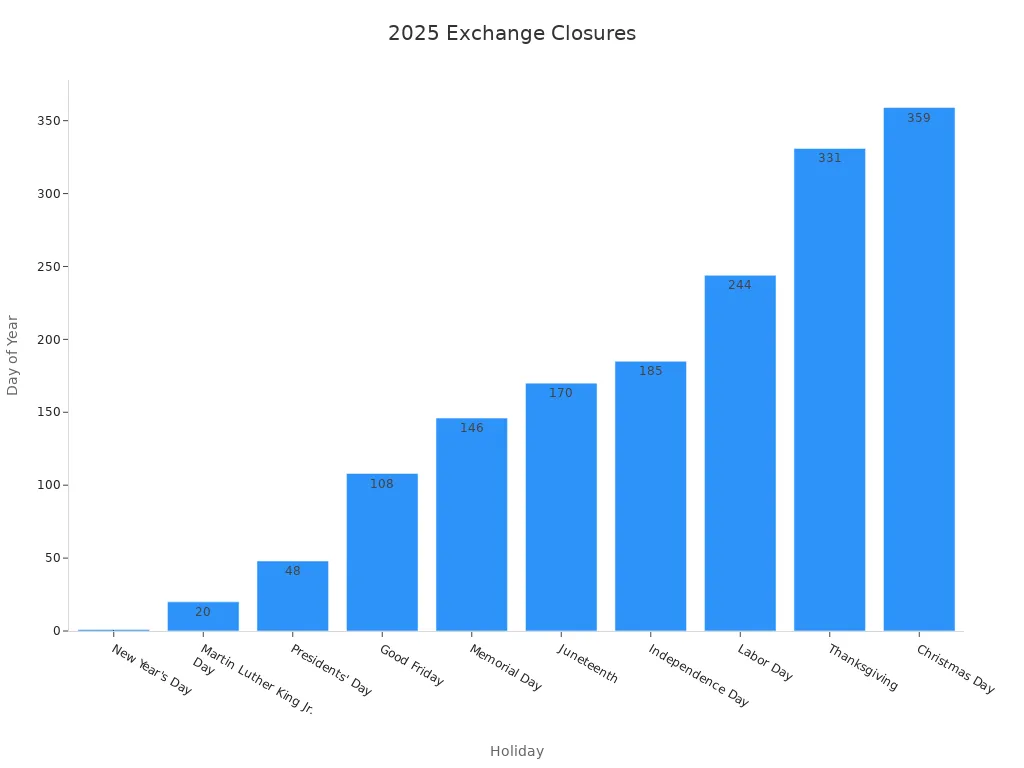
You can see from the chart above that these closures spread throughout the year. The 2025 stock market holidays reduce the number of trading days, so you should always check the schedule before making plans.
Early Closures
Some days in 2025 do not have full closures, but the markets close early. On these days, the NYSE and Nasdaq close at 1:00 p.m. Eastern Time instead of the usual 4:00 p.m. Early closures often happen before or after major holidays. The official schedule for early closures in 2025 includes:
- July 3 (the day before Independence Day)
- November 28 (the day after Thanksgiving)
- December 24 (Christmas Eve)
On these dates, you have less time to trade. The early close helps market participants prepare for the holiday or spend time with family.
Here is a chart that shows the early closure days for Nasdaq in 2025:
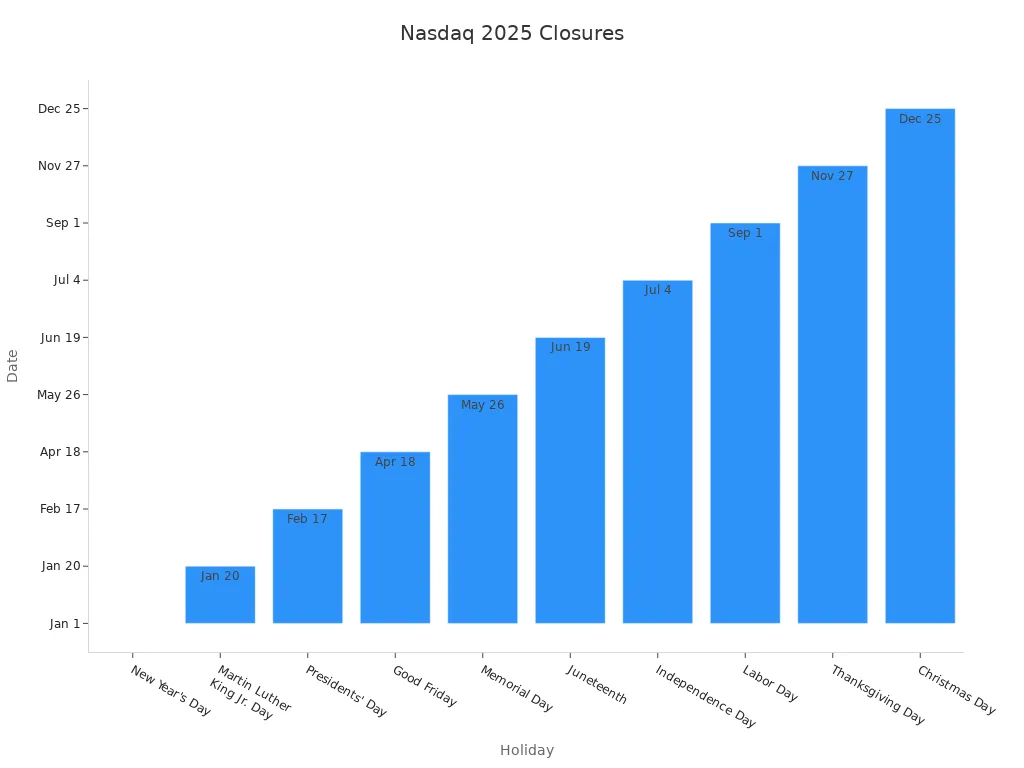
The early closure schedule is the same for both the NYSE and Nasdaq. This consistency makes it easier for you to remember the important dates. Early closures differ from full closure days because the market opens in the morning but shuts down after lunch.
Tip: Always check the official market holidays 2025 schedule before placing trades around these dates. Early closures can affect order processing and settlement times.
The 2025 stock market holidays and early closures help you plan your trading year. Knowing these dates lets you avoid missed opportunities and manage your investments with confidence.
Stock Market Holiday Schedule Table
Image Source: pexels
You need a simple way to check when the stock market opens and closes in 2025. The holiday calendar below helps you plan your trades and avoid surprises. Both the NYSE and Nasdaq follow the same schedule for full closures and early closings. You can use this table to see all the important dates at a glance.
Tip: Mark these dates on your calendar so you never miss a trading opportunity.
| Holiday/Event | Date (2025) | NYSE Status | Nasdaq Status |
|---|---|---|---|
| New Year’s Day | January 1 (Wed) | Closed | Closed |
| Martin Luther King Jr. Day | January 20 (Mon) | Closed | Closed |
| Presidents’ Day | February 17 (Mon) | Closed | Closed |
| Good Friday | April 18 (Fri) | Closed | Closed |
| Memorial Day | May 26 (Mon) | Closed | Closed |
| Juneteenth | June 19 (Thu) | Closed | Closed |
| Day Before Independence Day | July 3 (Thu) | Early close at 1:00 p.m. ET | Early close at 1:00 p.m. ET |
| Independence Day | July 4 (Fri) | Closed | Closed |
| Labor Day | September 1 (Mon) | Closed | Closed |
| Thanksgiving Day | November 27 (Thu) | Closed | Closed |
| Day After Thanksgiving | November 28 (Fri) | Early close at 1:00 p.m. ET | Early close at 1:00 p.m. ET |
| Christmas Eve | December 24 (Wed) | Early close at 1:00 p.m. ET | Early close at 1:00 p.m. ET |
| Christmas Day | December 25 (Thu) | Closed | Closed |
You can see that most holidays in 2025 fall on weekdays. The market closes for major events like New Year’s Day, Independence Day, and Christmas Day. Early closures happen before or after big holidays, such as July 3, November 28, and December 24. On these days, the market shuts down at 1:00 p.m. Eastern Time. You should finish your trades early on these dates.
The 2025 stock market holidays table gives you a quick overview of all closures and early closing times. This schedule helps you avoid trading on days when the market is not open. You can use this holiday calendar to plan your investment strategy for the year. Always check the table before making important trading decisions.
Is the Stock Market Open on Martin Luther King Day?
January 20, 2025
You may wonder, is the stock market open on Martin Luther King Day? The answer is clear: the stock market does not open on this day. Both the New York Stock Exchange (NYSE) and Nasdaq close their doors on Martin Luther King, Jr. Day every year. In 2025, this holiday falls on January 20. You will not be able to buy or sell stocks on this date.
The NYSE Group’s official press release for 2025 confirms that the market will close on Martin Luther King, Jr. Day. This announcement matches the Nasdaq holiday calendar, which lists January 20, 2025, as a full market holiday. You can see this information in the table below:
| Date | Holiday | Market Status |
|---|---|---|
| January 20, 2025 | Martin Luther King Jr. Day | Closed |
You should always check if the stock market is open on Martin Luther King Day before planning your trades. Missing this detail could affect your investment strategy. Many investors use the holiday to review their portfolios or catch up on market news.
Martin Luther King, Jr. Day holds a special place in the official holiday schedule. The closure honors the legacy of Dr. King and his impact on American history. By closing the market, the exchanges show respect for this important day.
If you try to trade on Martin Luther King, Jr. Day, you will find that the stock market open status is set to closed. No trades will process until the next business day. You should plan ahead and make any important trades before the holiday.
Remember, is the stock market open on Martin Luther King Day is a common question each year. In 2025, you can answer with confidence: the market is closed on January 20. Mark your calendar so you do not miss this important date.
Bond Market Holidays 2025
Full Closures
You need to know that the bond market in the United States follows a schedule that is similar to the stock market holidays in 2025. Most major federal holidays, such as Memorial Day, Labor Day, and Independence Day, mean the bond market will not open. You will also see full closures on Columbus Day and Veterans Day, which do not always match the stock market calendar. The Securities Industry and Financial Markets Association (SIFMA) sets these dates. Here is a table to help you see the main bond market holidays for 2025:
| Holiday/Event | Date(s) in 2025 | Notes |
|---|---|---|
| New Year’s Day | January 1 (Wed) | Full closure |
| Martin Luther King Jr. Day | January 20 (Mon) | Full closure |
| Presidents’ Day | February 17 (Mon) | Full closure |
| Good Friday | April 18 (Fri) | Full closure |
| Memorial Day | May 26 (Mon) | Full closure |
| Juneteenth | June 19 (Thu) | Full closure |
| Independence Day | July 4 (Fri) | Full closure |
| Labor Day | September 1 (Mon) | Full closure |
| Columbus Day | October 13 (Mon) | Full closure |
| Veterans Day | November 11 (Tue) | Full closure |
| Thanksgiving Day | November 27 (Thu) | Full closure |
| Christmas Day | December 25 (Thu) | Full closure |
Early Closures
You will find that the bond market sometimes closes early before or after certain holidays. In 2025, the market will close early at 2:00 p.m. Eastern Time on July 3 (before Independence Day), November 28 (after Thanksgiving), and December 24 (Christmas Eve). Some sources also show early closures at 1:00 p.m. on these days, so you should always check with your broker. Special events, such as a national day of mourning, can also lead to early closures. For example, the bond market will close early at 2:00 p.m. on January 9, 2025, to honor former President Carter.
Tip: Early closures mean you have less time to trade. Plan your bond trades ahead of these dates.
Here is a chart that shows the number of full closures and early close events for bond market holidays in 2025:
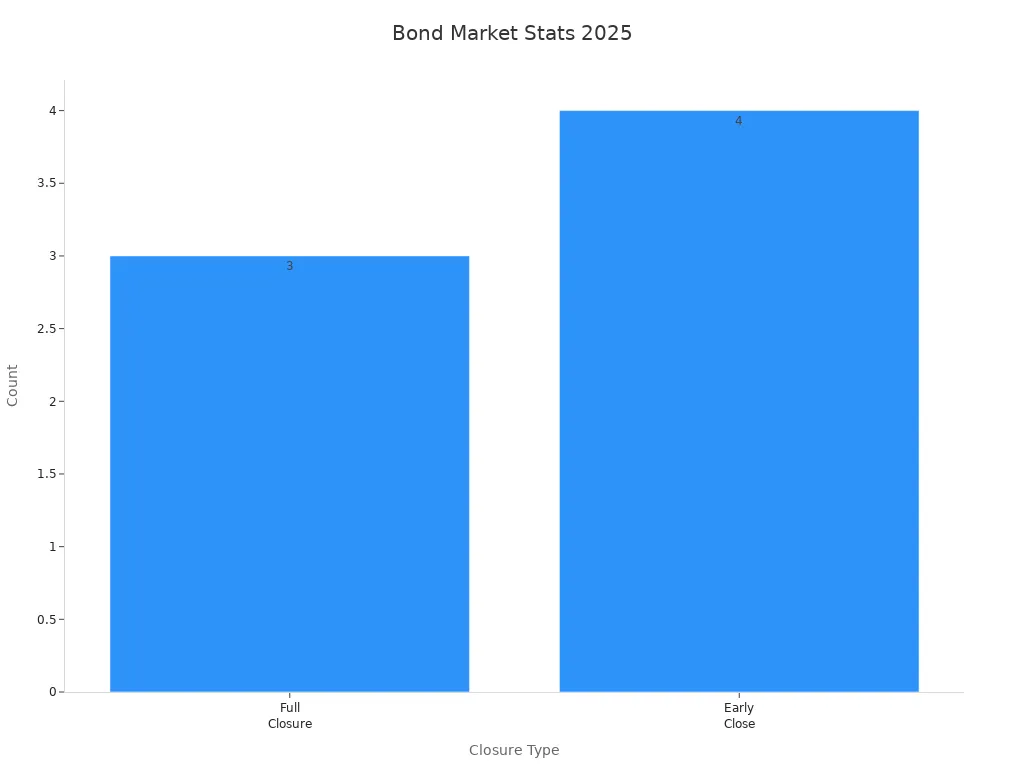
Differences from Stock Market Holidays
You may notice that the bond market and the stock market holidays in 2025 look very similar. Both markets close for most federal holidays, such as Memorial Day and Christmas Day. However, the bond market also closes for Columbus Day and Veterans Day, while the stock market stays open on those days. Early closure times can also differ. The bond market often closes at 2:00 p.m., while the stock market usually closes early at 1:00 p.m. These small differences can affect your trading plans. Always check the official holiday calendar for each market before you trade.
Trading on Holidays
When you try to trade on a holiday or early close day, you may notice that the stock market open status changes. The NYSE and Nasdaq do not process trades when the market is closed. You need to understand how this affects your trading experience, especially in 2025.
Platform Access
Most trading platforms let you log in and view your account during holidays. You can place orders, but the system will not execute them until the next stock market open. Some brokers limit premarket and after-hours trading during official holidays. This means you cannot buy or sell stocks until the market resumes. Your account stays accessible, but you cannot complete trades.
Note: Some electronic platforms offer pre-market or after-hours trading, but these features may not work during holidays or early closures. Always check your broker’s holiday schedule.
You should keep a global economic calendar that includes all 2025 holidays and early closures. This helps you avoid surprises and plan your trades. Many traders set calendar alerts for these dates. You may also notice that liquidity drops during holiday periods, which can affect your ability to enter or exit positions.
- Lower trading volumes reduce liquidity and can cause price swings.
- Volatility often increases before holidays as traders adjust their portfolios.
- Some earnings reports or economic data releases may be delayed around holidays.
Order Processing
When the stock market open status is set to closed, your orders remain pending. The system will not process them until the next trading day. According to Investopedia, trade confirmations and settlements depend on whether the market is open. Orders placed during holidays or early closures wait in line until the market reopens. This can delay both order execution and settlement.
If you trade right before a holiday, you may see settlement delays, especially for international transactions. Early closures in 2025 also mean that afternoon trading sessions have less liquidity. You should plan to finish your trades before the early close time. Some traders use 24-hour markets like forex to manage risk during stock market holidays, but even these markets can see lower liquidity.
Tip: Adjust your trading strategy before holidays to avoid risks from low liquidity and delayed settlements.
You need to know the stock market open schedule for 2025 to avoid these issues. Always check the holiday calendar and plan your trades ahead of time.
Exceptions and Special Closures
Emergency Closures
You should know that sometimes the stock market closes without warning. These emergency closures do not follow the regular calendar. Events like severe weather, power outages, or national emergencies can cause the NYSE and Nasdaq to stop trading for a day or even longer. For example, the stock market closed after the September 11 attacks in 2001. You may also see closures for national days of mourning, such as when a former president passes away.
If an emergency closure happens in 2025, you will not be able to trade until the market reopens. The exchanges will announce these changes on their official websites and through news outlets. You should always check for updates if you hear about a major event. Your broker may also send alerts to your email or trading platform. Planning for these rare events helps you avoid surprises and manage your investments better.
Note: Emergency closures are rare, but they can affect your trading plans. Always stay informed about current events.
International Markets
You may want to trade stocks in other countries. International stock markets do not follow the same schedule as the NYSE or Nasdaq. Each country sets its own trading calendar. For example, the London Stock Exchange, the Tokyo Stock Exchange, and the Shanghai Stock Exchange all have different closure dates. Some markets close for local festivals or national observances that do not affect U.S. markets.
If you plan to trade in international markets during 2025, you should check each exchange’s official calendar. You might find that a market in China or Europe is open when the U.S. market is closed, or vice versa. This difference can create unique trading opportunities or risks. Always review the trading hours and closure dates before you place an order in a foreign market.
Tip: Use a global market calendar to track important dates for all the exchanges you follow.
You now have a clear view of the 2025 stock market holidays and early closure dates. The schedule includes major holidays like Memorial Day, Juneteenth, and Christmas Day, with early market closures on July 3, November 28, and December 24.
Always check for last-minute or emergency changes. Plan your trades using the holiday schedule, and save this guide for quick reference.
FAQ
What happens if you place a trade on a stock market holiday?
Your order will not process until the next trading day. The system holds your trade in a queue. You can still log in and view your account, but no trades will go through when the market is closed.
Are all U.S. stock exchanges closed on the same days?
Most major U.S. stock exchanges, like NYSE and Nasdaq, follow the same holiday schedule. You should always check the official calendar for each exchange. Some smaller exchanges may have different rules.
How do early closures affect your trading?
On early closure days, the market shuts at 1:00 p.m. Eastern Time. You have less time to trade. You should finish your trades before the early close to avoid delays or missed opportunities.
Does the stock market ever close unexpectedly?
Yes, the market can close for emergencies, such as severe weather or national events. You should watch for announcements from the exchanges. In 2025, always check for updates before trading on important days.
The 2025 stock market holiday schedule, with ten full closures and early closures on July 3, November 28, and December 24, demands careful planning to navigate reduced trading days and potential volatility spikes. For investors aiming to diversify across global markets, high cross-border fees and the complexity of opening overseas accounts can complicate trading around these closures. BiyaPay offers a seamless solution, allowing you to invest in both U.S. and Hong Kong stock markets directly on its platform without needing an overseas account. With real-time, fee-free conversion of over 200 digital currencies, including USDT, into 30+ fiat currencies like USD and HKD, and cross-border remittance fees as low as 0.5%, BiyaPay ensures cost-effective access to global markets. A 1-minute BiyaPay account registration provides rapid, secure entry, enabling you to plan trades around holidays and capitalize on opportunities in diverse markets with confidence.
Master your 2025 trading strategy! Join BiyaPay.
*This article is provided for general information purposes and does not constitute legal, tax or other professional advice from BiyaPay or its subsidiaries and its affiliates, and it is not intended as a substitute for obtaining advice from a financial advisor or any other professional.
We make no representations, warranties or warranties, express or implied, as to the accuracy, completeness or timeliness of the contents of this publication.
Related Blogs of
US Stock Market Holiday Countdown: How Investors Should Position for Next Week's Trading


A Blessing for Small Investors: Finding the Lowest Trading Cost US Stock Brokers


How to Choose US Major Indices: Pros and Cons Analysis of S&P 500, Dow Jones, and Nasdaq


Focusing on AI and Semiconductors: In-Depth Analysis of 10 Leading Future US Tech Stocks
Choose Country or Region to Read Local Blog
 Australia
 Austria
 Belgium
 Canada
 Cyprus
 Czech Republic
 Denmark
 Estonia
 Finland
 France
 Germany
 Greece
 Hong Kong
 India
India Indonesia
 Ireland
 Italy
Italy Japan
Japan Latvia
 Lithuania
 Luxembourg
 Malaysia
 Malta
Malta Morocco
 Nepal
Nepal Netherlands
 New Zealand
 Norway
 Pakistan
 Philippines
 Poland
 Portugal
 Romania
 Singapore
 Slovakia
 Slovenia
 South Africa
 South Korea
 Spain
Spain Sweden
 Thailand
 The United States
 Turkey
 United Arab Emirates
 United Kingdom
 Vietnam
Contact Us




BIYA GLOBAL LLC is a licensed entity registered with the U.S. Securities and Exchange Commission (SEC No.: 802-127417); a certified member of the Financial Industry Regulatory Authority (FINRA) (Central Registration Depository CRD No.: 325027); regulated by the Financial Industry Regulatory Authority (FINRA) and the U.S. Securities and Exchange Commission (SEC).
BIYA GLOBAL LLC is registered with the Financial Crimes Enforcement Network (FinCEN), an agency under the U.S. Department of the Treasury, as a Money Services Business (MSB), with registration number 31000218637349, and regulated by the Financial Crimes Enforcement Network (FinCEN).
BIYA GLOBAL LIMITED is a registered Financial Service Provider (FSP) in New Zealand, with registration number FSP1007221, and is also a registered member of the Financial Services Complaints Limited (FSCL), an independent dispute resolution scheme in New Zealand.