2025 U.S. Stock Market Holidays and Closures List




Image Source: pexels
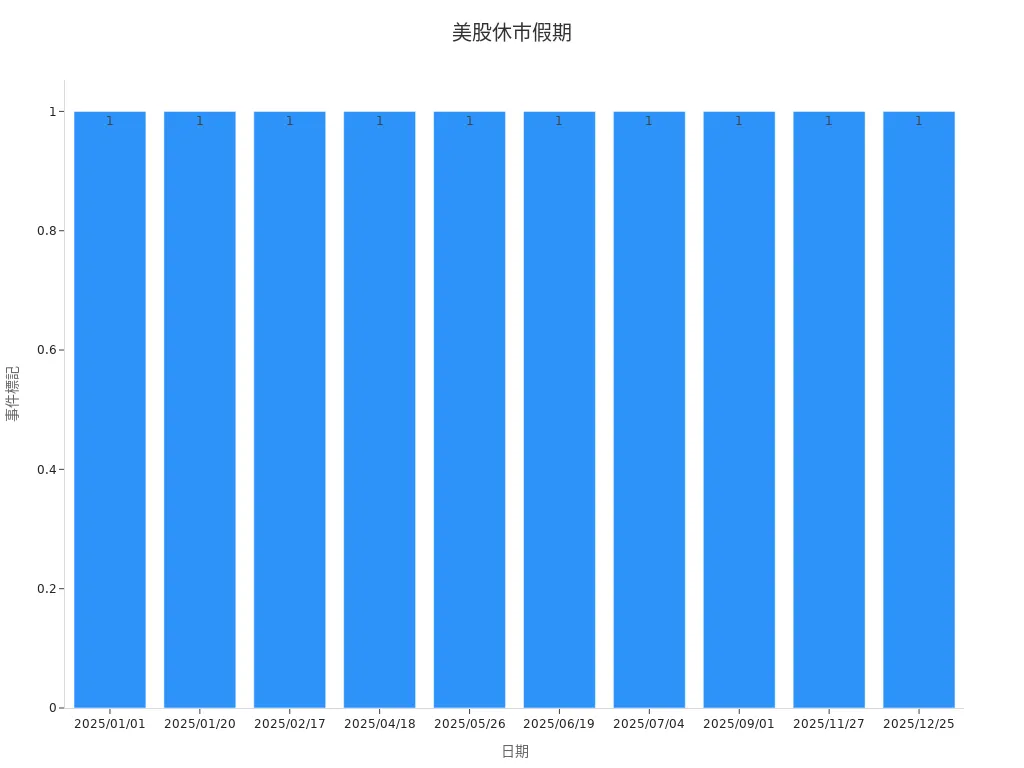
Investors can quickly check the 2025 U.S. stock market holidays through the table below.
The table data comes from official announcements, covering major closure days and half-day trading arrangements, helping everyone stay informed about trading day information instantly.
| Date | Day | Holiday Name | NYSE and Nasdaq Status |
|---|---|---|---|
| 2025/01/01 | Wed | New Year’s Day | Closed |
| 2025/01/20 | Mon | Martin Luther King Jr. Day | Closed |
| 2025/02/17 | Mon | Presidents’ Day | Closed |
| 2025/04/18 | Fri | Good Friday | Closed |
| 2025/05/26 | Mon | Memorial Day | Closed |
| 2025/06/19 | Thu | Juneteenth National Independence Day | Closed |
| 2025/07/04 | Fri | Independence Day | Closed, previous day 7/3 closes at 1 PM (three hours early) |
| 2025/09/01 | Mon | Labor Day | Closed |
| 2025/11/27 | Thu | Thanksgiving Day | Closed, next day 11/28 closes at 1 PM (three hours early) |
| 2025/12/25 | Thu | Christmas Day | Closed, previous day 12/24 closes at 1 PM (three hours early) |
Key Points
- In 2025, the U.S. stock market will close on several major holidays, including New Year’s Day, Independence Day, Thanksgiving, and Christmas, and investors should plan their trading schedules in advance.
- Some holidays have half-day trading sessions before or after, with trading ending at 1 PM, so pay attention to these times to avoid missing trading opportunities.
- U.S. stock market trading hours vary due to Daylight Saving Time and Standard Time, and investors in Hong Kong and Taiwan need to note time differences to ensure timely participation in trading.
U.S. Stock Market Holidays Overview

Image Source: pexels
Closure Days
U.S. stock market holiday schedules are adjusted annually based on official announcements.
In 2025, the New York Stock Exchange (NYSE) and Nasdaq will close on several major holidays.
These closure days include New Year’s Day, Martin Luther King Jr. Day, Presidents’ Day, Good Friday, Memorial Day, Juneteenth National Independence Day, Independence Day, Labor Day, Thanksgiving, and Christmas.
According to official announcements and historical data, the U.S. stock market will close for Memorial Day in 2025, which has been designated as the last Monday in May since 1971 to ensure a long weekend.
Additionally, announcements indicate that June 19, 2025 (Thursday) will be a closure day for Juneteenth, confirming the arrangements and changes for major closure days in 2025.
An announcement issued by President Securities on June 12, 2025, clearly lists non-business days for funds, providing official evidence to confirm the 2025 closure day arrangements, and this announcement, along with historical data, supports the arrangements and changes for major closure days.
| Date | Day | Holiday Name | Exchange Status |
|---|---|---|---|
| 2025/01/01 | Wed | New Year’s Day | Closed |
| 2025/01/20 | Mon | Martin Luther King Jr. Day | Closed |
| 2025/02/17 | Mon | Presidents’ Day | Closed |
| 2025/04/18 | Fri | Good Friday | Closed |
| 2025/05/26 | Mon | Memorial Day | Closed |
| 2025/06/19 | Thu | Juneteenth National Independence Day | Closed |
| 2025/07/04 | Fri | Independence Day | Closed |
| 2025/09/01 | Mon | Labor Day | Closed |
| 2025/11/27 | Thu | Thanksgiving Day | Closed |
| 2025/12/25 | Thu | Christmas Day | Closed |
Investors should closely monitor official announcements, as U.S. stock market holiday schedules may occasionally change.
Each year, authorities adjust closure days based on actual circumstances to ensure smooth market operations.
Half-Day Trading Sessions
In addition to full-day closures, U.S. stock market holidays also include half-day trading sessions.
Half-day trading refers to days when exchanges close early, typically at 1:00 PM Eastern Time.
In 2025, the half-day trading schedule is as follows:
| Date | Day | Reason for Half-Day | Closing Time (Eastern Time) |
|---|---|---|---|
| 2025/07/03 | Thu | Independence Day Eve | 1:00 PM |
| 2025/11/28 | Fri | Day After Thanksgiving | 1:00 PM |
| 2025/12/24 | Wed | Christmas Eve | 1:00 PM |
Half-day trading sessions typically occur the day before or after major U.S. stock market holidays.
This arrangement allows market participants more time to spend with family during holidays.
Investors should note the closing times for half-day sessions to avoid missing trading opportunities due to timing errors.
Tip: All U.S. stock market holiday and closure data are subject to official announcements. It is recommended that investors regularly check the latest notices from exchanges and brokerage platforms to ensure they have the most accurate trading day information.
Opening and Closing Times

Image Source: pexels
Regular Trading Days
The U.S. stock market’s regular trading day opens at 9:30 AM Eastern Time and closes at 4:00 PM.
Investors participating in U.S. stock trading from Hong Kong or Taiwan need to pay special attention to the time difference.
Daylight Saving Time and Standard Time affect the corresponding trading hours locally.
The table below lists the opening and closing times for U.S. stock market regular trading days for easy reference by investors:
| Trading Time Type | U.S. Local Time | Taiwan/Hong Kong Time (Daylight Saving) | Taiwan/Hong Kong Time (Standard Time) |
|---|---|---|---|
| Regular Trading Hours | 09:30~16:00 | 21:30~04:00 | 22:30~05:00 |
Some brokers also offer pre-market and after-hours trading services.
Pre-market trading generally starts at 4:00 AM Eastern Time, and after-hours trading extends until 8:00 PM.
These sessions allow investors to flexibly adjust order placement times.
Tip: U.S. futures markets, such as the CME electronic platform, operate nearly year-round with longer trading hours, suitable for investors needing flexible trading.
Daylight Saving Time vs. Standard Time
The U.S. observes Daylight Saving Time from the second Sunday in March to the first Sunday in November, with the rest of the year being Standard Time.
During Daylight Saving Time, trading hours for investors in Hong Kong and Taiwan shift one hour earlier.
The table below clearly shows the differences between Daylight Saving Time and Standard Time:
| Time Type | Opening Time (Taiwan/Hong Kong) | Closing Time (Taiwan/Hong Kong) |
|---|---|---|
| Daylight Saving Time | 9:30 PM | 4:00 AM (next day) |
| Standard Time | 10:30 PM | 5:00 AM (next day) |
Investors should closely monitor the transition dates for Daylight Saving Time and Standard Time to avoid missing trading sessions due to time differences.
Brokerage platforms typically send notifications during these transitions, and it’s recommended to check related announcements regularly.
Investors should regularly check official announcements and brokerage platforms, as U.S. stock market holiday schedules may change. Staying informed helps with investment planning. They can bookmark or share this list for future reference.
FAQ
Which days in 2025 are half-day trading sessions for the U.S. stock market?
Half-day trading sessions in 2025 include July 3, November 28, and December 24, with closing times at 1:00 PM Eastern Time.
Investors should pay attention to brokerage platform announcements to avoid missing trading sessions.
What’s the difference between U.S. stock market Daylight Saving Time and Standard Time?
Daylight Saving Time trading sessions start earlier, requiring Hong Kong and Taiwan investors to participate one hour earlier.
| Time Type | Opening (Hong Kong/Taiwan) | Closing (Hong Kong/Taiwan) |
|---|---|---|
| Daylight Saving | 21:30 | 04:00 |
| Standard | 22:30 | 05:00 |
Do U.S. stock market closure days affect Hong Kong banks’ U.S. stock-related services?
On U.S. stock market closure days, U.S. stock-related services at Hong Kong banks will be suspended, and investors should plan their trades in advance.
The 2025 U.S. stock market holiday and early closure schedule impacts trading plans, requiring Hong Kong and Taiwan investors to track time differences and sessions closely. BiyaPay simplifies your approach, enabling investment in U.S. and Hong Kong stocks through one account, bypassing complex setups for these markets. Access a wealth management product with up to 5.48% annualized returns, offering flexible withdrawals to manage funds during market closures.
BiyaPay’s real-time currency conversions and rate queries keep costs as low as 0.5%, enhancing investment efficiency. Regulated by international financial authorities, it ensures secure transactions. Visit BiyaPay today to optimize your U.S. and Hong Kong stock trading strategy!
*This article is provided for general information purposes and does not constitute legal, tax or other professional advice from BiyaPay or its subsidiaries and its affiliates, and it is not intended as a substitute for obtaining advice from a financial advisor or any other professional.
We make no representations, warranties or warranties, express or implied, as to the accuracy, completeness or timeliness of the contents of this publication.
Related Blogs of

Focusing on AI and Semiconductors: In-Depth Analysis of 10 Leading Future US Tech Stocks

US Stock Market Holiday Countdown: How Investors Should Position for Next Week's Trading


A Blessing for Small Investors: Finding the Lowest Trading Cost US Stock Brokers

Essential Apps for Getting Started with US Stock Futures: These Apps Will Turn You into a Pro

Choose Country or Region to Read Local Blog
 Australia
 Austria
 Belgium
 Canada
 Cyprus
 Czech Republic
 Denmark
 Estonia
 Finland
 France
 Germany
 Greece
 Hong Kong
 India
India Indonesia
 Ireland
 Italy
Italy Japan
Japan Latvia
 Lithuania
 Luxembourg
 Malaysia
 Malta
Malta Morocco
 Nepal
Nepal Netherlands
 New Zealand
 Norway
 Pakistan
 Philippines
 Poland
 Portugal
 Romania
 Singapore
 Slovakia
 Slovenia
 South Africa
 South Korea
 Spain
Spain Sweden
 Thailand
 The United States
 Turkey
 United Arab Emirates
 United Kingdom
 Vietnam
Contact Us




BIYA GLOBAL LLC is a licensed entity registered with the U.S. Securities and Exchange Commission (SEC No.: 802-127417); a certified member of the Financial Industry Regulatory Authority (FINRA) (Central Registration Depository CRD No.: 325027); regulated by the Financial Industry Regulatory Authority (FINRA) and the U.S. Securities and Exchange Commission (SEC).
BIYA GLOBAL LLC is registered with the Financial Crimes Enforcement Network (FinCEN), an agency under the U.S. Department of the Treasury, as a Money Services Business (MSB), with registration number 31000218637349, and regulated by the Financial Crimes Enforcement Network (FinCEN).
BIYA GLOBAL LIMITED is a registered Financial Service Provider (FSP) in New Zealand, with registration number FSP1007221, and is also a registered member of the Financial Services Complaints Limited (FSCL), an independent dispute resolution scheme in New Zealand.